
When You Know He Wants You but You No Longer Know Why
Some relationships are difficult because you do not know whether the other person cares.
This one is harder.
You know he wants you in his life.
He keeps coming back. He looks for you when distance grows between you. He confides in you, wants affection, seeks closeness and often becomes noticeably unsettled when you pull away. There may be moments when the connection feels so strong that questioning it almost feels unfair.
That is exactly what makes the doubt so difficult.
Because the real question is not whether there is something between you.
There clearly is.
The real question is what that something has become.
Does he want you?
Or has he become attached to the way your presence makes him feel?
Does he love the relationship itself, or the comfort, attention, reassurance, affection, intimacy and emotional safety he receives inside it?
Those questions can be painful because the answers are rarely clean.
A man may genuinely love a woman and still become comfortable with an arrangement that gives him a great deal while asking relatively little from him. He may miss her intensely, value her presence and fear losing her, yet still resist changes that would require greater responsibility, sacrifice or commitment.
That is where love and convenience begin to overlap.
And when they overlap, the relationship can become incredibly difficult to read.
When His Return Starts Feeling Like Proof
Perhaps you have tried to leave before.
You became tired of the uncertainty. Maybe you stopped replying as quickly, created distance or told yourself that enough was enough.
Then he came back.
He called. He became more attentive. Perhaps he suddenly found the words you had been waiting to hear. He told you that you matter, that he misses you, that losing you would hurt him.
Those moments can feel like powerful evidence.
You think, If I were only convenient, why would he fight so hard to keep me?
That is a reasonable question.
But fear of losing someone can come from more than one place.
He may fear losing a woman he genuinely loves. He may also fear losing the person who understands him, comforts him, validates him, gives him affection or represents a part of life where he feels lighter and more alive.
Sometimes all of those things are true at once.
This is why repeated return tells you something important, but not everything.
It tells you the bond has value to him.
It does not automatically tell you what kind of value.
That distinction becomes crucial when the relationship keeps restarting but never really develops.
When You Feel Deeply Valued but Still Carry Most of the Relationship
There may be many things you do naturally because you care.
You listen when he is stressed. You reassure him when he doubts himself. You make time when his own life becomes difficult. Perhaps you are the person who helps him calm down after an argument, reminds him of his worth, brings excitement into a routine that has become emotionally flat, or gives him a sense of peace he struggles to find elsewhere.
None of that is wrong.
Love naturally includes giving.
The question appears when giving becomes so normal that you stop noticing how much of the relationship depends on your willingness to keep providing.
Do you often make the emotional space?
Do you adapt to his schedule more than he adapts to yours?
Are you usually the one who keeps the connection alive after distance, misunderstanding or disappointment?
Perhaps the relationship feels deep partly because you keep making it deep.
That does not mean he feels nothing.
It means we need to look at whether the emotional weight is being carried by both of you.
A relationship can feel incredibly meaningful while still becoming comfortable for one person in ways the other person does not fully recognise.
When His Need for You Feels Like Love
Being needed can feel almost identical to being loved.
If he calls when something goes wrong, you know you matter to him. When he tells you that nobody understands him the way you do, the connection feels rare. If your absence affects his mood or he becomes anxious when you withdraw, it is natural to believe that your place in his life must be significant.
And perhaps it is.
The difficulty is that need and love answer different questions.
Need asks, What does this person help me feel, avoid, manage or receive?
Love, when it becomes mature, eventually asks something more: What does this relationship require from me too?
That difference is easy to miss when the emotional intensity is strong.
You may become the person he turns to because he genuinely loves you and because you have also become essential to his emotional balance.
Those realities can exist together.
The challenge is discovering whether the relationship has grown beyond his need for what you provide.
When You Start Wondering Whether He Would Stay If You Gave Less
This is one of the thoughts many women are afraid to admit.
What would happen if you stopped doing so much?
If you were not always available, would he still pursue closeness?
If you stopped reassuring him every time he became uncertain, would the relationship still feel equally important to him?
If you needed support instead of providing it, would he know how to meet you there?
If you no longer made the relationship easy to maintain, would he begin contributing more, or would the connection start disappearing?
These are uncomfortable questions because they touch the possibility that part of the relationship’s strength may depend on the role you have learned to play inside it.
That possibility does not automatically mean you are being used.
Healthy relationships contain routines, comfort and mutual dependence. People naturally become used to the good things another person brings into their life.
The issue is whether your presence is valued as a whole person or mainly because of what becomes easier when you are there.
That is a much deeper question.
When Comfort Starts Looking Like Commitment
Comfort can be remarkably convincing.
A man who feels completely at ease with you may seem like someone who has found exactly where he belongs.
He relaxes around you. Conversation flows. You know his habits. He knows yours. Perhaps the two of you have created routines that feel almost domestic even if the relationship is hidden or complicated.
He may tell you that being with you feels natural.
That can be genuine.
But comfort and commitment do not always grow at the same speed.
A person can become deeply comfortable in a relationship without being prepared to make difficult choices for it.
In fact, sometimes comfort reduces urgency.
If he already receives closeness, understanding, affection, sexual intimacy and emotional support without having to confront the harder parts of the situation, the relationship may begin working well enough for him that changing it feels less necessary.
That does not mean he consciously planned to keep things this way.
Human beings often settle into arrangements that feel emotionally satisfying because continuing them is easier than questioning them.
Over time, what began as a temporary situation can become a stable pattern simply because neither person knows how to disturb it without risking loss.
The Relationship May Be Giving Him More Than You Realise
Think about everything he may receive from being with you.
Perhaps he feels admired.
He may feel desired.
You listen to him.
You give him emotional safety.
You bring novelty into his life.
Maybe the relationship gives him peace away from conflict, or excitement away from routine.
He may be able to experience parts of himself with you that feel less available elsewhere.
None of those things are trivial.
They can make a relationship deeply meaningful.
But they can also make the relationship highly valuable even before commitment enters the picture.
That is why someone can fight hard to preserve a connection while still resisting changes that would make it more balanced or secure.
He may not be protecting only love.
He may also be protecting everything the relationship gives him.
Again, that does not automatically make him selfish or dishonest.
It simply reminds us that human motivation is rarely pure enough to be reduced to one explanation.
Love can exist beside comfort.
Attachment can exist beside self interest.
Genuine feelings can exist beside an arrangement that benefits one person more than the other.
That is exactly why this article needs to go deeper than asking whether he says the right things.
When You Begin Questioning Whether He Loves You or Loves Having You
This may be the hardest distinction in the whole article.
There is a difference between:
“I love who you are.”
and
“I love what my life feels like when you are available to me.”
In healthy relationships, those two experiences often overlap.
Your partner may genuinely love you and love the peace, affection, humour, intimacy or support you bring into his life.
There is nothing wrong with that.
The problem appears when what you provide becomes more protected than what you need.
If he fights harder to keep access to your comfort than he fights to create security for you, something may be out of balance.
If losing your support terrifies him but giving you greater clarity always feels too difficult, the relationship may be revealing a difference between valuing your presence and accepting responsibility for your place in his life.
That difference matters.
Because love is not only about how painful your absence would be.
It also becomes visible in what someone is willing to contribute while you are still there.
You May Be Asking the Wrong Question
Perhaps you have spent months asking:
Does he really love me?
That is understandable.
But it may not be the question that brings the most clarity.
A man can love you and still become comfortable with an arrangement that works largely in his favour.
He can miss you and still avoid difficult decisions.
He can be emotionally attached and still expect you to carry more of the relationship than he does.
So instead of asking only whether love exists, this article will ask something more revealing:
What is holding this relationship together, and who is carrying the greater cost of keeping it that way?
That question does not assume he is using you.
It does not assume the relationship is false.
It simply gives us somewhere more honest to look.
Why Convenience Can Feel Almost Identical to Love
Convenience is easy to misunderstand because people often imagine it as something cold, selfish and obvious. They picture a man who knows exactly what he is doing, keeps a woman around because she makes his life easier and gives very little in return.
Sometimes that happens.
But many relationships become convenient in a much quieter way.
A man may genuinely care about you. He may miss you, enjoy your company, trust you emotionally and feel deeply attached to the relationship. At the same time, he may also become increasingly comfortable with everything your presence gives him.
That is where the confusion begins.
The relationship can contain real affection and still develop an imbalance. He may love the person you are while also becoming used to the emotional safety, attention, reassurance, intimacy or stability you provide. Those benefits do not automatically make the relationship false. They simply mean that love and convenience can begin living side by side.
This is why the question cannot be reduced to:
“Does he love me?”
A better question is:
“What does this relationship ask from each of us, and what does each of us receive from keeping it exactly as it is?”
That question takes us much deeper.
Convenience Does Not Always Look Cold or Calculated
A convenient relationship does not always begin with manipulation.
Often, it develops because both people repeatedly choose what feels easiest in the moment.
Perhaps he has a difficult day and calls you because you understand him. You comfort him because you care. The next time something goes wrong, he calls again. Over time, turning to you becomes natural.
Maybe your availability becomes dependable. He knows you will answer. He knows you will listen. He knows that even after conflict, the connection usually repairs itself.
None of this requires a conscious plan.
That is exactly why convenience can be difficult to recognise.
Human beings naturally repeat behaviours that reduce discomfort or create pleasure. If a relationship provides emotional relief without immediately requiring difficult decisions, it can become very easy to preserve the relationship exactly as it is.
Imagine a man who feels unhappy in parts of his life but receives warmth, admiration and emotional intimacy from you. That connection may make him genuinely happier. It may also make the rest of his situation easier to tolerate.
The relationship can therefore become meaningful to him for two reasons at once.
He cares about you.
And the relationship makes his life easier.
Those two facts do not cancel each other out.
The real concern appears when preserving the comfort becomes more important than addressing the imbalance that comfort is built upon.
Someone Can Enjoy What You Give Him and Still Have Genuine Feelings
There is a dangerous idea in relationship advice that says if someone benefits from you, the love must be fake.
That is nonsense.
Every healthy relationship contains benefits.
People stay close because relationships give them something valuable: companionship, affection, laughter, security, intimacy, support, belonging and the feeling of being understood.
You probably receive things from him too.
That does not make your feelings false.
The problem is not benefit.
The problem is imbalance.
Suppose he receives emotional support whenever he is struggling, but your own difficult moments repeatedly become inconvenient. He enjoys your affection, but becomes distant when you need reassurance. He values your flexibility, yet rarely adjusts his own life when something matters to you.
Now the question changes.
The issue is no longer whether he benefits from the relationship. Of course he does.
The issue becomes whether your wellbeing matters enough to create inconvenience for him too.
That is one of the clearest differences between mutual love and a relationship that has become too convenient for one person.
Love can still exist inside an unequal relationship.
But healthy love gradually pushes people towards greater reciprocity.
Convenience often protects the imbalance.
Familiarity Can Create a Powerful Bond
Familiarity is one of the strongest forces in long relationships because human beings become emotionally attached to what they know.
He knows your voice.
He knows how you respond when he is stressed.
Perhaps he knows exactly what to say when you are angry and what usually brings the two of you back together.
You know him too.
There are routines, jokes, memories and habits that belong only to the two of you.
That familiarity can feel deeply romantic because it creates the experience of being known.
It can also create resistance to change.
A relationship may continue partly because leaving would mean losing an entire emotional routine. He would not simply lose you. He would lose the conversations, reassurance, intimacy, habits and version of himself that exist around you.
That loss can feel enormous.
This is why someone can be terrified of losing a relationship while still failing to build more with it.
The fear of losing familiarity does not automatically equal commitment.
Commitment asks for something different.
It asks whether the person is prepared to take responsibility for protecting and developing the relationship rather than simply preserving access to what has become familiar.
That distinction is subtle.
But once you see it, many confusing patterns begin making more sense.
Being Needed Can Make You Feel Irreplaceable
There is something emotionally powerful about knowing that someone depends on you.
Perhaps he tells you:
“You’re the only person I can talk to.”
Maybe he says:
“Nobody understands me like you do.”
He might even tell you that he does not know what he would do without you.
Statements like these can create a profound sense of significance.
You start feeling less like one person in his life and more like the person holding an important emotional part of him together.
That can make walking away incredibly difficult.
You are not only thinking about losing him.
You begin thinking about what losing you would do to him.
Who would listen?
Who would calm him?
Who would understand the things he feels unable to say elsewhere?
Now the relationship carries responsibility as well as love.
This is where being needed can become confused with being irreplaceable.
But someone can depend heavily on what you provide and still fail to build a life that reflects your importance.
A man may genuinely struggle without you.
That tells you something about the value of your presence.
It does not automatically tell you that he is willing to create the level of commitment or reciprocity you need.
The stronger question is not:
“Would he suffer if I disappeared?”
It is:
“How does he treat me while I am still here?”
That question often reveals more.
The Most Confusing Relationships Often Contain Both Love and Convenience
This is the point where simple relationship advice usually fails.
It wants to separate everything neatly.
Love or use.
Genuine or fake.
Commitment or convenience.
Real life is messier.
A man may love you and still prefer an arrangement that protects him from difficult consequences.
He may care deeply and still become comfortable with the fact that you ask for less than you need.
He may fear losing you while also avoiding the changes that would make the relationship more secure.
The relationship can therefore contain genuine love and convenience at the same time.
That is not a contradiction.
Human beings are capable of sincere feelings and self protective behaviour in the same relationship.
Imagine a man who loves the emotional closeness he has with you. He may also love the fact that he does not have to restructure his entire life to keep receiving that closeness.
Both can be true.
This is exactly why you should be careful with articles that say:
“If he does this, he is using you.”
Sometimes he is.
Sometimes he is not.
Often, the reality is more uncomfortable: he genuinely cares, but the arrangement has become comfortable enough that caring no longer creates enough pressure for change.
That is where the article needs to move next.
Because if love and convenience can coexist, then we need to understand what convenience actually looks like inside a relationship and where healthy comfort ends and unhealthy imbalance begins.
What Convenience Actually Means Inside a Relationship
The word convenience can make a relationship sound colder than it really is. It can suggest that one person deliberately selected another because she was useful, easy to access or willing to accept less. While relationships like that certainly exist, convenience often develops without either person sitting down and deciding that this is what the relationship will become.
It usually grows through repetition. One person gives, the other becomes accustomed to receiving, certain arrangements become normal, difficult conversations are postponed, and both people gradually learn how to keep the relationship functioning without confronting everything that is missing from it. Months later, the relationship may contain genuine affection, attachment and history, but it may also be organised in a way that protects one person’s comfort far more than the other’s needs.
That is why recognising convenience requires more than asking what he gets from you. Every meaningful relationship gives both people something. The deeper questions concern reciprocity, responsibility and movement. Does the relationship work for both of you? Does he contribute when contribution becomes inconvenient? Are your needs allowed to influence the relationship, and is what you share developing into something more secure over time?
Those questions take us much closer to the real difference between love and convenience.
Convenience Begins When the Relationship Works Particularly Well for One Person
Imagine a relationship where he can contact you whenever he needs emotional support, affection or intimacy. You understand that his schedule is complicated, so you adapt. When he cannot see you, you try not to create additional pressure. If he becomes distant, you give him space. When something goes wrong in his life, however, you make yourself available because you know how much he needs someone who understands him.
None of those choices is necessarily unhealthy on its own. They may come from genuine compassion. The imbalance develops when flexibility moves mainly in one direction and eventually becomes an unspoken condition of keeping the relationship peaceful.
Perhaps you begin arranging your emotional needs around his circumstances. You wait for the right moment to raise difficult subjects because there is always something happening in his life. When he is stressed, you do not want to add pressure. When things are going well, you do not want to spoil the good period. When he becomes distant, you fear that asking questions will push him further away. Eventually, there is almost never a convenient time for your needs.
Meanwhile, his needs continue having a place.
He can be confused. He can need reassurance. His responsibilities can change plans. His fears can delay decisions. His difficult circumstances can explain inconsistency, while your disappointment is expected to remain patient enough to accommodate all of it.
That is how convenience can become part of a relationship without anyone formally creating it.
The relationship has slowly learned to organise itself around one person’s emotional and practical reality.
This does not automatically prove that he does not love you. In fact, that is precisely why the situation can become so confusing. He may genuinely care while also becoming accustomed to a relationship structure in which your understanding protects him from many of the consequences of remaining uncertain.
Love may therefore be present while the arrangement itself remains unequal.
Emotional Convenience Can Be More Powerful Than Practical Convenience
When people hear relationship of convenience, they often think about practical benefits: money, housing, sex, social status, childcare or someone making everyday life easier.
Emotional convenience can be far less visible and sometimes much more powerful.
Perhaps you are where he goes when he wants to feel understood. Around other people, he may carry responsibilities, expectations or an identity he feels pressured to maintain. With you, he can relax. He can complain, admit fear, speak about frustrations and receive reassurance without having to defend himself.
That emotional environment can become enormously valuable.
If he is married, for example, you may represent a part of his emotional life that feels completely different from the pressures he associates with home. If he is single but reluctant to commit, you may provide much of the closeness of a committed relationship without requiring him to confront the fears or responsibilities that commitment represents to him. If you are an ex, repeated reconciliation may give him access to familiar affection whenever loneliness makes separation difficult.
In each case, he may sincerely care about the woman involved. Emotional convenience does not require fake feelings.
What matters is whether emotional comfort becomes a substitute for relationship development.
A man who can repeatedly relieve loneliness, frustration or insecurity through the relationship may feel less urgency to confront whatever keeps the relationship stuck. Ironically, the comfort you lovingly provide can sometimes make an uncomfortable situation easier for him to continue living with.
That does not mean you caused the problem by being supportive. It means support can become part of a pattern, and patterns deserve to be understood.
Sex, Attention, Validation and Peace Can All Become Part of the Comfort
Relationships rarely continue because of one emotional reward. Usually, several experiences become woven together until the relationship represents an entire emotional world.
Sexual intimacy may be part of it, but reducing convenience to sex would miss far too much. He may value the way you look at him, the confidence he feels around you, the excitement of being desired or the freedom of being with someone who sees him differently from the people in his ordinary life. Your attention may remind him that he is attractive, interesting or important during periods when he does not feel those things elsewhere.
Validation can become especially powerful because it affects how a person experiences himself. If you consistently admire him, encourage his ambitions, defend him when he feels misunderstood and remind him of his strengths, being around you may become connected with feeling better about who he is.
Peace can work in a similar way. Perhaps your relationship feels like the one place where he does not have to deal with conflict. You deliberately avoid arguments because your time together is limited, or you have learned that difficult conversations cause him to withdraw. Gradually, you become associated with relief while other parts of his life remain associated with pressure.
Again, none of these experiences proves exploitation.
A loving relationship should contain attention, validation, peace, intimacy and support. The important distinction is whether those benefits are mutual experiences or primarily services one person has learned to receive from the other.
If he enjoys your peace but disappears when you are distressed, the balance deserves examination. If he depends on your validation but dismisses your insecurity as neediness, something is uneven. If intimacy is easy to obtain but conversations about your future repeatedly become too difficult, the contrast matters.
Love does not require perfect equality in every moment. Sometimes one person carries more because the other is struggling. Over the life of a healthy relationship, however, there should be enough reciprocity that both people experience themselves as cared for rather than one becoming the permanent provider of what the other needs.
Familiarity Can Make Leaving Difficult Even When Commitment Is Weak
Time creates its own form of attachment.
After months or years, you are no longer simply two people deciding whether you like each other. You have memories, routines, private language, familiar arguments, reconciliations, physical memories and perhaps dreams that have been discussed so many times that they almost feel like shared history from the future.
Losing all of that can hurt tremendously.
This is one reason a man repeatedly returning does not automatically settle the question of love versus convenience. He may return because his feelings are genuine, but he may also be returning because separation forces him to experience everything the relationship had quietly been providing.
Suddenly, there is nobody sending that familiar message. The person who normally listens is absent. The affection is gone, the routine changes and the emotional safety he took for granted becomes noticeable precisely because it is no longer available.
That absence can create powerful urgency.
He may call more. He may become emotional. Promises can suddenly become easier to make because the possibility of losing you feels immediate.
Then you return.
The anxiety settles. Familiarity is restored, and the relationship gradually moves back towards its previous structure.
This cycle is especially confusing because the intensity of his return feels like evidence that something fundamental has changed. Yet what happens after the reunion often tells you considerably more than what happened while he feared losing you.
If the relationship becomes more reciprocal, clearer or more secure after reconciliation, the return may have triggered genuine reflection. If everything simply returns to the old arrangement once your presence is secure again, familiarity may be helping preserve the relationship without necessarily helping it develop.
This is why we should never judge the entire relationship by how desperately someone reacts to losing it. We also need to observe what they do once they have it back.
A Comfortable Relationship Is Not Automatically a Convenient Relationship
This distinction is essential because I do not want you leaving this article suspicious of every good thing you bring into someone’s life.
Love should become comfortable.
You should be able to become someone’s safe place. Partners should know how to reassure one another. Familiar routines can be beautiful. Sexual intimacy, emotional support, companionship and the feeling of being understood are not evidence that someone is using you. They are often exactly what makes a loving relationship worth protecting.
The difference lies in what happens around the comfort.
In a healthy relationship, comfort does not remove responsibility. He may feel safe with you while still caring about whether you feel safe with him. He can rely on your emotional support while remaining capable of supporting you. Your flexibility is appreciated rather than assumed, and his circumstances do not automatically outrank yours every time the two conflict.
Most importantly, comfort does not become an excuse for permanent stagnation.
A couple may move slowly because their situation is genuinely complicated. There may be children, finances, family obligations, distance, previous relationships or other realities that cannot simply disappear because two people have feelings for each other. Progress therefore does not always mean dramatic decisions.
Sometimes progress is increased honesty. It may mean becoming more consistent, taking greater responsibility, addressing a problem that used to be avoided or finally having a conversation that both people kept postponing.
The important thing is that the relationship is capable of movement.
Convenience becomes more concerning when the existing arrangement works so well for one person that almost every proposed change becomes unnecessary, unreasonable or badly timed.
That is where comfort stops being merely one of love’s benefits and begins protecting the status quo.
Reciprocity Is Not About Keeping Score
At this point, it would be easy to make another mistake.
You could begin mentally counting everything.
“I called him three times this week and he called twice.”
“I listened to him for forty minutes, but yesterday he only listened to me for twenty.”
That is not what reciprocity means.
Relationships are not accounting systems.
There will be weeks when you give more and periods when he does. Someone may experience bereavement, financial problems, family difficulties or enormous pressure at work and temporarily have less emotional capacity. A healthy relationship makes room for those uneven seasons.
Reciprocity is better understood across the pattern of the relationship.
When you genuinely need him, does he try to be present?
When something affects both of you, are your interests considered?
If you explain that something repeatedly hurts you, does that information eventually influence his behaviour?
When circumstances require adjustment, are you always the person expected to make it?
Does he recognise what you contribute, or has your effort become invisible because it is so dependable?
These questions do not ask whether everything is exactly equal. They ask whether both people matter inside the relationship’s decision making.
That is much closer to what healthy reciprocity looks like.
Movement Reveals What Comfort Alone Cannot
There is another reason we need to examine movement alongside reciprocity.
A relationship can feel wonderful while remaining structurally unchanged for years.
You may have beautiful conversations. The attraction may remain strong. He may tell you how much you mean to him, and perhaps you genuinely believe him. Yet the same unresolved issue that troubled you two years ago may still be sitting between you today.
This does not automatically mean the relationship has failed.
But time should give us information.
Has anything become clearer?
Has his behaviour become more consistent?
Have repeated promises developed into decisions?
Has he taken greater responsibility for the effect of the situation on you?
Have you both learned how to address conflict differently?
Even complicated relationships should reveal some kind of development if both people are genuinely working towards something.
If the emotional bond keeps deepening while the practical relationship remains permanently frozen, it becomes reasonable to ask whether the emotional rewards of the current arrangement are helping preserve the very situation that causes you pain.
That question is uncomfortable.
It is also far more useful than asking whether he called you today.
Start Looking at the Relationship From Both Directions
Up to this point, you may have measured love primarily by what comes towards you.
His messages.
His affection.
His jealousy.
His desire.
His return after distance.
His vulnerability.
His words about the future.
Those things deserve consideration, but they are only one side of the relationship.
Now begin looking in the other direction as well.
What travels from you towards him?
How much understanding do you provide? How much flexibility? How much emotional reassurance? How often do you absorb uncertainty so that the relationship can continue peacefully? What practical or emotional benefits does your presence create in his life?
Then ask what comes back towards you.
Not only affection.
Not only desire.
Look for consideration, responsibility, emotional availability, reciprocity and movement.
You do not need to accuse him of anything to do this. You are simply looking at the whole exchange rather than only the parts that feel most romantic.
And this gives us our first reflective pause in the article:
If you temporarily stopped measuring this relationship by how strongly he feels when he might lose you and instead looked at how both of you contribute while the relationship is secure, what would you notice?
You do not need to decide anything from that question today.
Just notice what comes to mind.
What Genuine Love Usually Adds That Convenience Alone Does Not

Once you understand that comfort is not automatically evidence of convenience, another question becomes more useful: what begins appearing in a relationship when love matures beyond attraction, attachment and emotional need?
There is no single behaviour that proves genuine love. A thoughtful gift does not prove it. Daily messages do not prove it. Jealousy certainly does not prove it, and neither does a dramatic return after separation. Individual moments can tell you something about someone’s feelings, but relationships are better understood through patterns that repeat when circumstances change.
Mature love tends to widen a person’s attention. Instead of being concerned only with how the relationship makes him feel, he becomes increasingly aware of how the relationship feels for you. Your needs begin carrying weight. Your uncertainty matters to him. Decisions are no longer judged only by what is easiest for his life because he understands that his choices have consequences for someone he claims to love.
This does not make him perfect or suddenly fearless. A person can love deeply and still struggle with difficult decisions, family responsibilities, children, finances, previous commitments or personal fears. What changes is that your reality becomes part of the reality he considers.
That is one of the most important differences we need to explore.
He Becomes Interested in Your Life, Not Only Your Availability
There is a difference between wanting access to someone and becoming genuinely invested in who that person is.
A man may contact you frequently because he enjoys talking to you. He may want to know when you are free, when he can see you or whether you are still emotionally available to him. Those behaviours can feel like strong interest, especially when he becomes disappointed if you cannot give him the time he expected.
Deeper involvement looks somewhat different. His attention begins extending beyond the parts of your life that affect his access to you. He remembers what matters at your work, asks how something important turned out, notices when your mood changes and takes an interest in the pressures you carry even when they have nothing to do with him. Your ambitions, fears, family concerns and ordinary experiences become meaningful because your life matters to him, not merely your role in his life.
This distinction becomes particularly revealing in complicated relationships. If most conversations eventually return to his marriage, his problems, his loneliness, his frustration or when the two of you can next meet, you may be emotionally close while still occupying a role largely organised around his needs. By contrast, when he begins making room for your inner world without requiring that it serve the relationship, you are seeing a different kind of investment.
Genuine interest does not need to look dramatic. Often, it appears through ordinary consistency. He remembers because he was listening. He asks because the answer matters. He wants to understand the parts of your life from which he receives no immediate benefit.
That is difficult for convenience alone to imitate indefinitely.
Your Needs Still Matter When They Are Inconvenient
Almost anyone can be loving when love asks very little from them.
The more revealing moments often arrive when your needs interfere with what would otherwise be easiest for him.
Perhaps you need reassurance at a time when he would rather avoid an uncomfortable conversation. Maybe a decision that suits him leaves you feeling increasingly insecure. You might need greater consistency, more honesty or clarity about something the two of you have postponed for months.
This does not mean that loving you requires him to agree with every request. Nor does it mean that your needs must always come before his responsibilities. Healthy relationships contain competing needs, and sometimes the answer genuinely has to be no.
What matters is how your needs are treated when they are inconvenient.
Does he try to understand them, even when he cannot immediately satisfy them? Can he discuss the problem without treating your feelings as an attack? Does he search for a compromise, explain his limitations honestly or return to an unresolved issue because he knows it matters to you?
Compare that with a relationship in which harmony depends on you needing very little. Everything may feel beautiful while you remain patient, flexible, understanding and available. Yet as soon as you ask for something that changes the arrangement, you become “difficult,” “demanding,” “impatient” or accused of creating pressure.
If peace only exists when one person suppresses her needs, that peace deserves closer examination.
Love does not make every request possible. It does, however, make the person behind the request worth taking seriously.
He Gives as Well as Receives
Reciprocity does not mean keeping a record of who called first, who paid for dinner or who apologised more often. As we established earlier, relationships naturally become uneven during difficult seasons. The meaningful question is whether giving moves in both directions across the wider relationship.
Perhaps you provide emotional support exceptionally well. That may always be one of your strengths. His way of caring may look different. He might be more practical, protective, solution focused or consistent through actions rather than words. We should not demand identical expressions of affection before recognising reciprocity.
Instead, look at whether he has learned what you need.
If reassurance matters to you, does he make an effort to provide it? If reliability matters, does he become more dependable? When you are struggling, can the relationship temporarily stop revolving around his problems? When he disappoints you, does he try to repair the damage, or is forgiveness simply expected because you have always eventually given it?
The strongest relationships develop a kind of emotional responsiveness. Each person gradually learns that loving the other requires more than giving what comes naturally to themselves. Sometimes it requires learning how the other person experiences care.
Convenience tends to preserve what already works for the receiver. Mature love becomes more willing to adjust.
That is why this distinction matters so much:
Convenience asks, “What does this relationship give me?” Mature love eventually asks, “What does this relationship require from me too?”
A person may never consciously phrase it that way. You see the answer through behaviour.
He Remains Connected When You Have Nothing to Offer Him
There are periods when you will not be your easiest, happiest or most emotionally generous self.
You may be exhausted. Work may overwhelm you. Family problems may consume your attention. Perhaps you become less sexually available, less cheerful or temporarily unable to provide the reassurance he normally receives from you.
Those periods can reveal something important.
If much of the relationship has been built around what you provide, your reduced capacity may change its emotional temperature quickly. He may become impatient, withdraw or appear only when he wants the familiar version of you back. Instead of becoming curious about what is happening to you, he may experience your difficulty mainly as the loss of something he normally receives.
Love creates more room for seasons in which you cannot perform your usual role.
That does not mean he will respond perfectly. Some people are uncomfortable around distress, and others genuinely do not know what support looks like until it is explained to them. We should not turn one clumsy response into a verdict on an entire relationship.
Look at the larger pattern. Does he stay emotionally present when you are not entertaining, reassuring, sexually available or solving his problems? Does he remain interested in you when you temporarily have less energy to invest in him? Can you be vulnerable without immediately feeling that you must recover so the relationship can become comfortable again?
Being loved as a whole person means there is room for versions of you that are not constantly useful.
He Protects the Relationship Even When Doing So Costs Him Something
The word sacrifice is often abused in relationship advice. It can make people believe that suffering proves love or that a partner must destroy every other responsibility to demonstrate devotion.
That is not what I mean.
Healthy sacrifice is usually more ordinary.
It may mean changing a habit because he understands its effect on you, making time when his schedule would be easier without doing so, having an uncomfortable conversation he has been avoiding or becoming more transparent because secrecy is damaging trust. Sometimes it means accepting short term discomfort to protect something he believes has long term value.
The size of the sacrifice matters less than the principle behind it: is he willing to carry some of the difficulty required to maintain the relationship, or does that difficulty repeatedly become yours?
This becomes particularly important when circumstances are complicated. A man may have children, financial obligations, a marriage, family expectations or other responsibilities that cannot responsibly be treated as disposable. Genuine love does not automatically tell him what decision to make.
However, complicated circumstances should not become a permanent explanation for why every emotional cost belongs to you.
Perhaps he cannot make the enormous change you want today. Can he make smaller meaningful changes that demonstrate movement? Can he become more honest? More consistent? Can he stop making promises he cannot keep? Can he address one obstacle rather than continually describing all the reasons nothing can change?
Love does not always remove obstacles.
It should eventually affect how someone responds to them.
Your Future Becomes Part of the Conversation
Future talk can be misleading because some people speak beautifully about tomorrow while doing very little today.
You may have heard everything you want to hear. Perhaps he has imagined where you could live, described trips you might take, talked about what life would be like once circumstances change or even discussed marriage and a permanent future.
Those conversations can be sincere.
People sometimes describe futures they genuinely desire but are not yet prepared to create.
Therefore, the presence of future talk is less important than the relationship between future language and present behaviour.
Does the future become gradually more specific? Do today’s choices make tomorrow more possible? Are obstacles being addressed, or does the imagined future remain conveniently positioned beyond the next problem, the next year, the next family situation or the next promise?
A healthy relationship does not require a perfect five year plan. Life is too unpredictable for that. What matters is whether you increasingly exist in his decision making as someone whose future is connected to his own.
That might appear in small ways before large ones. He consults you before making a decision that affects both of you. He stops assuming you will always be available under the same conditions. He thinks about what his choices will mean for your life as well as his.
The future stops being merely something he describes to keep hope alive.
It begins influencing the present.
Love Gradually Creates Responsibility Towards Your Feelings
This may be one of the most important distinctions in the article.
Love is a feeling, but relationships create consequences.
Once someone knows that his behaviour repeatedly hurts you, he has information he did not have before. What he does with that information matters.
This does not mean he becomes responsible for every emotion you experience. You remain responsible for your choices, boundaries and emotional life, just as he remains responsible for his. Healthy love should not become a demand that another person constantly regulate how you feel.
But there is a difference between being responsible for someone’s feelings and behaving responsibly towards them.
If he knows disappearing without explanation causes unnecessary distress, does he make any effort to communicate differently? If repeated promises keep raising expectations he cannot fulfil, does he become more careful about what he promises? When an arrangement benefits him but causes you increasing pain, can he acknowledge that imbalance honestly rather than simply asking for more patience?
Mature love develops awareness of impact.
A person begins recognising that intentions are not the entire story. He may not intend to hurt you, but if the same behaviour keeps producing the same wound, love should eventually create curiosity about whether something needs to change.
This is one reason words alone become less convincing over time.
“I love you” tells you what he believes he feels.
How he responds to the consequences of loving you tells you something about what those feelings have become capable of carrying.
Genuine Love Does Not Always Produce an Immediate Choice
We need this section because otherwise everything we have said could accidentally create another oversimplification.
You could read about reciprocity, sacrifice, responsibility and future planning and conclude:
“If he genuinely loved me, he would have chosen me already.”
Not necessarily.
Love influences decisions, but it does not make decisions alone.
A man may genuinely love you while also loving his children, fearing the consequences of divorce, feeling responsible for another person, protecting financial stability or struggling with an identity built around his existing life. He may also have fears and weaknesses that prevent him from acting as courageously as his feelings suggest he should.
None of those realities automatically excuse indefinite uncertainty.
They simply mean that the absence of an immediate dramatic choice does not prove the absence of love.
This is where patterns become more useful than ultimatums.
Even when the final decision is difficult, do you see movement towards greater honesty, responsibility and clarity? Does he acknowledge what waiting costs you? Is he confronting obstacles or merely describing them? Does the relationship become more balanced as time passes, or are you repeatedly asked to accept the same uncertainty because his feelings are supposedly enough?
Love may explain why he stays emotionally connected.
It does not automatically justify keeping another person suspended indefinitely.
That distinction allows us to remain psychologically honest without becoming either cynical or naive.
Look at What Love Is Becoming, Not Only at Whether It Exists
By now, the question “Does he love me?” should be beginning to change.
Love can be genuine while still immature.
It can exist alongside fear.
It can coexist with selfishness, avoidance, attachment and comfort.
Therefore, identifying the feeling is only the beginning.
A more revealing question is whether love is developing into consideration, reciprocity, responsibility, consistency and movement.
This is also where our deeper article How to Know If He Truly Loves You becomes useful. That discussion looks specifically at how love can be recognised beyond words, intensity and isolated romantic moments. Here, our purpose is slightly different: we are examining whether genuine feelings are producing something that convenience alone would struggle to sustain.
Think about your own relationship over time. Not only the best weekend, the worst argument or the last message you received, but the wider pattern.
Has knowing you changed how he treats your needs?
Has loving you required anything from him?
Has your place in his life become clearer?
Can you see evidence that he is learning how to love you rather than simply enjoying being loved by you?
Those questions are not asking you to put him on trial. They are asking you to look beyond emotional intensity and examine what the relationship is becoming.
A Relationship Should Not Require You to Become Less Human to Keep It Comfortable
There is one final pattern worth recognising before we move forward.
Sometimes a woman gradually becomes easier to accommodate because she learns which parts of herself create problems.
She stops asking certain questions because they lead to arguments. She hides disappointment because he is already under pressure. She becomes careful about when she expresses jealousy, loneliness or frustration. Eventually, she may become extraordinarily understanding, but part of that understanding is being purchased by her own silence.
From the outside, the relationship may look peaceful.
Inside, one person has simply learned how to take up less emotional space.
That is not the kind of comfort we should confuse with mature love.
Love should not require you to remove every inconvenient part of being human so another person can continue enjoying only the easiest version of you. A healthy relationship will still require self control, compromise and emotional maturity from both people, but it should also contain enough safety for disappointment, disagreement and genuine needs to exist without threatening the entire connection.
Instead of asking only, “What does he do when he wants me?”, ask yourself, “What does he do when loving me requires patience, adjustment, honesty or effort from him?”
Do not use one answer to condemn the whole relationship. Look for the pattern.
Because once we recognise what mature love tends to add, we can face the more complicated reality that many women actually live with:
What happens when the love is genuine, but convenience is genuine too?
When Love and Convenience Exist at the Same Time
This is where the article needs to become more honest than most relationship advice is willing to be.
People often want a clean answer. Either he loves you, or he is using you. Either his marriage is held together by genuine love, or he stays because it is comfortable. Either the relationship with you is real, or it exists because you make his life easier.
Human relationships rarely divide themselves so neatly.
A man can genuinely love a woman while also benefiting enormously from the arrangement they have created. He can care about her feelings, miss her, desire her, fear losing her and still become comfortable with a relationship that asks much more of her than it asks of him. Likewise, a man can remain emotionally connected to his wife while also depending on the stability, home, family history, social identity and practical security the marriage provides.
Those motives do not cancel each other out. They overlap.
That overlap is what makes many complicated relationships so difficult to understand. The woman can see genuine emotion, which makes it impossible to dismiss the relationship as convenience. At the same time, she can see how little the man’s life has actually had to change, which makes it difficult to call the relationship fully committed.
Both observations may be accurate.
This is why the question should not be reduced to, “Does he love me or is this convenient?” Sometimes a better question is, “How much of what keeps this relationship alive comes from love, and how much comes from the fact that the current arrangement protects something he does not want to lose?”
That is a much harder question, but it gets closer to the truth.Real Feelings Do Not Remove Self Interest
One of the biggest myths about love is that genuine feelings make people completely selfless.
They do not.
Human beings remain human inside love.
A man can love you and still want to protect his comfort. He can care deeply and still avoid decisions that frighten him. He may sincerely want you to be happy while also wanting the relationship to continue in a form that asks less of him than the future you are hoping for.
That does not automatically make him dishonest.
It means love does not erase self interest.
Think about how this may appear in real life. He enjoys the relationship with you because it gives him affection, understanding and emotional intimacy. He may also enjoy the fact that he does not have to confront every difficult consequence immediately. If he is married, he may continue receiving stability, family structure and familiarity at home while receiving emotional closeness or romantic fulfilment from you.
From his perspective, both parts of his life may matter.
From your perspective, however, the arrangement may feel very different because you are the person carrying the uncertainty.
This creates an important imbalance in how the same relationship is experienced.
For him, maintaining the current arrangement may preserve two things he values. For you, maintaining it may mean postponing the one thing you most want: clarity.
That difference matters because people often judge relationships only by whether feelings are genuine. But genuine feelings do not automatically create an equal distribution of cost.
He may be hurting too. He may feel guilty, confused or frightened. Yet if the practical structure of the relationship protects him from making difficult choices while requiring you to remain patient, the arrangement can still serve him better even when his emotions are real.
Understanding self interest does not mean assuming bad intentions. It means recognising that people naturally resist changes that threaten things they value, even when those changes might be necessary for the relationship they claim to want.
Love can motivate change.
Self interest can resist it.
Sometimes both are operating inside the same man at the same time.
A Relationship Can Become Comfortable Enough to Prevent Change
Comfort becomes most complicated when the relationship is painful enough to create dissatisfaction but comfortable enough to continue.
Imagine a situation where he regularly tells you that things cannot stay this way forever. Perhaps he admits that you deserve more. He may say that he knows a decision will eventually have to be made, and you may believe him because the emotion behind those conversations appears genuine.
Then the immediate crisis passes.
You remain.
The relationship repairs itself.
He knows you are still there, the emotional connection is restored and the urgency quietly disappears.
Nothing was deliberately solved, but enough discomfort was removed for life to continue.
That pattern can repeat because human beings do not always change when something is wrong. Often, we change when remaining the same becomes harder than changing.
If the relationship continues giving him emotional closeness, sexual intimacy, validation, companionship and reassurance while his existing life remains largely intact, there may be surprisingly little immediate pressure forcing a decision.
That does not mean he is consciously calculating the benefits.
Comfort often operates beneath conscious reasoning.
He may genuinely think, “I need more time.” Each time he says it, he may believe it. Yet if every additional period of time restores the same arrangement rather than moving the relationship forward, time may be protecting comfort more than creating clarity.
This is one reason repeated emotional conversations can feel like progress when they are actually part of the mechanism maintaining the relationship.
You talk.
He reassures.
You feel closer.
The threat of losing the relationship decreases.
Both people calm down, and the underlying structure survives.
The conversation mattered emotionally, but nothing changed practically.
Over months or years, that can create a strange situation in which the relationship feels deeply alive because emotions are constantly moving while the structure itself barely moves at all.
That distinction is crucial.
Emotional movement is not always relationship movement.
He May Fear Losing You Without Being Ready to Build More With You
Fear of losing someone is powerful evidence of attachment, but it is not always evidence of readiness.
A man may become genuinely distressed when you pull away. His communication may suddenly intensify. He may say things he has struggled to express before, promise greater effort or become more affectionate because the possibility of losing you has become emotionally real.
Those reactions may be sincere.
The mistake would be assuming that fear of loss automatically means readiness for change.
A person can desperately want to preserve a relationship while still wanting to preserve the rest of his life almost exactly as it is.
That is one of the hardest contradictions to accept.
He may not want you gone.
He may also not be prepared to give you more.
Both realities can exist together.
This is especially common when the relationship fulfils an important emotional role. Losing you would not only mean losing romantic affection. It may mean losing the person he confides in, the person who reassures him, the person who makes him feel desirable or the person who offers relief from responsibilities and conflict.
So when you leave, he experiences a genuine emotional loss.
He comes back strongly because the loss feels unbearable.
Once you return, however, the urgency that created the effort may begin fading because the emotional threat has been removed.
This is where the pattern matters more than the reunion.
Did his fear of losing you teach him something about the relationship that permanently changed his behaviour? Did he begin addressing the problems that pushed you away? Did he become more honest, more reciprocal or more willing to confront difficult choices?
If not, the return may have restored attachment without creating development.
That does not prove his love is false. It reveals that love and fear of loss have still not become enough to produce the relationship you need.
This is exactly why our article Can Someone Love Two Women at the Same Time? becomes relevant here. A person can carry genuine feelings for more than one woman while remaining emotionally divided about what he is willing to lose, protect or change.
Can Someone Love Two Women at the Same Time?
The Existing Arrangement May Be Giving Him More Than You Realise
Sometimes the easiest way to understand why change is so difficult is to stop looking only at what the arrangement costs him and examine what it allows him to keep.
If he is married, the marriage may provide far more than romance.
It may provide a home, daily familiarity, financial stability, shared parenting, social acceptance, extended family relationships, predictable routines and an identity that has existed for years. Even if some parts of the marriage are unhappy, the surrounding structure can still feel deeply valuable.
At the same time, your relationship may provide things he believes are missing elsewhere.
Perhaps you give him emotional understanding. Maybe he feels desired, admired or more alive with you. He may experience affection without the accumulated conflicts that exist inside the marriage. Time with you may represent freedom, hope or another possible version of his life.
Now look at the arrangement from his position.
Leaving the marriage could mean losing stability.
Leaving you could mean losing emotional fulfilment.
Maintaining both allows him, at least temporarily, to avoid both losses.
That does not mean he feels good about the situation. In fact, he may experience enormous guilt and conflict. Still, the arrangement may protect enough of what he values that indecision becomes easier than choosing.
This is why some married men remain in unhappy marriages longer than people around them expect. Emotional dissatisfaction may be real, but dissatisfaction is competing with attachment to everything the marriage still represents.
Our deeper article Why Married Men Stay in Unhappy Marriages examines those forces in detail, including children, identity, responsibility, familiarity and fear of change.
Why Married Men Stay in Unhappy Marriages
The important point here is not that marriage always wins because it is convenient. Nor should you assume that an affair always represents true love because it feels more emotionally intense.
Both relationships may offer different forms of value.
What matters is what he is actually willing to confront once those values begin competing.
He May Love His Wife Differently From the Way He Loves You
Another oversimplification appears when people assume that if a man loves another woman, his love for his wife must have disappeared completely.
Sometimes it has.
Sometimes it has changed rather than disappeared.
A long marriage can contain forms of love that no longer resemble early romance. There may be affection, loyalty, shared identity, friendship, gratitude and a deep attachment to someone who has been present through major parts of life. Sexual or romantic intensity may have faded while emotional bonds remain.
Then another woman enters his life and awakens a different form of love.
With her, he may experience excitement, emotional intimacy, sexual attraction, possibility or a feeling of being newly understood. Those emotions can be intensely romantic precisely because they are different from the familiar attachment of a long marriage.
Now he may genuinely believe he loves both women.
Not necessarily in the same way.
That distinction matters.
Trying to force the two relationships into a competition based solely on emotional intensity can produce misleading conclusions. New love often feels more vivid because novelty, anticipation and limited access amplify emotion. Long term attachment may feel quieter but remain deeply rooted through history and shared life.
Neither intensity nor familiarity tells you automatically which relationship will determine his future.
The future depends on what he is willing to choose, lose, rebuild and take responsibility for.
This is why a woman can spend years trying to answer “Who does he love more?” while the more useful question may be “Which life is he actually willing to change?”
Love describes emotion.
Change reveals readiness.
The two influence each other, but they are not the same thing.
Convenience Can Exist on the Wife’s Side Too
It would be unfair to analyse convenience only in the relationship with the other woman.
A husband may remain married partly because the marriage itself has become comfortable in ways he rarely examines.
Perhaps his wife manages much of the household, family organisation or emotional labour. She knows his habits. She understands how he likes things done. Their finances are intertwined. Their families know each other, and daily life runs according to routines neither person has had to rethink for years.
Even if the romantic connection has weakened, leaving may mean giving up an entire system that supports his life.
That comfort can become powerful.
Again, it does not prove he feels nothing for his wife.
He may love her deeply while also depending heavily on the life they have built.
Likewise, a wife may remain in a difficult marriage partly because stability, children, finances, social identity or familiarity make leaving frightening. Convenience is not exclusively male, nor is it always selfish.
Human beings naturally become attached to structures that provide security.
This wider view matters because it prevents the article from turning into a story where one woman is automatically “true love” and the other is merely convenience.
Reality can be considerably more complicated.
Sometimes the wife represents love and stability.
Sometimes the other woman represents love and emotional fulfilment.
Sometimes both relationships contain love and convenience in different proportions.
And sometimes the man himself does not fully understand which forces are keeping him where he is.
That uncertainty can be genuine.
But genuine uncertainty still has consequences.
His Confusion Can Still Become Your Waiting
This is where empathy has to remain balanced.
A man can be genuinely confused.
He can feel torn.
He may lose sleep over the situation, feel guilty about hurting people and sincerely wish there were a solution that allowed everyone to remain unharmed.
You can understand all of that.
The problem is that while he is experiencing confusion, you may be experiencing waiting.
Those are not the same experience.
His internal struggle may feel active because he is constantly thinking, worrying and emotionally processing. From his perspective, a great deal may be happening.
From your perspective, nothing may be happening at all.
That creates one of the most painful mismatches in complicated relationships.
He says, “I’m trying to figure this out.”
You hear, “Please give me more of your life while I remain uncertain.”
Neither interpretation has to be dishonest.
They are simply the two sides of the same delay.
This is why intention and impact must both matter.
He may not intend to keep you waiting. But if his confusion repeatedly produces the same uncertainty for you, the impact remains real regardless of what he intends.
At some point, understanding his confusion has to be accompanied by observing whether the confusion is producing any movement towards clarity.
Is he confronting the difficult questions?
Is he becoming more honest about what he can and cannot offer?
Does the uncertainty slowly narrow, or does every attempt at clarity create another reason why now is not the right time?
Those patterns help distinguish genuine processing from an arrangement where confusion has become a permanent shelter from decision making.
If this distinction feels especially close to your situation, How to Tell If He’s Confused or Simply Keeping You Waiting explores exactly how to recognise whether uncertainty is creating movement or simply repeating itself.
How to Tell If He’s Confused or Simply Keeping You Waiting.
Understanding His Conflict Does Not Require You to Live Inside It Forever
Compassion is one of the reasons complicated relationships can last so long.
You understand why leaving is difficult for him. Perhaps you know things about his marriage that outsiders do not. You know what his children mean to him, how important family is, what financial pressures he carries or how deeply he fears disappointing people.
Because you understand, patience feels like love.
Often, it is.
But compassion can slowly become self abandonment when another person’s difficulty becomes the permanent reason your own needs never receive equal consideration.
There is a subtle psychological trap here.
The better you understand him, the easier it becomes to explain every disappointment.
He did not call because home was difficult.
He cancelled because the children needed him.
He avoided the conversation because he was overwhelmed.
He became distant because guilt was affecting him.
Any individual explanation may be entirely legitimate. Yet if every painful part of the relationship always has a reasonable explanation, you can become so focused on understanding why things happen that you stop evaluating what repeatedly happening is doing to you.
Understanding is not the same as consent.
You can understand why someone is unable to give you something and still decide that living without it indefinitely is not right for you.
That does not make you cruel.
It makes your experience part of the relationship again.
Real Feelings Can Become an Excuse for Preserving an Unequal Arrangement
There is another uncomfortable possibility that deserves careful attention.
Sometimes both people become so certain that the love is real that the existence of love begins excusing everything the relationship lacks.
Whenever you question the arrangement, the conversation returns to feelings.
“You know I love you.”
“You know what we have is real.”
“You know I don’t want to lose you.”
And perhaps all of those statements are true.
But none directly answers the question you were asking.
If you ask why the relationship has not developed and he answers by proving that he loves you, the two of you may be discussing different things.
You are asking about structure.
He is answering with emotion.
That creates temporary reassurance because hearing that you are loved feels good, but the original question remains unresolved.
This is one reason real feelings can sometimes maintain an unequal arrangement more effectively than fake ones.
If you believed he felt nothing, leaving might become easier.
Because you believe the love is genuine, every delay has something emotionally powerful protecting it.
Hope survives.
Patience continues.
The relationship receives more time.
Meanwhile, the arrangement may remain largely unchanged.
This does not mean the solution is to deny the love.
The solution is to stop expecting the existence of love to answer questions it cannot answer on its own.
Love can explain why two people remain connected.
It cannot tell you whether the current arrangement is fair, sustainable or moving towards the future either person says they want.
The Relationship May Be Working Exactly as Designed, Even If Nobody Designed It
This is one of the deeper psychological ideas I want you to consider.
Some relationship patterns survive not because anyone consciously planned them, but because the pattern successfully reduces immediate discomfort for everyone involved.
He avoids a decision that terrifies him.
You avoid losing a relationship you love.
His wife may avoid confronting a disruption she fears.
Each person protects something important in the short term.
The result is a system where nobody receives everything they want, but nobody has to face the full loss that change might create.
That system can continue for years.
Every individual decision feels temporary.
Another month.
Another conversation.
Another chance.
Another attempt to wait for the “right time.”
Yet temporary decisions repeated often enough become a permanent structure.
This is why some complicated relationships seem strangely resistant to change even when everyone involved is unhappy with parts of them.
The arrangement is solving one problem while creating another.
It avoids immediate loss.
But it creates long term uncertainty.
That is a powerful psychological trade off.
And until someone becomes willing to tolerate the discomfort of changing the system, the system has a strong reason to survive.
The Important Question Is Not Whether Convenience Exists
By now, you may be tempted to look at your relationship and ask:
“Is there convenience here?”
There probably is.
Almost every lasting relationship contains some form of convenience.
People become familiar. They create routines. They rely on each other. They enjoy emotional benefits and practical support. Comfort is part of human attachment.
The more useful question is whether convenience has become strong enough to prevent necessary growth.
Does the relationship remain where it is because the current arrangement gives him enough of what he wants?
Does your patience remove the urgency to make difficult decisions?
Do emotional reunions repeatedly restore the relationship without resolving what nearly ended it?
Has the comfort of having you become stronger than the responsibility of building more with you?
Those questions move us away from labels and towards patterns.
And patterns are where this article becomes useful.
Look at Who Benefits Most From Nothing Changing
This may be one of the most revealing questions in the entire article.
Imagine that nothing changes during the next twelve months.
The same relationship continues.
The same availability.
The same level of commitment.
The same uncertainty.
The same practical arrangement.
Who benefits most from that outcome?
If the answer is mainly him, pay attention.
Perhaps he continues receiving affection, intimacy, emotional support and access to you without making decisions he fears. His existing life remains stable, and the relationship with you remains emotionally available.
What happens to you during that same year?
Do you receive enough of what you need?
Do you become more secure?
Do you move closer to the future you want?
Or does another year of maintaining his comfort require another year of postponing your own clarity?
This does not prove he planned the imbalance.
It simply reveals who carries the larger cost of preserving it.
That is exactly the kind of distinction convenience often hides.
Love Becomes More Meaningful When It Can Survive Necessary Change
There is one final thought I want to leave with you before we move into the next stage.
If love is genuine, changing an unhealthy arrangement should not automatically destroy everything valuable between two people.
It may create discomfort.
It may create arguments.
There may be fear, mistakes and periods of uncertainty.
But mature love should have some capacity to survive honest change.
That is why boundaries can be so revealing.
When you stop overgiving, does the relationship collapse because the convenience disappears, or does the other person begin adjusting because maintaining the connection matters?
When you ask for greater reciprocity, does he become curious about what you need, or does your request itself become the problem?
When the old arrangement can no longer continue exactly as before, does he participate in creating something healthier, or does he mainly fight to restore the comfort he lost?
These are not tests you should manufacture.
Life will naturally create enough moments where the relationship is asked to change.
Watch what happens during those moments.
Because if love and convenience truly coexist, the distinction becomes clearest when the relationship is no longer allowed to remain convenient in exactly the same way.
The Moment Convenience Becomes Easier to See
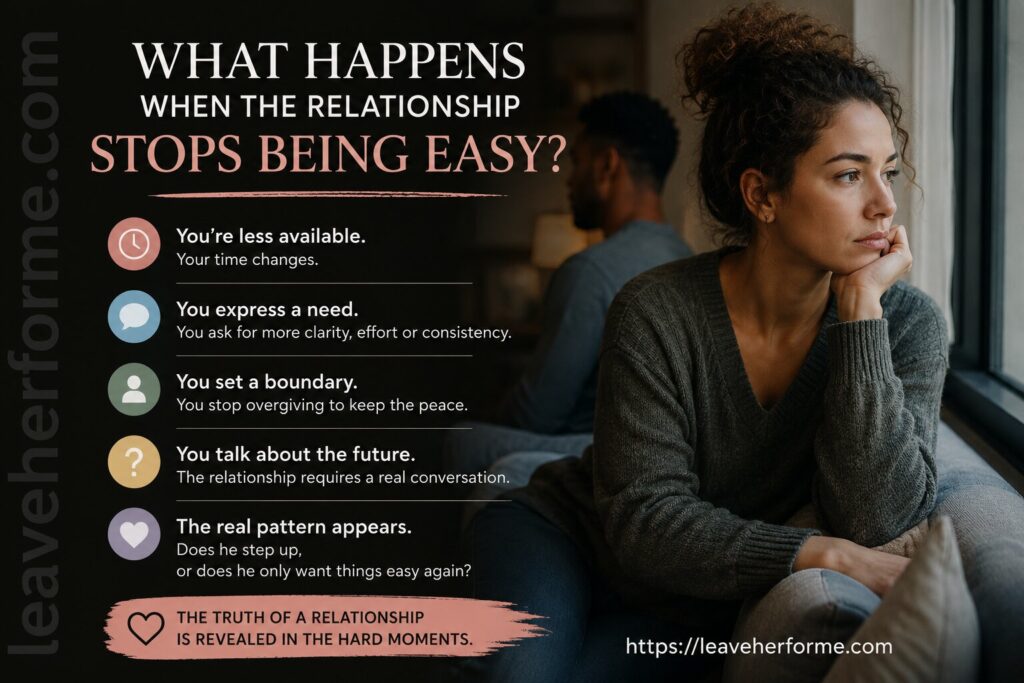
As long as a relationship continues under familiar conditions, it can be surprisingly difficult to tell whether love, attachment, convenience or some mixture of all three is holding it together. The arrangement has already found a rhythm. You know what he expects from you, he knows what you normally provide, and both of you may have learned how to avoid the areas most likely to disturb the connection.
That is why convenience often becomes easier to recognise when something changes.
Perhaps you need more from him than usual. Maybe you are no longer able to remain endlessly available. You establish a boundary, ask a difficult question or simply stop carrying responsibilities that gradually became yours without anyone ever discussing them. The relationship is now being asked to function differently, and his response can reveal things that were difficult to see while everything continued comfortably.
This does not mean you should manufacture tests, deliberately become cold or withdraw affection to see whether he chases you. Those strategies create artificial situations and often produce equally artificial reactions. Real life will create enough natural moments when your needs, boundaries and circumstances challenge the existing arrangement.
Pay attention to those moments.
A relationship built mainly around convenience may function beautifully while you continue supplying what makes it comfortable. Genuine love has a greater chance of adapting when the person it loves can no longer play exactly the same role.
The difference is rarely exposed by one incident. It becomes visible through the pattern that follows disruption.
Watch What Happens When You Need Him
Some women know almost everything about the man they love. They know when he is unhappy before he admits it, understand which subjects upset him and can recognise from one message that something is wrong. Over time, they become extraordinarily skilled at caring for the emotional world of the relationship.
Then one day the direction changes.
You need him.
Perhaps something serious has happened in your family. Work has become overwhelming, you are emotionally exhausted or the relationship itself has reached a point where reassurance is no longer enough. Instead of being the person providing understanding, you are asking to receive it.
This is one of the moments when the deeper structure of a relationship can become visible.
A loving man may not respond perfectly. He might be uncomfortable with emotion, misunderstand what you need or initially try to solve a problem when you simply wanted him to listen. Human beings do not suddenly become expert carers because they have genuine feelings.
What matters more is whether he tries to enter your experience.
Does he become curious about what you are feeling? Can the conversation remain focused on you without quickly returning to his problems? If he cannot immediately be there physically, does he find another meaningful way to remain emotionally present? When your difficulty lasts longer than one evening, does his concern continue after the initial moment has passed?
These behaviours matter because reciprocity becomes easiest to recognise when the relationship temporarily stops revolving around the emotional role you normally play.
Imagine that you have spent months hearing about his problems at home. You have listened to arguments, frustrations and fears about his future. Then you tell him that the uncertainty between the two of you has begun affecting you deeply.
If his response is mainly about how your feelings make his life harder, something important has happened. You approached him with your pain, but the conversation quickly returned to protecting his comfort.
Perhaps he says you are putting him under pressure, reminds you how complicated everything is or becomes distant because he does not want another difficult situation to deal with. His circumstances may genuinely be complicated, but the question remains whether there is room inside those complications for your emotional reality too.
Love does not guarantee that he can solve your problem. It should at least create some willingness to understand why the problem matters.
Notice What Changes When You Stop Carrying the Emotional Weight
Relationships often develop roles without anyone consciously assigning them.
One person becomes the peacemaker. Another becomes the one who needs reassurance. Someone becomes responsible for starting difficult conversations, while the other becomes accustomed to waiting until problems disappear. One person remembers important dates, repairs conflict, makes plans and keeps emotional connection alive.
You may not realise how much you carry until you stop carrying quite so much.
Perhaps you have always been the one who reaches out after an argument. This time, instead of punishing him with silence, you simply allow him some responsibility for repairing what happened. Maybe you normally adjust your schedule whenever an opportunity to see him appears, but circumstances now mean that your own commitments cannot constantly move around his availability.
Nothing manipulative has happened. Life has simply made the old arrangement less automatic.
Watch what follows.
Does he begin contributing to the parts of the relationship you previously carried alone? If communication decreases, does he notice and make an effort? When arranging time together becomes more difficult, does he begin solving some of the practical problem rather than assuming you will eventually find a way?
A relationship with genuine reciprocity can adapt because both people have an interest in keeping it alive. Someone may initially be clumsy because they have become accustomed to the old pattern, but they eventually recognise that maintaining the connection requires more participation from them.
Convenience behaves differently. When the person who made the relationship easy stops doing all the work, the relationship itself can begin looking strangely fragile.
That fragility does not prove there was never love. It may reveal that love had become supported by an arrangement where one person’s effort quietly compensated for the other’s limited contribution.
Once that compensation disappears, both people finally see how much work was being done behind the scenes.
Boundaries Often Reveal What Comfort Was Hiding
Boundaries are frequently misunderstood as threats.
They are not supposed to be punishments, strategies for gaining power or ways of frightening someone into choosing you. A healthy boundary is much more personal. It identifies what you can continue participating in without damaging your own wellbeing.
For example, perhaps you realise you can no longer repeatedly clear your schedule for plans that are frequently cancelled. Your boundary might simply mean that you stop rearranging important commitments until plans are reasonably certain.
Maybe late night conversations have become the only time he gives you emotional attention, while meaningful discussions about the relationship are continually avoided. You may decide that you are no longer willing to spend hours providing emotional support while important questions concerning your own future remain permanently off limits.
The boundary is not:
“Do this or I will punish you.”
The deeper message is:
“I care about this relationship, but I cannot continue participating in this particular pattern in the same way.”
What follows can be revealing.
A man who genuinely values the relationship may initially dislike the change because human beings naturally resist losing something comfortable. Yet once he understands why the boundary exists, he may begin adjusting, communicating differently or taking greater responsibility for the problem that created it.
Someone primarily attached to the convenience may focus far more heavily on restoring your old behaviour.
Instead of becoming curious about why you reached your limit, he may concentrate on how much easier things were when you asked for less. Perhaps he tells you that you have changed, become difficult or stopped being the woman he fell for, even though what has actually changed is your willingness to continue carrying an arrangement that was hurting you.
That reaction deserves attention because boundaries often expose expectations that were invisible while you continued meeting them.
Sometimes you discover that the relationship was comfortable because your discomfort had been doing part of the work.
Healthy Boundaries Should Not Require You to Become a Different Person
There is another side to this that deserves equal attention.
Once people begin reading about boundaries, they can become tempted to turn themselves into someone deliberately unavailable. They may start delaying messages, withholding affection or pretending not to care because they believe scarcity will increase their value.
That is not the direction of this article.
You should not have to perform indifference to discover whether someone loves you.
If you are naturally affectionate, you do not need to become cold. If communication matters to you, pretending you do not care about contact will not create clarity. Manipulative distance can certainly make another person chase, but being chased does not necessarily tell you whether the relationship has become healthier.
The goal is not to become inconvenient as a strategy.
The goal is to stop making yourself unreasonably convenient at your own expense.
Those are very different things.
You can remain kind while having boundaries. You can be understanding without agreeing to indefinite uncertainty. You can love someone deeply and still recognise that certain patterns are no longer sustainable.
The most useful changes are therefore authentic ones. You simply stop abandoning reasonable needs in order to preserve comfort.
What the relationship does with that reality becomes information.
His Reaction to Your Needs Can Tell You More Than His Reaction to Losing You
Many women place enormous importance on what happens when they try to leave.
He panics. He calls repeatedly. Perhaps he becomes more romantic, makes promises or suddenly communicates with an intensity that had been absent for months.
Those reactions feel persuasive because they demonstrate emotion.
But there is another moment that often provides even more useful information: what happens when you remain in the relationship but ask for something reasonable from it?
Imagine two situations.
In the first, you say you are leaving. He becomes terrified and does everything possible to keep you.
In the second, you stay but explain that the pattern between you needs to change. You ask for greater consistency, more honesty or a clearer understanding of what you are building together.
Which version of him appears then?
If extraordinary effort exists mainly when access to you is threatened but ordinary resistance returns whenever the relationship itself requires adjustment, fear of loss may be doing more work than commitment.
That does not mean his fear is fake. He may genuinely love you and genuinely experience the thought of losing you as devastating.
The question is what he does before the relationship reaches the edge.
Mature love should not require repeated emotional emergencies before the relationship receives attention.
A person who values what you have begins noticing the problem while you are still standing beside him, not only when you have one foot out the door.
This is why his response to your ordinary needs can sometimes tell you more about the future than his most dramatic attempt to stop you from leaving.
Watch Whether the Problem Becomes Your Personality
There is a particularly painful pattern that can emerge when you begin asking for something the existing arrangement was not designed to provide.
Instead of addressing the problem, the conversation gradually turns towards your character.
You ask why plans are constantly uncertain, and you are told you are impatient. You ask why the future remains vague, and suddenly you are putting too much pressure on him. You explain that disappearing affects your trust, and the discussion becomes about how sensitive or demanding you have become.
Perhaps there are moments when you genuinely do communicate badly. Everyone can become frustrated, accusatory or emotional when a problem has continued for too long. It is worth being honest about your own behaviour.
But that does not mean the original concern disappears.
A mature relationship can hold two truths at once: “You could have expressed that differently, and the issue you raised still deserves an answer.”
Convenient arrangements often struggle with that second part.
If identifying an imbalance repeatedly results in you becoming the problem, the relationship never has to examine the structure creating your frustration.
The status quo remains intact because attention moves away from what is happening and towards whether you had the right to be unhappy about it.
That is why you should pay attention when every request for change becomes a discussion about your personality rather than the pattern you were trying to discuss.
Supporting You Requires a Different Kind of Love Than Needing You
Being needed can make you feel enormously important.
He may call because you know how to calm him. He trusts your advice, misses your affection and values the peace he experiences around you. Those are meaningful forms of connection.
Supporting you, however, asks something different from him.
He has to leave the centre of the emotional story.
For a while, the relationship is not primarily about what he needs, what he fears or what he is struggling with. Your experience becomes the focus.
That can require patience when he would rather move on, attention when he is tired and emotional presence when there is no obvious reward waiting for him.
This is one reason reciprocal support is such an important distinction between love and convenience.
Someone can enjoy being cared for without being particularly capable of caring.
Mature love gradually develops that capacity.
Not perfectly, and not always naturally, but because the wellbeing of the other person begins mattering enough to require effort.
If you are consistently exceptional at meeting his emotional needs while he remains strangely confused whenever yours appear, the imbalance deserves more attention than the strength of his dependence on you.
Notice What Happens When You Ask Where the Relationship Is Going
Few questions disturb a comfortable relationship more effectively than asking what it is becoming.
Not because everyone should immediately know the answer. Relationships can genuinely develop through uncertain periods, and complicated situations often involve factors that prevent simple timelines.
The question becomes revealing because it asks both people to move from experience into direction.
Perhaps you have wonderful moments together. He tells you that he loves you and cannot imagine life without you. The emotional present feels strong.
Then you ask:
“What are we actually building?”
A person who is genuinely uncertain may still struggle to answer, but there are differences in how uncertainty is handled. He may admit what he does not know, explain what makes the decision difficult and engage honestly with what the uncertainty is costing you.
Another person may repeatedly respond with reassurance instead of clarity.
“Why can’t you just enjoy what we have?”
“You know how I feel about you.”
“Why do you always have to make things complicated?”
“Everything will work out eventually.”
These responses may sound loving, but notice what they accomplish. The question about direction disappears, and the conversation returns to preserving the present.
This is exactly where convenience can hide inside affection.
The relationship may contain enough emotional richness to make questions about structure feel almost unnecessary, particularly to the person who benefits most from the current arrangement.
Yet wanting to know what you are building is not an attack on love.
Sometimes it is the question that reveals what love is actually prepared to become.
Reassurance Can Solve the Feeling Without Solving the Problem
Reassurance is valuable. Relationships would be miserable without it.
When you are frightened, hearing that you matter can help restore perspective. After conflict, affection can remind both people that the disagreement is not the entire relationship.
The problem appears when reassurance repeatedly becomes a substitute for resolving the issue that created the insecurity.
Suppose you tell him that the lack of direction is exhausting you. He responds with warmth, reminds you how important you are and says he would never want to lose you. You leave the conversation feeling much better because your fear has been soothed.
Several weeks later, the original problem remains exactly where it was.
Eventually the uncertainty returns, another emotional conversation happens, reassurance restores closeness and the cycle begins again. The relationship feels repaired because the emotional discomfort decreases, but the underlying issue has not actually moved.
This is where we need to distinguish emotional repair from structural change.
Both matter.
A relationship needs emotional repair after difficult moments. However, if the same unresolved issue repeatedly requires repair, there eventually has to be curiosity about why the wound keeps reopening.
Otherwise reassurance can unintentionally become the mechanism that makes an unsustainable arrangement sustainable for a little longer.
Convenience Often Becomes Visible When You Stop Solving the Same Problem for Both of You
Perhaps there is an issue the relationship has faced repeatedly.
He struggles to make time, so you find creative ways to fit around his schedule. Communication becomes inconsistent, so you initiate more often. His circumstances make planning difficult, so you learn to live without firm plans. He avoids emotional conversations, so you become increasingly careful about how and when you raise them.
Each adaptation solves an immediate problem.
But notice what may happen over time.
Because you keep solving the consequences, he has less reason to address the cause.
This does not mean you were wrong to adapt. Loving people naturally accommodate each other. Flexibility is often necessary, particularly when circumstances are genuinely difficult.
The problem appears when accommodation becomes permanent compensation.
You are no longer helping the two of you through a temporary difficulty. You have become the system that allows the difficulty to continue indefinitely without requiring meaningful change.
That realisation can be uncomfortable because the qualities that made you loving, patient and understanding may also have made an unequal relationship easier to maintain.
Do not blame yourself for that.
The more useful question is what happens once you recognise it.
If you stop solving the same problem alone, does he begin helping solve it with you?
That response can tell you a great deal.
Returning Is Not the Same as Rebuilding
Some relationships become extremely good at reunion.
There is distance, frustration or even a breakup. Both people suffer. Eventually one reaches out, the emotional connection returns and the strength of the reunion seems to prove that the relationship must be meant to survive.
Then life settles.
Gradually, the same unresolved problems return.
Another rupture follows, another reunion occurs and once again the emotional intensity creates hope that this time something fundamental has changed.
There is an important difference between returning to a relationship and rebuilding one.
Returning restores access.
Rebuilding requires confronting what made the relationship unstable in the first place.
If he comes back, does he want to understand why you reached your limit? Are specific problems handled differently? Does either person’s behaviour change enough that the relationship has a better chance of producing a different outcome?
Or is the reunion primarily about relieving the pain of separation?
That distinction matters because people can become attached to reunion itself. The emotional relief of getting each other back is so powerful that both people temporarily forget why they separated.
If your relationship repeatedly follows that cycle, our article Why He Keeps Coming Back but Won’t Commit explores the psychology behind repeated return without corresponding commitment in much greater depth.
Why He Keeps Coming Back but Won’t Commit.
The question to keep here is simple but demanding: after he comes back, what has actually been rebuilt?
Being His Priority and Being Convenient to Him Can Sometimes Look Similar
This stage also connects directly to another distinction we have already explored.
A man may contact you constantly, confide in you, fear losing you and make you feel emotionally central to his life. Those behaviours can look like priority.
Yet if the relationship remains organised primarily around when he is available, what he needs and what circumstances make easiest for him, emotional importance may not have developed into practical priority.
This is exactly why How to Tell If You Are His Priority or His Emotional Escape is such a useful companion article. It examines the difference between being emotionally essential to someone and carrying meaningful weight in the decisions that shape his life.
How to Tell If You Are His Priority or His Emotional Escape.
The connection between these articles is important but they are not answering the same question. That article asks what place you hold in his life. This one asks whether the relationship continues partly because the existing arrangement is especially beneficial or comfortable for him.
Together, they reveal two different sides of the same complicated experience.
Do Not Turn This Into a Test
At this point, you may feel tempted to change everything immediately just to observe his reaction.
Do not deliberately create emotional traps.
Do not disappear for a week because you want to see whether he panics. Do not invent another man to create jealousy. Avoid withholding affection as punishment or manufacturing a crisis simply to find out whether he will fight for you.
Those behaviours may certainly produce a reaction, but the reaction will be to a situation you created rather than the relationship as it naturally exists.
The stronger approach is quieter.
Begin respecting your own genuine limits.
If you cannot keep adjusting your schedule indefinitely, stop pretending that you can. When something matters, communicate it honestly rather than hiding it because you fear losing him. If a pattern is hurting you, allow that reality to exist inside the relationship rather than immediately smoothing it over.
Then observe.
Can the relationship accommodate the reality that you are a person with needs, boundaries and a future of your own?
Or did it work primarily because you were exceptionally skilled at making yourself easy to keep?
That difference tells you considerably more than any artificial test could.
The Most Revealing Moment May Be When the Relationship Stops Working Entirely on His Terms
A relationship can remain emotionally convincing for a long time while the arrangement suits one person particularly well.
He receives closeness without committing more deeply. He gets support without restructuring his life. Perhaps intimacy is available without the responsibilities that normally accompany a more visible partnership. When difficult questions appear, affection and reassurance restore enough security for the arrangement to continue.
Then something changes.
You no longer agree that every limitation must be accepted indefinitely. You do not threaten him or demand an immediate outcome, but your needs begin taking up legitimate space.
Now the relationship has a choice to make.
Not necessarily a dramatic choice between two women.
A smaller and psychologically revealing choice comes first: will the relationship adjust to accommodate both people, or will most of the effort go into restoring the version that was easier for him?
That is often where love and convenience begin separating more clearly.
Genuine love may initially resist change because people resist discomfort. Yet over time, it has a reason to learn, compromise and participate because preserving you matters, not simply preserving what you provide.
Convenience is more interested in returning to the old arrangement.
A Reflective Pause Before You Decide What Any of This Means
Do not take one difficult conversation from your relationship and use it as proof that everything is convenient. Likewise, do not use one beautiful gesture as proof that the arrangement is completely mutual.
Look across time.
When you have needed support, what usually happens? When you communicate a boundary, does the relationship learn anything from it? If you stop carrying an emotional responsibility that never truly belonged to you alone, does he begin carrying part of it? When the future is discussed, does the conversation create greater honesty or mainly greater reassurance?
Most importantly, notice what happens when maintaining the relationship requires something from him that it did not require before.
Does his love begin adapting to the new reality, or does most of his energy go into getting you to return to the old one?
You do not need to make an immediate decision from the answer. The purpose of this stage is to help you see where comfort has been hiding inside familiar patterns.
Because once convenience becomes easier to recognise, another question appears naturally: what have you been giving up in order to keep the relationship comfortable enough to survive?
What This Relationship Is Asking You to Give Up to Keep It
Up to this point, much of our attention has been on him. We have examined what he may feel, what the relationship gives him, why convenience can coexist with genuine love, how familiarity protects certain patterns and what happens when the arrangement is asked to change. Those questions were necessary because you cannot understand the relationship without understanding some of the forces keeping him inside it.
Now the direction needs to change.
There is another person whose experience matters just as much: you.
A relationship can become so psychologically complicated that you spend most of your emotional energy trying to understand the other person. You analyse why he pulls away, why he returns, what he fears, why he stays, what his marriage means to him, whether his feelings are real and what might finally encourage him to make a decision. Meanwhile, a quieter question receives far less attention: what have you gradually been required to give up in order for this relationship to continue functioning as it does?
That question is not asking you to calculate every sacrifice and declare yourself the victim. All meaningful relationships require compromise. People change schedules, adjust expectations, support each other through difficult seasons and sometimes accept circumstances they would never have chosen because somebody they love is going through something genuinely difficult.
The difference lies in whether sacrifice has a direction and whether both people recognise its cost.
A temporary sacrifice can help two people get through a difficult period together. A permanent pattern of sacrifice can slowly turn one person’s life into the support system for another person’s comfort.
That difference deserves our attention now.
Have You Become Easier to Love by Asking for Less?
One of the most subtle changes in a complicated relationship happens when you begin editing yourself to keep the connection peaceful. It rarely starts dramatically. Perhaps you ask an important question and he becomes distant, so the next time you wait for a better moment. You explain that something hurts you, but the conversation becomes tense, and you decide that perhaps you raised it at the wrong time. A plan is cancelled and you feel disappointed, yet you know his circumstances are difficult, so you tell him you understand.
Any one of those responses can be emotionally mature. Timing matters. Compassion matters. Not every disappointment deserves an argument.
The concern develops when there is always a reason your needs must wait.
When his life is stressful, you do not want to add pressure. When his life is peaceful, you do not want to disturb the good period. If he is affectionate, you fear spoiling the closeness. When he is distant, you fear pushing him further away. Without deliberately deciding to do so, you can begin searching for a perfect moment to express needs in a relationship where no perfect moment ever arrives.
Eventually, you may become proud of how understanding you are. Perhaps he praises this quality in you. He tells you that you are different from other women because you understand his circumstances, do not create unnecessary drama and know how to give him space.
That praise can feel deeply meaningful, particularly if you love him and genuinely want to be someone who brings peace into his life.
But there is an uncomfortable question worth asking: has being “understanding” gradually come to mean requiring less from him than you actually need?
Perhaps you once wanted regular communication, but you learned to accept long gaps because questioning them created tension. Maybe you wanted a clearer future, but every attempt to discuss it made him feel pressured, so you taught yourself to appreciate the present. You may have wanted more time together, greater visibility or more emotional reciprocity, yet each need was slowly negotiated downward until the relationship became much easier for him to maintain.
At that point, it is worth asking whether the version of you he finds easiest to love is simply the version who asks him to change the least.
That does not mean you should become demanding to prove a point. It means genuine love should be capable of knowing the whole person, including the parts whose needs occasionally create inconvenience.
If a relationship can remain peaceful only when one person continually reduces herself, the peace may be real, but the price deserves to be acknowledged.
Are You Protecting His Comfort at the Expense of Your Own?
Love can make people remarkably protective of each other’s emotional wellbeing. You may know that certain conversations overwhelm him, that his family situation already creates pressure or that he carries guilt about what is happening between you. Because you understand these things, you may instinctively try to reduce the emotional burden he experiences in your relationship.
You choose your words carefully. You wait before bringing up problems. If he has had a difficult day, you postpone your own concern. When he says he cannot deal with another argument, you may decide that remaining silent is kinder than pushing the issue.
Again, compassion itself is not the problem.
The problem appears when his comfort becomes something you protect more consistently than your own.
Perhaps you are awake at two in the morning thinking about where the relationship is going, but you avoid asking because you know the subject makes him uncomfortable. You may feel lonely during weekends or holidays, yet tell yourself that raising the issue would only make both of you miserable. Maybe a particular pattern repeatedly leaves you hurt, but you have become skilled at recovering privately so that the next conversation between you can remain warm.
From his side, the relationship may feel surprisingly peaceful.
From yours, that peace may require considerable emotional labour.
This can create one of the most hidden forms of convenience. The relationship becomes comfortable for him partly because you privately absorb the discomfort that might otherwise force both of you to examine what is not working.
That does not mean you should bring every emotion to him immediately. Healthy adults need the ability to process some feelings independently. The issue is whether important recurring problems can exist openly inside the relationship without threatening the connection.
If the only way to keep him comfortable is to make your discomfort invisible, then the relationship may be more balanced emotionally than it appears.
When Understanding Him Becomes an Excuse for Ignoring Yourself
Empathy is one of the strongest qualities you can bring into a difficult relationship. Understanding another person’s fears, responsibilities and limitations can prevent unnecessary conflict and help you distinguish genuine complexity from careless behaviour.
Yet empathy has a shadow side.
The better you become at explaining him, the easier it can become to explain away almost anything.
He cancelled because the children needed him. He did not call because home was complicated. He avoided the future conversation because work has been overwhelming. He became distant because guilt affects him after the two of you become emotionally close. He asked for another few months because there are financial consequences you do not fully see.
Any of those explanations could be completely true. The problem is not that you understand them.
The problem is what can happen when explanation becomes the end of every conversation.
You begin believing that because you understand why something hurts, you should no longer be hurt by it. You know why he cannot give you more time, so you tell yourself you should stop missing him. You understand his fear of making a decision, so you feel guilty for wanting clarity. Because you know the pressure he carries, your own exhaustion starts seeming selfish.
That is where empathy begins turning against you.
Understanding another person’s behaviour does not cancel the impact of that behaviour on your life. You can understand why someone is unavailable and still feel lonely. You can understand why commitment frightens him and still need to know whether you want to remain indefinitely in a relationship without it. You can recognise that his children deserve consideration while also recognising that your life continues moving while he decides what he can offer.
These truths do not compete with one another.
Mature understanding makes room for both.
The relationship should not require you to choose between compassion for him and honesty about yourself.
The Relationship May Be Convenient for Him Because You Carry the Difficult Parts
Sometimes convenience is not created primarily by what a man receives. It is created by what he does not have to carry because you have quietly begun carrying it for both of you.
Perhaps you carry the uncertainty.
He says he does not know when circumstances will change, and you absorb the emotional consequences of not knowing.
You may carry the flexibility. His schedule determines when the two of you can meet, so you repeatedly reorganise yours around it.
Maybe you carry the secrecy. You learn which times are safe to call, where you can meet and what subjects cannot be discussed openly.
You may carry the emotional repair as well. After arguments, you reach out because you cannot tolerate the distance. When communication weakens, you find ways to restore warmth. If he becomes overwhelmed, you reduce your needs so the relationship can settle again.
Viewed individually, each action may look loving.
Viewed together, they may reveal that you are performing much of the emotional work required to keep the relationship functioning.
This is where convenience can hide particularly well because he may never have asked you explicitly to carry these things. Perhaps you took them on naturally because you loved him and wanted the relationship to survive.
Over time, however, what you voluntarily offered can become something the relationship automatically expects.
Your patience becomes part of the infrastructure.
Your flexibility becomes part of the infrastructure.
Your willingness to forgive becomes part of the infrastructure.
Your ability to tolerate uncertainty becomes part of the infrastructure.
When that happens, the relationship can continue with surprisingly little pressure on him to confront the areas you have been compensating for.
This does not make your love foolish. It makes it powerful enough that it may have been doing more work than you realised.
The important question becomes whether he begins sharing that work once you recognise it.
When Your Patience Starts Protecting the Problem
Patience is often praised as though more of it is always better.
It is not.
Patience is useful when time is allowing something meaningful to develop. It can be necessary when circumstances are genuinely complicated, particularly when children, finances, distance, family obligations or the ending of another long relationship are involved.
But patience can serve two very different functions.
In one situation, patience gives reality enough time to change responsibly.
In another, patience gives an unchanged pattern more time to remain unchanged.
From inside the relationship, those experiences can initially feel identical because both require waiting.
The difference emerges when you examine what happens during the waiting.
Are difficult conversations being addressed? Is he becoming clearer about what he can realistically offer? Are practical obstacles slowly being confronted? Is the relationship gaining greater reciprocity and stability, even if the final outcome is still uncertain?
If so, patience may be supporting genuine movement.
If every six months produces the same explanation, the same promise, the same emotional reunion and the same return to uncertainty, patience may have become one of the things protecting the arrangement from having to change.
This does not mean you were wrong to wait. You made decisions with the understanding and hope you had at the time.
It means there eventually comes a point where patience itself needs to be evaluated.
You are not only asking, “Can I wait longer?” You are asking, “What is my waiting allowing to happen?”
That is a much more useful question.
Have You Put Parts of Your Own Life on Hold?
The emotional cost of a relationship does not always appear inside the relationship itself. Sometimes it appears in the rest of your life.
Perhaps you have delayed decisions because you keep imagining that his circumstances may change soon. You avoid committing to travel plans because he might become available. Maybe you hesitate to relocate, begin something new or invest in another direction because your imagined future with him remains emotionally present.
For some women, the consequences are even more personal. They stop allowing themselves to imagine other romantic possibilities because emotionally they already feel committed. Years may pass while they remain loyal to a future that still has no clear shape.
This is not automatically a mistake.
People sometimes make sacrifices for relationships that eventually become exactly what they hoped for. The important question is whether those sacrifices are being made consciously.
There is a significant difference between saying, “I understand the uncertainty and I am choosing to give this another year because I can see meaningful movement,” and discovering three years later that you repeatedly postponed your own life because you kept assuming clarity was just around the corner.
One is a decision.
The other can become drift.
Convenient relationships often survive through drift because nobody has to make a dramatic choice. The next month simply looks enough like the previous one that continuing feels easier than reconsidering everything.
Meanwhile, your life continues spending time whether or not the relationship progresses.
That deserves recognition.
When Hope Requires You to Ignore Information You Already Have
Hope is not foolish.
It is one of the reasons people endure difficult periods, rebuild damaged relationships and continue working towards futures that are not immediately available.
But healthy hope remains in conversation with reality.
There is a difference between hoping that someone will change because you can see evidence of movement and needing to believe they will change because accepting the alternative feels unbearable.
The second form of hope can gradually make certain information difficult to look at.
Perhaps he has given the same explanation many times. Maybe timelines repeatedly move. You have noticed that his greatest effort comes when you are ready to leave, while ordinary commitment decreases once the relationship feels secure again.
Each fact on its own has an explanation.
Together, they form a pattern.
Yet recognising the pattern may threaten the future you have invested in, so the mind naturally looks for evidence that protects hope instead.
You remember the night he cried.
You remember how frightened he became when you tried to leave.
You remember the future he described.
Those memories may all be genuine and important.
The problem appears when emotional evidence is repeatedly used to override behavioural evidence.
Hope should help you move through uncertainty. It should not require you to become increasingly skilled at ignoring what uncertainty has already taught you.
What Would Happen If You Stopped Making the Relationship Easy?
This is one of the strongest questions in the article, but it needs to be understood correctly.
I am not suggesting that you suddenly become difficult.
Do not disappear to provoke him. Do not deliberately stop answering messages, manufacture jealousy, punish him with silence or withdraw affection in order to measure how desperately he chases you. Those behaviours would create a test, and tests often reveal how people react to manipulation rather than how they function inside an ordinary relationship.
The question is much simpler and much more honest.
What would happen if you stopped doing the things that are hurting you simply because those things make the relationship easier to maintain?
If constantly changing your schedule has become exhausting, what happens when you respect your existing commitments? If you normally hide disappointment so that your limited time together remains peaceful, what happens when you calmly speak about an issue that genuinely matters? If you repeatedly repair every disagreement because silence frightens you, what happens when you allow him some responsibility for restoring the connection?
Nothing artificial needs to be introduced.
You simply stop paying for the relationship’s comfort with parts of yourself you can no longer afford to keep giving away.
His response can be informative.
Perhaps he begins adjusting because he did not fully recognise how much you were carrying. Maybe the relationship becomes more reciprocal once the imbalance is visible. He may initially struggle with the change but eventually understand why it was necessary.
That is very different from a situation where every authentic boundary produces anger, withdrawal or pressure for you to return to your old role.
If the relationship works only when you overfunction, its apparent stability may have depended more heavily on your sacrifice than either of you realised.
Ordinary Boundaries Reveal More Than Manufactured Tests
A natural boundary is powerful precisely because it does not require pretending.
Suppose you have repeatedly accepted last minute plans because you were afraid declining would reduce the little time you already receive. One day you genuinely have another commitment and cannot rearrange it. You explain this normally.
What happens?
A man who values the relationship may be disappointed, but he recognises that you have a life. Perhaps the two of you find another time.
If he reacts as though your availability was something he was entitled to, you learn something about the expectations that developed around the relationship.
The same principle applies emotionally.
If you say, “I care about you, but I cannot keep having this same conversation without eventually understanding what we are doing,” you are not issuing a threat. You are communicating a legitimate reality about what you can continue participating in.
His answer does not have to be the answer you want for the conversation to be meaningful.
He may admit that he remains uncertain. That could hurt, but honesty gives you something real to work with.
Convenience becomes more visible when honest information is treated as a threat simply because it disturbs an arrangement that previously required less from him.
That is why boundaries can reveal so much without becoming games.
They introduce reality where accommodation previously kept reality quiet.
Do You Feel Loved, or Do You Feel Useful?
This question requires caution because useful and loved are not opposites.
Being useful to someone we love can be beautiful. Partners help each other. They provide emotional support, practical assistance, intimacy, advice and stability. Healthy relationships are full of usefulness.
The problem arises when usefulness becomes the main condition under which your presence feels valuable.
Consider how the relationship feels during periods when you are not performing your usual role. If you cannot provide emotional comfort, does he remain interested in your company? When you are not sexually available, is affection still present? If you disagree with him rather than validating him, can closeness survive? When you stop solving a problem he repeatedly brings to you, does he still experience you as someone worth being close to?
Those questions are not designed to make you suspicious of every good thing you give.
They help reveal whether your value is broad enough to include who you are when you are not useful.
A person who loves you may appreciate what you provide enormously. But there should also be space for you to be tired, complicated, uncertain, unavailable or in need of care yourself.
Otherwise the relationship can begin resembling a role you perform rather than a place where your whole self is known.
You Should Not Have to Compete by Becoming Easier Than Another Woman
This becomes particularly important for women involved with married men or men who have another partner.
It can be tempting to believe that the way to “win” is to become the easier relationship.
If his wife argues with him, you remain peaceful. If she demands responsibility, you try not to pressure him. When their home feels complicated, you make your relationship feel simple. Perhaps you believe that if being with you feels consistently better, he will eventually recognise where he belongs.
That strategy can create the opposite result.
You may become extraordinarily valuable to him while accidentally building a relationship that asks less of him than the one he says makes him unhappy.
He experiences you as peace partly because the difficult conversations required to build a complete partnership are continually postponed.
Meanwhile, the wife may appear demanding precisely because she shares responsibilities with him that your relationship has not yet had to carry.
This does not mean the marriage is healthier or that the other woman should imitate the wife. Nor does it mean your peaceful connection is false.
It means you cannot reliably measure relationship quality by comparing how easy each woman makes his life.
Real partnership eventually introduces responsibilities of its own.
If becoming his preferred woman requires never becoming inconvenient, you may win more of his emotional attention without necessarily becoming closer to the future you actually want.
Your Relationship Should Have Enough Space for Your Truth
There is another way to understand everything we have explored in this stage.
Ask whether the relationship has enough emotional space for reality.
Can you say when something hurts?
Can he admit when he does not know what he wants without immediately giving you a promise designed to stop you leaving?
Can the two of you discuss limitations without turning them into accusations?
Can you acknowledge that love exists while also acknowledging that the current arrangement may be unfair?
These conversations are uncomfortable because they remove the protection of fantasy.
But relationships become more trustworthy when both people can tell the truth without believing that every uncomfortable truth will destroy the bond.
If your relationship survives only through carefully maintained optimism, it may feel emotionally strong while remaining surprisingly fragile.
Mature love should have some capacity to hear:
“I love you, and this is hurting me.”
Both parts of that sentence can be true.
You should not have to eliminate the second in order for the first to remain believable.
What Has Keeping This Relationship Cost You?
At this point, I want the focus completely away from proving what kind of man he is.
Instead, look at what maintaining the relationship has required from you.
Perhaps the cost has been manageable. You may genuinely believe that the relationship gives you enough love, meaning and movement to justify the difficulties you have accepted.
If so, that matters.
This article is not trying to persuade every woman in a complicated relationship to leave.
For someone else, however, the cost may have grown quietly.
She has given time, flexibility, emotional labour and years of patience. She has lived with secrecy, postponed important decisions or repeatedly placed her emotional needs behind another person’s circumstances.
Neither woman should be judged from outside.
The more useful question is whether you understand the price you are currently paying and whether you still consciously choose to pay it.
That is very different from continuing automatically because leaving feels frightening.
Once the cost becomes visible, you can assess the relationship with greater honesty.
A Reflective Pause Before We Go Any Further
You do not need to answer every question in this stage immediately. Some of them may take time because the relationship has become part of your life in ways that are difficult to separate from ordinary routine.
For now, consider one broader question: if you stopped protecting this relationship from every reasonable need, boundary and truth that might make it uncomfortable, would the relationship become healthier, or would it simply become harder for him to maintain?
There is no universal answer.
Some relationships improve when one person stops carrying so much because the other finally recognises the imbalance and begins participating differently. Other relationships destabilise because what appeared to be mutual love depended more heavily on one person’s accommodation than anyone wanted to admit.
Either outcome gives you information.
What matters is that you do not need to manipulate the relationship to discover it. Ordinary honesty, reasonable boundaries and your willingness to stop abandoning yourself create enough reality on their own.
And once you have understood the psychology, looked honestly at what you have been giving and tried to change the patterns within your control, another kind of frustration can emerge: what if you have done all of that and the relationship still keeps returning to exactly the same place?
When You Have Changed the Pattern but the Relationship Still Returns to the Same Place
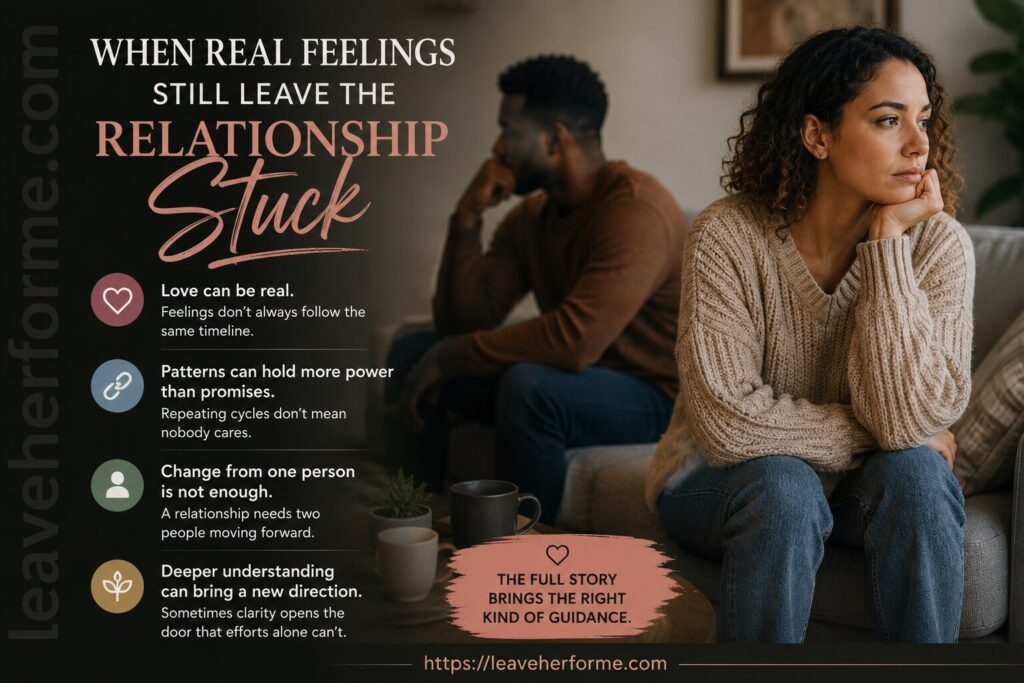
There comes a point in some relationships when understanding more does not necessarily make the situation easier.
Perhaps you have already looked carefully at the difference between love and convenience. You understand how attachment develops, why familiarity can become powerful, how emotional dependence can exist alongside genuine feelings and why people sometimes remain connected to more than one life, responsibility or relationship at the same time. You have also looked at yourself rather than placing every unanswered question on him.
Maybe you have communicated more clearly. You have tried not to overgive simply because you are afraid of losing the relationship. Reasonable boundaries have been introduced without turning them into threats or tests. You have tried to understand his circumstances while also becoming more honest about your own needs.
Yet somehow the relationship returns to the same place.
The conversations may change, but the central difficulty remains. There can be periods of extraordinary closeness followed by familiar uncertainty. A decision appears closer and then circumstances shift again. Both of you may genuinely want something to change, yet neither ordinary relationship advice nor greater psychological understanding seems to explain why movement remains so difficult.
This is where I believe we need to be careful.
Reaching this point does not automatically mean there is something spiritual blocking the relationship. It also does not mean somebody is deliberately preventing progress. Sometimes circumstances really are complicated. Sometimes two people can love each other deeply while responsibilities, fear, timing, family, existing relationships or different needs make the future difficult to resolve.
At the same time, my work comes from a spiritual perspective. When someone has already tried to understand the ordinary relationship dynamics and still feels that something deeper remains unresolved, I believe it can be reasonable to explore the situation spiritually as well.
But the order matters.
I do not begin with spiritual work. I begin with the relationship.
Understanding the Pattern Does Not Always Change the Pattern
Understanding can be powerful because it changes the way you interpret behaviour. Once you recognise that someone’s hesitation may involve attachment, responsibility, fear, children, familiarity or genuine emotional conflict, you may stop interpreting every delay as proof that the feelings are false. Equally, understanding your own role can help you recognise where fear of loss, hope or over accommodation may have influenced the relationship.
Sometimes that understanding is enough to create change. Better communication follows, expectations become clearer and both people begin responding differently because they finally understand what has been happening between them.
Other relationships are not so easily moved.
You can know why an argument keeps happening and still have the argument again. A man can understand that his uncertainty affects you and genuinely wish he could give you clarity, while remaining unsure about what he can realistically change. You can understand why he feels divided and still find yourself struggling with what that division means for your own future.
Knowledge does not automatically remove emotion, attachment, responsibility or fear.
This is particularly true when more than two people are affected. A married man who develops genuine feelings for another woman is not making decisions in an emotional vacuum. His feelings for her may be real while his marriage still contains history, affection, family, children, responsibility or another form of love. His wife may also have her own emotional reality, hopes and understanding of the marriage. The other woman has her experience as well, including the love she did not necessarily plan to feel.
Reducing such a situation to “he should simply choose” may sound logical from outside while failing to capture what the people inside it are actually experiencing.
Love does not always arrive according to the arrangements people already have.
Sometimes people develop feelings at inconvenient times, for complicated people and inside circumstances none of them would have deliberately designed. That does not tell us what anyone should ultimately do. It simply explains why psychological understanding must remain compassionate enough to acknowledge complexity.
A Stuck Relationship Does Not Automatically Mean Someone Is Doing Something Wrong
When nothing seems to change, the mind naturally searches for someone to blame.
Perhaps he is wasting your time. Perhaps you have been too patient. Maybe his wife is preventing him from moving forward, or perhaps the other relationship itself is the reason his marriage cannot recover. Depending on which person’s position we begin from, we can construct a convincing story in which almost anyone becomes responsible for the situation.
That is precisely why I do not want to begin there.
Sometimes there is deception, manipulation or harmful behaviour, and when clear behaviour supports that conclusion it should not be ignored. But complicated does not automatically mean malicious. A person can create pain without deliberately setting out to hurt someone, just as someone can make choices another person dislikes while genuinely believing those choices are necessary.
Three people can even experience the same situation completely differently without any one perspective containing the entire truth.
A wife may be fighting for a marriage she still believes has value. Another woman may be fighting for a relationship she experiences as genuine love. The man between those relationships may feel emotionally divided, frightened of hurting people or uncertain which part of his life he can bear to lose. None of those perspectives has to be mocked or dismissed for us to recognise that the situation cannot continue indefinitely without affecting everyone involved.
Understanding each person’s position does not require agreeing with every decision.
It simply prevents us from turning complicated human beings into convenient characters.
Why I Do Not Assume Every Stuck Relationship Has a Spiritual Cause
This distinction is important to me because spiritual explanations can become too easy when they are applied to everything.
If a man becomes distant, that does not automatically mean somebody has spiritually interfered with him. If a husband is having an affair, I do not believe the existence of the affair alone proves a spiritual cause. A married man who cannot leave his marriage may be dealing with children, finances, attachment, guilt, responsibility or genuine love for parts of the life he already has.
Likewise, if a man loves another woman but repeatedly returns to his wife, that behaviour should not automatically be interpreted spiritually. The marriage may contain emotional bonds, history and responsibilities that remain powerful even when another relationship is also meaningful.
Ordinary human explanations deserve to be examined first.
That is one reason this article has spent so much time discussing psychology before mentioning my spiritual work. If every relationship problem were immediately labelled spiritual, there would have been no need to understand attachment, convenience, reciprocity, fear, familiarity, boundaries or emotional dependence in the first place.
Those things are real.
They matter.
My spiritual perspective should add another possible layer of understanding when appropriate. It should not erase everything we already know about human relationships.
I do not begin by deciding that your relationship has a spiritual problem. I begin by understanding the pattern that keeps bringing you back to the same place.
That distinction is central to how I want someone approaching me to understand my work.
Where Spiritual Guidance May Become Relevant
There are situations where someone reaches the limits of what ordinary analysis seems able to answer.
She may understand the psychological explanations and still feel that they do not fully explain her particular relationship. Communication has taken place, sometimes repeatedly. The people involved may have separated and returned to each other, tried to change the relationship, addressed obvious problems and still found themselves drawn back into the same unresolved position.
For someone who believes that relationships can also have a spiritual dimension, this is where spiritual guidance may become worth exploring.
I do not present that as scientific proof of an unseen cause. My work belongs to a spiritual tradition and should be understood in that context. The purpose of looking spiritually is not to replace what we have already observed but to consider whether there may be another dimension to the bond, the obstacles around it or the repeated lack of movement that deserves attention within that belief system.
This matters because spiritual work should not become a shortcut around reality.
If someone has clearly said they do not want the relationship, spiritual language should not be used to pretend their words have no meaning. If practical circumstances are the obvious source of difficulty, those circumstances still matter. When children, finances, distance, marriage, family expectations or another relationship influence someone’s choices, spiritual guidance does not make those realities disappear.
My approach is to understand as much of the whole situation as possible before deciding whether I believe spiritual work has a meaningful place in it.
That is a very different approach from assuming that every painful relationship requires the same solution.
The Relationship Must Be Understood Before Spiritual Work Is Recommended
Two women can arrive with almost identical questions and be living completely different realities.
One may say, “He loves me, but he will not leave his wife.” Another may say exactly the same words.
In the first situation, the man may have been consistently emotionally involved for years. He talks openly about the conflict he feels, has made meaningful changes and remains deeply connected to both the woman and responsibilities within his marriage. In the second situation, contact may be inconsistent, promises appear mainly when separation is threatened and neither person’s expectations have ever been clearly discussed.
The sentence is the same.
The relationships are not.
The same applies to a wife saying, “My husband is involved with another woman and I want my marriage back.” One marriage may still contain affection, communication and a husband who remains emotionally connected to his family while confused by another relationship. Another may have been emotionally disconnected for years before anybody else entered the picture.
Again, the request may sound similar while the underlying relationships are entirely different.
This is why I do not believe a responsible spiritual approach should begin with a predetermined answer.
Before considering what spiritual work may be appropriate, I want to understand the people involved, what has happened, what changed, what remains between them and what the person asking for help actually hopes will happen.
That understanding does not guarantee a particular outcome.
It gives the spiritual work a more honest foundation.
When Your Goal Is Greater Closeness, Priority and Commitment
Sometimes the person reading this article is not trying to determine whether she should leave.
She already knows what she wants.
Perhaps she believes the love between them is genuine and wants the relationship to become closer, clearer and more committed. She may want to become a greater priority in his emotional life, see the bond strengthened or understand whether obstacles surrounding the relationship can be addressed.
That desire deserves to be understood without immediately being judged.
A woman who loves a married man may not have planned to fall in love with him. Their relationship may have begun innocently, developed gradually or become serious long after both understood how complicated the situation was. The fact that a marriage exists does not magically prevent another human being from developing real feelings.
At the same time, the wife has her own relationship, history and feelings. If she is trying to restore closeness with her husband or end the distance that has developed between them, her desire also deserves to be understood rather than treated as an obstacle in someone else’s love story.
This is where neutrality matters most.
My work is not built on deciding that one category of woman deserves love more than another. I meet people from the position they are actually standing in. The woman who wants greater closeness with a married man has her story. The wife trying to rebuild her marriage has hers. What matters first is understanding the relationship she is asking me about and what she hopes to change.
Where I believe spiritual work is appropriate, the focus may involve the emotional bond, closeness, attention, obstacles surrounding the relationship and movement towards the kind of commitment the person is seeking. I would rather explain that carefully after understanding the situation than make a universal promise that the same spiritual approach fits everyone.
That is also why personal assessment becomes important later in this article.
Spiritual Work Should Not Require Me to Pretend I Know What I Do Not Know
There is another principle that strengthens spiritual authority rather than weakening it: uncertainty should be admitted where uncertainty exists.
If someone contacts me with a few sentences about a complicated relationship, I should not pretend those sentences reveal everything. I may need to understand how long the relationship has existed, whether the connection has changed, what has already been tried, whether another relationship is involved and what the person actually wants.
Without that context, certainty can sound impressive while telling us very little.
The same applies to spiritual explanations. I do not need to tell every woman that somebody has interfered spiritually, that a third party is responsible for everything or that one hidden cause explains all of the man’s behaviour. Sometimes what appears mysterious becomes understandable once the relationship itself is examined properly.
Other times, after the ordinary dynamics have been considered, the person may still want the situation explored through a spiritual lens.
That is the point where my role becomes distinct from that of the relationship articles she may already have read elsewhere.
The psychology helps us understand the pattern.
The spiritual perspective explores whether there is another layer she believes deserves attention.
Those approaches do not have to compete.
Spiritual Guidance Should Add to Understanding, Not Replace It
A woman can believe deeply in spiritual work while still paying attention to behaviour.
Those positions are compatible.
If a man says one thing and repeatedly does another, the behaviour still matters. If communication is poor, improving it can still matter. When a relationship has become dominated by fear, jealousy or repeated conflict, those emotional patterns remain relevant even if someone also believes spiritual influences can affect relationships.
This is why I would never want the spiritual section of this article to undo everything we have spent thousands of words establishing.
We have learned that genuine love can coexist with convenience. Attachment can exist without readiness. A marriage can contain love, familiarity, responsibility and stability simultaneously. Another relationship can contain genuine romantic love while still existing inside circumstances that make commitment difficult.
Spiritual guidance enters after those possibilities have been taken seriously.
For someone who shares this worldview, it becomes another way of exploring the relationship rather than an excuse to stop observing it.
That creates a more grounded spiritual position because it does not depend on rejecting psychology in order to make spirituality meaningful.
Sometimes the Question Is No Longer Whether the Love Is Real
By this stage of the article, you may already have enough evidence to believe that feelings exist.
Perhaps that has never been your main doubt.
You know how he looks at you. You know what the two of you have shared. You have experienced his vulnerability, affection, return after distance and the emotional connection that exists when you are together. Those experiences may be part of why simplistic advice telling you that the relationship is merely convenient has never felt completely accurate.
Your question may have moved beyond:
“Does he love me?”
You may now be asking why genuine feelings have not produced the kind of relationship you expected them to produce.
That is a different question.
Miko Kana Insight: Sometimes the question is not whether love exists. The question is why a relationship with real feelings keeps returning to the same place, even when the people involved want something to change.
There can be many answers. Fear may be part of it. Existing commitments may matter. Timing, family, attachment, financial realities or conflicting forms of love may all contribute. In some cases, someone who shares my spiritual worldview may also want to explore whether there is a spiritual dimension to what keeps repeating.
The important word is explore.
Not assume.
Understanding should come before conclusions.
What I Would Want to Understand Before Considering Spiritual Work
If you came to me after reading this article, I would not want to begin by telling you what is wrong.
I would want to understand what is happening.
How did the relationship begin? What changed? What does he actually do when the two of you become closer? If another relationship or marriage exists, what do you genuinely know about it rather than what you have had to assume? Has he ever tried to change his situation? What happened when he did? Have the two of you separated before, and what brought you back together?
I would also want to understand what you want.
Greater attention is not necessarily the same as commitment. Commitment is not necessarily the same as marriage. A wife trying to restore emotional closeness with her husband is asking for something different from another woman hoping that the man will eventually build a life with her.
Those distinctions influence how I understand the situation.
They also prevent spiritual guidance from becoming a generic product placed underneath every relationship problem.
Sometimes the most important thing I can discover is that the situation is not what the person initially believed it was.
Other times, the relationship may contain a strong bond but remain caught around specific obstacles.
That difference matters before anything further is considered.
When You Want the Love That Exists to Become More Visible in His Choices
There is a particular kind of frustration that appears when you do not feel unloved.
You feel unrealised.
The emotional connection exists, yet you want it to have a clearer place in his decisions. Perhaps you want greater closeness, more attention, stronger commitment or movement away from a pattern where the relationship repeatedly becomes secondary to everything surrounding it.
This is where our previous cornerstone, How to Tell If You Are His Priority or His Emotional Escape, becomes particularly relevant. Emotional importance and practical priority are not always the same thing, and understanding that distinction helps clarify what someone actually wants to change.
For some clients who approach me spiritually, their goal is not to manufacture feelings where they believe nothing exists. They come because they believe a meaningful bond already exists and want spiritual help focused on strengthening closeness, addressing obstacles around the relationship or encouraging movement towards greater attention, priority and commitment.
I can understand why that desire exists without pretending that spiritual work gives me control over another human being or guarantees a particular decision.
That distinction makes the positioning stronger.
It allows the reader to understand what I actually do while preserving the complexity we have spent the entire article establishing.
Before You Ask What Can Be Changed, Understand What You Are Asking to Change
This is the final question I want to leave with you in this stage.
If you could change one thing about this relationship, what would it actually be?
Would you want him to communicate more consistently? Would you want the relationship to become visible rather than hidden? Are you seeking emotional priority, a decision about another relationship, reconciliation after separation or a clearer commitment to a shared future?
Those are not interchangeable goals.
Sometimes people say they want him to “choose me” when what they are really desperate for is certainty. Another person may say she wants her husband back when what she actually misses is the emotional closeness that disappeared long before another woman entered the picture.
Understanding the real goal changes the question.
And that brings us to the next stage of Conversion Depth. By now, a general article has taken the reader as far as a general article reasonably can. We have examined psychology, attachment, love, convenience, reciprocity, boundaries, behaviour, complicated relationship structures and the possible place of spiritual guidance.
What remains is individual.
Your relationship cannot be accurately reduced to one sign, one label or one paragraph on the internet. The next question is what all of these patterns mean when they are put together inside your particular situation.
That is where Personal Assessment should enter.
Your Relationship Cannot Be Reduced to “Love” or “Convenience”
By this stage, the question may feel less simple than when you first opened the article.
At the beginning, you may have wanted one clean answer: does he love me, or is this relationship simply convenient for him? After looking more closely at attachment, comfort, reciprocity, emotional dependence, practical realities, boundaries and the way relationships change over time, it becomes clear why a simple label can miss too much.
A man may genuinely love someone and still become comfortable with the arrangement they share. He may depend emotionally on a relationship because it gives him peace, understanding or a sense of belonging. Another relationship may remain important because it carries history, family, stability, loyalty or responsibilities that cannot be understood from the outside. In some situations, there may be genuine movement towards something deeper. In others, the people involved may care for each other while remaining unsure what they can realistically build.
Several of those things can be true at the same time.
That is where Narrative Neutrality becomes essential. The purpose of a personal assessment is not to decide in advance who is right, who is wrong, who is using whom or which relationship deserves to survive. It is to understand the actual pattern before attaching meaning to it.
A wife, a mistress, a girlfriend, a boyfriend or a married man can all experience the same situation differently because each person is standing in a different emotional position. One may experience love, another may experience loss, another may experience responsibility, and someone else may be carrying uncertainty. None of those perspectives should be dismissed merely because another perspective also exists.
The job is to understand the relationship before deciding what any of it means.
Two Similar Relationships Can Have Completely Different Meanings
Imagine two women who both say, “He tells me he loves me, but nothing has really changed.”
The sentence sounds identical.
The relationships may not be.
In one situation, the man may be actively confronting difficult practical circumstances. He may be having uncomfortable conversations, making changes slowly, becoming more honest and trying to find a responsible way forward while protecting children or dealing with financial consequences. The woman may still feel frustrated, but there is visible movement.
In another situation, the same sentence may describe a relationship that has repeated the same pattern for years. There may be affection, return after distance and genuine emotional connection, yet the structure remains largely unchanged and neither person can clearly explain what is expected to happen next.
A third relationship may contain strong emotional dependence. The connection becomes closest during difficult periods, and both people rely on each other for emotional comfort even though neither has fully decided what kind of future they want.
None of those situations can be understood properly by the sentence, “He says he loves me.”
The meaning comes from context.
How long has the relationship existed? What has changed? What happens after conflict? What happens after promises? What happens when one person needs more? How does the relationship respond when circumstances become difficult?
Those details can completely change the interpretation.
That is why I do not believe personal guidance should begin with a conclusion. It should begin with the story.
The Timeline Often Reveals What Individual Moments Hide
One emotional moment can be powerful enough to shape how you understand an entire relationship.
Perhaps he cried when you tried to leave. Maybe he said something unforgettable about the future. There may have been a period when he became especially close, made a major promise or showed you a level of vulnerability you had never seen before.
Those moments matter.
But a timeline helps place them in context.
What happened before that moment, and what happened afterwards? Did the relationship become more stable, more reciprocal or clearer? Did the promise lead to practical movement, or did the relationship eventually return to an earlier pattern?
The timeline can also reveal progress that is easy to overlook.
Sometimes people assume nothing has changed because the final outcome has not arrived yet. Yet when they look back honestly, communication may have improved, certain obstacles may have been addressed and the relationship may actually be developing slowly.
That is why personal assessment should not begin with the latest emotional event.
It should look at the relationship as a sequence.
A relationship that has been steadily changing for eighteen months is psychologically different from one that has repeated the same cycle for eighteen months, even if both contain strong feelings.
Time does not automatically tell us whether a relationship is healthy or unhealthy.
What matters is what the time contains.
What Changes After the Promise Matters
Promises are especially difficult to evaluate because people can make them sincerely and still fail to fulfil them.
A man may genuinely believe that circumstances will change soon. At the time he speaks, he may mean everything he says. Then reality becomes more complicated than expected, fear increases or new responsibilities appear.
That does not automatically make the original promise dishonest.
At the same time, repeated promises deserve context.
If the same future is described again and again while nothing around the relationship ever changes, the pattern becomes important. The question is no longer only whether he meant the promise when he made it. It becomes whether promises are producing movement or mainly restoring hope when uncertainty becomes difficult.
A personal assessment looks at what follows the words.
Does communication become clearer? Do actions begin aligning more closely with what was discussed? Are practical obstacles being confronted, even slowly? Does the relationship become easier to understand over time?
Those patterns often reveal more than the promise itself.
And again, the purpose is not to accuse him of lying. A person can sincerely want a future they are not yet capable of creating. The more useful task is understanding the gap between intention and action.
What Happens When You Stop Overgiving Matters Too
The relationship should also be examined from your side.
Perhaps you have been highly flexible, patient or emotionally available because you genuinely care. Maybe your circumstances allowed you to carry more of the emotional weight for a period, or perhaps you simply became the person who naturally kept the relationship connected.
There is nothing automatically wrong with that.
The question is what happens when the balance changes.
If you begin expressing reasonable needs, respecting your own schedule or allowing him more responsibility for maintaining the connection, does the relationship adapt? Does he notice? Does communication become more balanced, or does the relationship struggle because the old pattern depended heavily on your level of accommodation?
This does not mean you should deliberately withdraw to test him.
The most useful information comes from authentic change.
Perhaps your work becomes busier and you cannot be as available. Maybe you have reached a point where a particular pattern genuinely needs to be discussed. You are not trying to create pressure; you are simply allowing your own reality to have equal space.
What happens then can help clarify the relationship.
Not because one reaction gives you a final answer, but because adaptation tells us something about the depth and flexibility of the bond.
Several Explanations May Be True at the Same Time
This is one of the reasons personal interpretation matters.
A relationship may not have one cause.
He may genuinely love you and also depend on the emotional comfort you provide. He may be attached to another relationship because of history, loyalty or family while also feeling strongly connected to you. He may want change but fear what change would cost. You may be patient because you understand his situation while also beginning to feel exhausted by uncertainty.
None of these explanations automatically cancels the others.
Human relationships often become difficult precisely because several emotional truths exist together.
This is why I do not want to reduce a person to a label such as avoidant, user, cheater, victim or convenient option without understanding what is actually happening.
Labels can make complicated situations feel easier to explain.
They can also make us stop looking.
A personal assessment should do the opposite.
It should open the situation up enough to see where love, attachment, comfort, responsibility, fear, practical reality and personal choices intersect.
That is where a more useful picture begins to emerge.
Why I Want to Understand the Relationship Before Recommending Spiritual Work
If someone contacts me for spiritual guidance, the easiest thing would be to assume that every difficult relationship requires spiritual work.
I do not believe that approach serves anyone well.
First, I want to understand what is happening.
Is the relationship genuinely stuck, or is it moving slowly? Are the obstacles mainly practical? Is emotional dependence playing a large role? Are expectations different between the people involved? Has communication improved or broken down? Are there signs that the relationship is developing, or are the same questions repeating without change?
Those distinctions matter before any spiritual recommendation is made.
Where I believe spiritual guidance may have a place, I want the work to be connected to what the person is actually experiencing rather than applied as a generic solution.
For one person, the goal may be greater emotional closeness. Another may be seeking stronger commitment. Someone else may want reconciliation, greater attention or clarity around a relationship that keeps returning to the same place.
A wife trying to restore her marriage and another woman hoping to become a greater priority are asking different questions. Both deserve to be understood from the position they are actually standing in.
That is why Balanced Authority and Narrative Neutrality remain part of the assessment.
I do not need one person to become the villain in order to understand another person’s pain.
A Personal Relationship Assessment Looks at the Whole Story
The purpose of a Personal Relationship Assessment is not to give you a dramatic answer after reading two sentences about your situation.
If you can see several of these patterns in your relationship but still cannot tell which one is keeping you stuck, I can look at the full story through a Personal Relationship Assessment.
It is to look at the relationship as a whole.
How did it begin? What changed? How long has the current pattern existed? What has already been tried? What does he say, and what does he actually do? If another relationship is involved, what do you know about that situation rather than what you have had to assume? What usually happens when the two of you become closer, and what tends to create distance?
I also want to understand what you want.
That part matters more than people realise.
Two women can describe the same relationship and want completely different outcomes. One wants clarity so she can decide whether to continue. Another wants greater priority and commitment. Someone else wants reconciliation after separation, while another wants to understand whether the bond she already has can become stronger.
Without understanding the goal, it is difficult to know what kind of guidance would actually be useful.
This is where Conversion Depth becomes natural.
You have already read the general psychology.
You understand that love and convenience can coexist, that comfort does not automatically mean exploitation, that real feelings do not automatically produce readiness and that relationships involving more than one person can contain different emotional truths at the same time.
The remaining question is no longer only:
“What does this behaviour usually mean?”
It becomes:
“What does this pattern mean in my relationship?”
That is where individual assessment begins to have value.
Tell Me the Story, Not Simply the Latest Problem
When something painful has just happened, it is natural to begin there.
“He stopped calling.”
“He said he needs more time.”
“He went back to his wife.”
“My husband has become distant.”
“He came back after I thought the relationship was over.”
The latest event matters, but I do not want it to erase everything that came before it.
Tell me how the relationship began. Tell me what the two of you were like before the current problem developed. Explain when you first noticed the change, what you have already tried, what improved and what repeatedly returned.
If another relationship is involved, tell me what you actually know about it and what remains uncertain.
Most importantly, tell me what you want now.
Tell me the story, not simply the latest problem.
That line captures the way I want personal assessment to work.
A relationship is rarely defined by its most recent argument, message or period of silence. The meaning usually becomes clearer when the latest problem is placed inside the larger pattern.
Personal Guidance Should Help Clarify, Not Force a Conclusion
A personal assessment should not simply tell you what you want to hear.
Nor should it automatically give you the most negative interpretation.
Sometimes the relationship may contain more genuine progress than you realised. In another situation, looking at the full timeline may reveal that the same cycle has been repeating for much longer than it felt from inside it.
Either way, clarity is more useful than certainty manufactured for comfort.
If I believe spiritual guidance may be appropriate, I can explain what I would focus on and what the work would be intended to support within my spiritual approach.
If I believe the situation first needs something else to be understood, I would rather explain that than force every relationship into the same spiritual answer.
The purpose is not to decide your future for you.
It is to help you understand the relationship well enough that the next step makes more sense.
If This Article Has Made Your Situation Feel More Complicated, That Is Not Necessarily a Bad Thing
Sometimes good guidance simplifies a problem.
Other times, it reveals that the problem was never as simple as it first appeared.
You may have arrived believing there were only two possibilities: love or convenience. Now you may recognise that genuine love, familiarity, emotional dependence, practical reality, comfort, loyalty, fear and hope can all exist inside the same relationship.
That can feel more complicated.
It is also more human.
Complexity does not mean nothing can be understood. It means understanding requires more than one sign.
This is often the point where people stop looking for a universal rule and begin asking what their particular combination of circumstances means.
That shift is important.
Because a general article can explain patterns, but it cannot know the history only you and the people involved have lived.
A Calm Invitation to Have Your Situation Looked At Personally
If you recognise several different parts of your relationship in this article and still cannot tell what they mean when placed together, you can share the situation with me.
You do not need to reduce the story to a perfect question before reaching out.
Tell me what happened, how the relationship developed, what keeps repeating and what you hope will change. I will look at the pattern first.
If I believe spiritual guidance may be appropriate, I can explain how I would understand the situation spiritually and what the work would be intended to support, whether that involves greater closeness, attention, commitment, reconciliation or another relationship goal that fits your circumstances.
If the relationship appears to need a different kind of understanding first, that should also be part of the conversation.
The purpose is not to judge the people involved.
It is to understand the relationship well enough to decide what kind of guidance, if any, makes sense.
That is where personal assessment becomes valuable.
Not because an article failed.
Because an article can explain human patterns, while your story contains details no general article can know.
Frequently Asked Questions About Love, Convenience and Commitment
The questions below are designed to answer the doubts readers are most likely to have after recognising that love and convenience are not always opposites. The aim is not to force a verdict on any person or relationship.
How can I tell if he loves me or is just comfortable with me?
The strongest answer usually comes from looking at what happens beyond the moments when the relationship feels easiest. Comfort is normal in love. In fact, most healthy relationships become comfortable over time because two people grow familiar with each other, develop routines and learn how to provide emotional safety.
The concern appears when comfort is doing most of the work. If he values you mainly when you are available, supportive, affectionate or easy to be around, but struggles whenever your needs require adjustment, the relationship may contain more convenience than you first realised. That still does not automatically mean the love is false.
Look for whether his care becomes reciprocal. Does he remain emotionally present when you are struggling? Does your wellbeing affect his choices? Can the relationship adapt when circumstances change? Those patterns reveal more than one romantic gesture ever could.
Can someone love you and still use you for convenience?
Yes, but the word use needs caution because it can imply deliberate manipulation where none may exist. A person can genuinely love someone while also benefiting from the emotional, practical or romantic comfort the relationship provides.
For example, he may love the peace he experiences with you and genuinely love you as a person. At the same time, he may become accustomed to an arrangement where you provide understanding, flexibility or emotional support without requiring much change from the rest of his life.
The important question is not whether he gains something from loving you. Every relationship gives both people something. What matters is whether the relationship allows both people to receive care, consideration and movement, or whether one person’s comfort repeatedly becomes easier to protect than the other’s needs.
What are the signs of convenience in a relationship?
Convenience is better recognised through patterns than through a fixed list of signs. One useful pattern is that the relationship works well as long as nothing important is required to change. Communication may be warm, intimacy may be strong and the bond may feel meaningful, but attempts to create more reciprocity, clarity or commitment repeatedly create resistance.
Another pattern is that one person becomes responsible for most of the accommodation. They adjust schedules, repair conflict, provide reassurance and accept uncertainty while the other person’s life changes very little.
Still, no single pattern should be treated as proof. Some relationships go through genuinely uneven seasons because of work, family, health, children or other responsibilities. The meaning becomes clearer when you look at how long the pattern has lasted and whether both people eventually respond to the imbalance.
How can I tell whether he needs me or genuinely wants me?
Need and genuine desire can exist together, so the distinction is not always either or. Someone may genuinely want you and also become emotionally dependent on what your presence provides.
A stronger question is whether his interest remains when you are not performing the role he usually relies on. If you are not available to reassure him, solve a problem, provide affection or make life easier, does he still seek connection with you because he wants to know you and share life with you?
Genuine wanting usually expands beyond usefulness. He becomes interested in your inner world, your future, your concerns and the parts of your life that do not directly benefit him. Need may bring someone close. Mature love usually broadens what that closeness begins to include.
Why does he keep coming back if he does not want commitment?
Repeated return can happen for many reasons, and several may exist at once. There may be love, attachment, familiarity, loneliness, sexual connection, emotional dependence, fear of loss or a strong sense of comfort in the relationship.
The fact that he returns tells you that the bond has emotional value. It does not automatically tell you what he is ready to build.
The more useful question is what changes after the return. Does greater honesty follow? Does the relationship become more stable? Are the problems that caused the distance addressed differently? If not, the relationship may be very good at reunion while still struggling with development.
That is why repeated return should be understood in context rather than treated as either proof of love or proof of manipulation.
Can emotional dependence be mistaken for love?
Yes, because emotional dependence can feel incredibly intense. When someone relies heavily on your attention, reassurance, affection or presence, their reactions to distance can become powerful. They may miss you deeply, struggle when you pull away and feel unable to imagine life without the relationship.
Those reactions can also exist in genuine love.
The distinction usually appears through reciprocity and responsibility. Emotional dependence focuses strongly on what your presence does for the other person’s emotional state. Mature love gradually becomes equally concerned with what the relationship is doing to you.
The two can coexist. The goal is not to force them apart artificially, but to notice whether the relationship continues growing beyond emotional need.
Does a man staying with you mean he loves you?
Staying can be evidence of attachment, commitment, love, responsibility, familiarity, practical necessity or a mixture of several things. By itself, staying does not tell you exactly what is holding the relationship together.
A husband may remain in a marriage because he loves his wife and also values the family structure, history and stability they share. A man may continue a relationship with another woman because he genuinely loves her while also depending on the emotional closeness the relationship provides.
The meaning becomes clearer when you look at behaviour within the relationship. Is there emotional presence, honesty, reciprocity and investment? Does he protect the relationship when doing so is inconvenient? Does the connection develop over time?
Staying is one piece of information. It should not be forced to answer every other question.
How do I know if I am his emotional support rather than his partner?
A person can be both, so the question is not whether you support him emotionally. Partners should support one another.
The concern appears when emotional support becomes your primary role and the relationship does not expand beyond it. If most of the deepest conversations happen when he is struggling, while your own needs receive much less attention, the connection may be functioning heavily around emotional support.
Partnership usually adds something broader. There is mutual consideration, shared responsibility, interest in each other’s futures and a willingness to address issues that affect both people.
You may still be deeply important to him even if the relationship has become centred on support. The useful question is whether that importance is developing into a more mutual form of partnership.
Why does he become more loving when I pull away?
Distance can activate fear of loss. When someone senses that a relationship they value may disappear, emotions that were easier to ignore can suddenly become intense. He may become more affectionate, attentive or open because the possibility of losing you has made the bond feel urgent.
That reaction can be completely genuine.
What matters is what happens after the relationship feels secure again. If the greater effort remains, the experience may have created real reflection. If the intensity fades and the previous pattern returns, fear of loss may be restoring connection without necessarily changing the relationship.
Again, this should not automatically be interpreted as manipulation. People often react more strongly to potential loss than they do to something they believe is secure.
The pattern after reassurance is usually more informative than the reaction during panic.
Can a married man genuinely love his mistress but still stay married?
Yes, it is possible for genuine feelings for another woman to exist alongside a continuing marriage. Human emotional life is complex, and love does not always erase existing attachments, responsibilities or history.
A married man may feel romantic love for another woman while also remaining emotionally attached to his wife, children, home, shared history, family structure or identity as a husband and father. He may also genuinely love his wife in a different way from the way he loves the other woman.
None of that automatically tells us which relationship he will choose or whether he will make a choice at all.
This is why the question is often less about whether love exists and more about what those feelings are capable of becoming in real life. Can Someone Love Two Women at the Same Time? explores that complexity in much greater depth.
How do I know if he is comfortable rather than committed?
Comfort and commitment can exist together. The distinction becomes clearer when the relationship requires something difficult.
Comfort says the relationship feels good and familiar. Commitment begins to show when someone takes responsibility for protecting and developing what the two of you share, even when doing so requires effort, honesty, adjustment or sacrifice.
If the relationship remains strong only while everything continues under the existing arrangement, comfort may be carrying more of it than commitment. If both people can adapt when life changes, address difficult problems and continue investing beyond the easy moments, commitment is more likely to be present alongside comfort.
Look for direction rather than perfection.
Can setting boundaries reveal whether someone truly values you?
Boundaries can reveal useful information, but they should not be turned into tests. A boundary is not a punishment designed to make someone chase you. It is a clear expression of what you can and cannot continue participating in.
When a reasonable boundary is introduced, watch whether the relationship adapts. Someone may initially dislike the change because people naturally resist losing familiar comfort. What matters is whether they eventually become curious about why the boundary exists and whether they can participate in finding a healthier way forward.
A negative first reaction does not necessarily tell the whole story. Patterns over time matter more.
The goal is not to prove someone’s love. It is to make room for your own reality and see whether the relationship can hold it.
Can spiritual guidance help a relationship that feels stuck?
For someone who already believes in spiritual guidance, it can be one way of exploring a relationship that feels difficult to understand after ordinary emotional and practical explanations have been considered.
My approach is not to assume that every stuck relationship has a spiritual cause. Fear, attachment, children, marriage, finances, timing, communication and genuine emotional conflict can all influence a relationship without requiring a spiritual explanation.
Where I believe spiritual guidance may be appropriate, it can be considered alongside those realities rather than instead of them. The goal is to understand the relationship first and then decide whether a spiritual perspective adds something meaningful to the situation.
Can spiritual work make me more important to him?
Where I believe spiritual work is appropriate, a client may seek support around intentions such as greater emotional closeness, attention, priority or commitment. That is different from promising that another person’s choices can be controlled or guaranteed.
Before recommending anything, I would want to understand why the relationship feels secondary in the first place. Is the bond already strong but complicated by other responsibilities? Has emotional dependence developed without corresponding commitment? Are there practical obstacles, unresolved fears or several relationships carrying different forms of emotional importance?
Those distinctions matter.
Spiritual guidance should be connected to the actual relationship rather than presented as the same answer for everyone.
When should I seek personal guidance about my relationship?
Personal guidance becomes useful when you understand the general patterns but still cannot tell what they mean when they appear together in your own situation.
Perhaps genuine love and convenience seem to coexist. Maybe the relationship is progressing, but slowly. There may be another relationship, family obligations or emotional dependence making the situation difficult to interpret. You may also have changed your own patterns and still find the relationship returning to the same place.
That is when context becomes especially valuable.
A Personal Relationship Assessment looks at the timeline, what changed, what keeps repeating, what has already been tried and what you actually want from the relationship.
You do not need to arrive with a perfect explanation. Tell me the story, not simply the latest problem. The larger pattern is often where the meaning begins to become clearer.
Tired Of Waiting For Him To Leave Her For You, Then Make Him Leave Her For You Now
Get your boyfriend to leave his wife for you. Make him leave her for you now regardless of what. Save him from his unhappy marriage or relationship.
Before You Call It Love or Convenience
By the time you reach the end of an article like this, it can be tempting to want a verdict. You may want to label the relationship clearly so that the uncertainty finally has somewhere to go. Love feels easier to accept. Convenience feels easier to reject. Real life, however, often refuses to fit neatly into either category.
A relationship can contain genuine affection, attachment, familiarity, emotional dependence, practical comfort and sincere hope all at the same time. A person may love someone deeply while also becoming accustomed to the role that relationship plays in their life. Another person may stay because of history, responsibility, family, security or emotional connection, while still feeling something real elsewhere. These realities can overlap without one automatically cancelling the other.
That is why I would not want you to leave this article trying to decide whether one person is good and another is wrong. Narrative Neutrality matters because complicated love is often complicated precisely because more than one person’s feelings are real.
The more useful question is what the relationship has become, what each person contributes, what each person receives, and whether the structure still makes sense for the people living inside it.
Look at What Happens When the Relationship Stops Being Easy
A relationship often reveals something important when familiar conditions change.
Perhaps availability becomes harder. One person’s needs become more visible. A boundary is introduced. The future has to be discussed more honestly, or a situation that had been avoided finally needs attention.
These moments can feel uncomfortable because the relationship is no longer operating exactly as it did before. Yet discomfort itself is not evidence that something is wrong. Healthy relationships also struggle when change requires adjustment.
What matters is whether both people can remain curious about what the change is revealing.
Does one person try to understand why the other has reached a limit? Can both adjust without turning the situation into a contest over who is right? Does the relationship create a new balance, or does everyone become focused mainly on restoring the old arrangement as quickly as possible?
Those patterns can tell you more than the strongest romantic moment because they show whether the relationship has enough flexibility to survive reality.
Love Should Not Require One Person to Carry Everything
Every relationship goes through uneven periods.
Sometimes one person is stronger. Another may be dealing with family pressure, financial problems, emotional exhaustion or responsibilities that temporarily demand more attention. During those seasons, the balance may not look equal.
That alone is not a problem.
The concern appears when one person becomes permanently responsible for most of what keeps the relationship functioning.
Perhaps she carries the emotional repair after conflict, the uncertainty about the future, the scheduling, the patience, the reassurance or the flexibility required to keep things moving. In another relationship, the husband may be carrying financial or family responsibilities that the other person cannot fully see. In yet another, both people may be sacrificing in different ways that are difficult to compare from outside.
This is why I do not want to reduce reciprocity to keeping score.
The deeper question is whether the relationship recognises what each person is carrying and whether there is enough willingness to respond when one person’s burden becomes too heavy.
Love does not guarantee perfect balance.
It should create enough awareness that neither person’s reality has to disappear in order for the relationship to survive.
You Can Recognise His Feelings Without Ignoring the Arrangement
One of the most useful things this article can help you do is hold two truths at once.
You may believe his feelings are genuine.
You may also recognise that the current arrangement is not giving you what you need.
Those truths are allowed to coexist.
You do not have to convince yourself that everything was false before you can question whether the relationship is working for you. Likewise, you do not have to dismiss the complexity of his circumstances simply because uncertainty has become painful.
The arrangement matters because love does not exist in isolation. It exists inside schedules, responsibilities, decisions, commitments, families, distance, histories and choices.
That is why someone can love deeply and still struggle to create the future another person wants.
Recognising that complexity is not an excuse for endless uncertainty, nor is it proof that the relationship should end. It simply gives you a more honest foundation from which to decide what you are willing to continue building.
If You Have Already Tried to Change the Pattern
There are situations where the people involved have already done much of what ordinary advice suggests.
They have talked.
They have tried to understand each other better.
One or both have adjusted boundaries, changed communication patterns or made an effort to stop repeating the same cycle.
Still, something remains unresolved.
That is where frustration can deepen because the problem no longer feels like lack of effort or lack of understanding. It simply feels stuck.
For someone who believes relationships can also have a spiritual dimension, this may be the point where spiritual guidance begins to feel relevant. Not because psychology failed, and not because every difficult situation must have an unseen cause, but because the person may want another way of understanding what continues repeating after practical and emotional factors have been considered.
My position remains the same: I do not begin by deciding that your relationship has a spiritual problem. I begin by understanding the pattern that keeps bringing you back to the same place.
That allows spiritual guidance to remain one possible layer of the conversation rather than becoming a shortcut around everything else.
Let the Full Story Come Before the Solution
The latest event can feel like the entire relationship when it has just happened.
A missed call feels enormous when you are waiting for reassurance. A return feels like proof when you thought the relationship was over. A promise can restore hope, while a period of silence can make you question everything.
Those moments matter.
They are still only parts of the story.
The full story includes the beginning, the patterns, the turning points, the changes that lasted, the changes that did not, the responsibilities surrounding both people and what each person has actually been trying to protect, build or understand.
That is why I prefer the full story before the solution.
A wife trying to restore her marriage may need her situation understood differently from another woman hoping that a man will build a future with her. A person trying to decide whether to keep waiting needs something different from someone who already knows what they want and is asking whether the relationship can move closer to it.
The label alone does not tell us enough.
Love or convenience may be the question that brought you here.
The story is what gives the question meaning.
Before You Decide What This Relationship Is
If you are still unsure how to describe what you have, do not rush simply because uncertainty feels uncomfortable.
Look at the relationship across time.
Notice what happens when both people are calm, not only during moments of fear or reunion. Notice whether responsibilities are becoming more mutual, whether difficult conversations create greater understanding and whether the relationship has room for both people’s needs without requiring either person to become invisible.
Then ask yourself the question I would rather leave with you than any checklist:
If you stopped measuring this relationship by how strongly he returns and started measuring it by what both of you contribute, what would you see?
Do not answer only from your happiest memory.
Do not answer from your worst day either.
Look at the pattern.
That is where the relationship usually becomes easier to understand.
If You Want the Full Pattern Looked At Personally
If you have reached the end and still feel that several explanations fit your situation, that is understandable.
Perhaps genuine love exists alongside comfort. Maybe another relationship, family responsibility or emotional attachment complicates what either person can easily change. You may have already tried communicating differently and still feel that the same pattern continues.
If you want me to look at your situation personally, tell me the story rather than trying to reduce everything to one sign.
Explain how the relationship began, what changed, what keeps repeating, what has already been tried and what you actually hope will happen next.
I will look at the pattern first.
Where I believe spiritual guidance may have an appropriate place, I can explain what I would understand the work to support, whether that relates to emotional closeness, attention, commitment, reconciliation or another goal that fits your circumstances.
Where the situation first needs a different kind of understanding, that should be acknowledged too.
The purpose is not to decide who deserves love more.
It is to understand the relationship you are actually living inside.
That is where meaningful guidance begins.