
When He Makes You Feel Important but You Still Don’t Know Where You Stand
There are relationships where you clearly know you are being ignored.
And then there are relationships like this one.
He calls you.
He looks for you.
He tells you things he does not easily tell other people.
When something happens in his life, good or bad, somehow you are one of the people he wants to talk to.
He may tell you that nobody understands him the way you do.
Perhaps he says he can be himself around you.
When the two of you are together, you do not feel like someone who means very little to him.
Quite the opposite.
There are moments when you feel deeply important.
That is what makes everything so difficult to understand.
Because when you look beyond those moments and examine the actual place you hold in his life, something does not quite match.
You feel important to his heart.
But you are not always sure you are important in his decisions.
And those are two very different experiences.
Perhaps you have never put it into those exact words before.
You simply know that something has been bothering you.
He can make you feel incredibly close to him on Tuesday, then somehow make you question the entire relationship by Friday.
Not necessarily because he suddenly becomes cruel.
Sometimes nothing dramatic happens at all.
Life simply returns to normal.
His normal.
And you begin noticing that although you are deeply involved in his emotional world, you are not always included in the parts of his life where real choices are being made.
That contradiction can be incredibly difficult to live with.
Because what are you supposed to believe?
The intimacy?
Or the reality?
Some Relationships Feel Deep Long Before They Feel Secure
Perhaps he comes to you when life becomes heavy.
After an argument at home.
When work overwhelms him.
When he feels misunderstood.
When he needs reassurance.
When something happens that he believes nobody else would understand.
He reaches for you.
You listen.
Sometimes for hours.
You know the things that frighten him.
You know what makes him angry.
You know the dreams he rarely talks about.
You recognise the change in his voice before he even admits something is wrong.
Over time, you begin knowing parts of this man that other people may never see.
That kind of emotional intimacy can become incredibly powerful.
It does not feel casual.
It certainly does not feel meaningless.
So naturally, you begin believing that your place in his life must be equally significant.
Then something happens that makes you question it.
Perhaps you need him this time.
And suddenly he is unavailable.
Maybe an important date comes around and you discover that everything else takes priority.
You ask where the relationship is going, and the man who can speak to you for three hours about his deepest fears somehow struggles to spend ten minutes discussing your future.
You notice something uncomfortable.
He knows how to come close emotionally.
But when closeness requires a decision, things become complicated.
That is often where confusion begins.
When You Know His Private World but Still Feel Outside His Real Life
There is a particular kind of closeness that can make a relationship feel almost impossible to question.
You know his private world.
You know what happens behind the smile other people see.
Perhaps you know that his marriage is not as happy as people assume.
Maybe you know how lonely he sometimes feels.
You have heard the conversations nobody else hears.
You know what frustrates him about his life.
You know the version of him that appears when the responsibilities, expectations and public image disappear.
That knowledge creates intimacy.
It can also create a powerful sense of significance.
You think:
“He wouldn’t tell me all this if I didn’t matter.”
And you may be completely right.
You probably do matter.
That is precisely why this subject requires more honesty than the usual relationship advice gives it.
The question is not always whether you matter.
Sometimes the much harder question is:
How do you matter?
Are you someone he is gradually making room for in his life?
Or have you become the place he goes when he needs relief from the life he is unwilling to change?
Those two relationships can feel surprisingly similar from inside them.
Both may contain affection.
Both can contain attraction.
Both may involve genuine emotional intimacy.
Both can include frequent communication.
Both may even include the words:
“I love you.”
Yet they can lead to completely different futures.
The Moments That Make You Believe You Are His Priority
Then there are those moments.
The ones you remember whenever doubt appears.
Perhaps he rearranged his entire day just to see you.
Maybe he drove a long distance because you needed him.
There was that night he stayed awake talking to you even though he had work the next morning.
The birthday he remembered.
The unexpected message.
The jealousy when another man showed interest in you.
The way his face changes when he sees you after being apart.
The conversation where he admitted how much losing you would hurt him.
Those moments are not imaginary.
They happened.
And it would be unfair to dismiss them simply because the relationship is complicated.
This article is not going to tell you that every loving gesture is manipulation.
Human relationships deserve more intelligence than that.
A man can genuinely care.
He can genuinely miss you.
He can genuinely fear losing you.
At the same time, those feelings do not automatically tell us what place he is prepared to give you in his life.
That is where many women become stuck.
They keep returning to the strongest moments as evidence of the entire relationship.
When doubt appears, the mind opens its private collection of memories.
“Remember what he said that night.”
“Remember how upset he became when I tried to leave.”
“Remember what he promised.”
Hope returns.
Then another month passes.
The larger situation remains almost exactly where it was.
When You Start Measuring Your Importance by How Much He Needs You
Sometimes the relationship changes so gradually that you do not notice what is happening.
At first, you simply enjoy being the person he trusts.
It feels good knowing he can talk to you.
There is something intimate about being someone’s safe place.
Then his problems begin taking up more space.
You become the person who calms him after arguments.
The person who reassures him when he doubts himself.
The person who listens when his marriage, work, family or life becomes difficult.
When he pulls away, you worry.
When he returns hurting, you welcome him back.
Eventually, his need for you can begin feeling like proof of your importance.
The more he needs you, the more significant the relationship seems.
And perhaps there is genuine love inside that need.
But there is another possibility that deserves to be explored without judgement.
Sometimes a person can become extremely important because of what the relationship provides emotionally, while still not becoming a priority in the decisions shaping the other person’s life.
That distinction is uncomfortable.
It is also essential.
Because being needed feels powerful.
Being chosen feels powerful too.
From inside a complicated relationship, the two can become very difficult to separate.
The Silence After the Closeness Can Hurt More Than the Closeness Helps
One evening can make everything feel certain.
You talk for hours.
He tells you how much you mean to him.
Perhaps he says he wishes circumstances were different.
He talks about what life could look like someday.
For a few hours, the confusion disappears.
You go to sleep feeling secure.
Then comes the silence.
Maybe he becomes busy.
Perhaps family responsibilities take over.
Messages become shorter.
Plans change.
Nothing terrible necessarily happens.
Yet the emotional temperature of the relationship changes completely.
Now you are left carrying the intimacy of yesterday while trying to understand the distance of today.
That emotional contrast can make the bond feel even stronger.
When he eventually comes back, relief arrives with him.
The closeness feels powerful again because you have just experienced what losing it might feel like.
Then the cycle repeats.
Close.
Distant.
Reassurance.
Uncertainty.
Return.
Hope.
Over time, you may stop asking whether the pattern itself is healthy because you become focused on getting back to the good part.
You are not foolish for feeling that way.
You are responding to a relationship that gives you enough closeness to feel deeply connected while leaving enough uncertainty to keep you searching for reassurance.
That combination can be extraordinarily powerful.
You May Not Be Asking for Too Much
Perhaps you have tried to convince yourself that you should simply enjoy what you have.
Stop analysing.
Stop asking questions.
Stop expecting so much.
After all, he has responsibilities.
His circumstances are complicated.
Maybe there are children involved.
Perhaps there is a marriage, another relationship, financial pressure, family expectations or years of history that cannot simply disappear because feelings changed.
You understand all of that.
Possibly more than anyone realises.
But understanding his situation does not automatically remove the questions inside you.
You still want to know where you stand.
You want to understand whether this relationship is actually moving somewhere.
You want to know whether the intimacy you share has a place in his future or only in the private spaces of his present.
Most of all, you want to understand something that has become surprisingly difficult to answer:
Am I truly becoming a priority in his life, or have I become the emotional place he escapes to when the rest of his life becomes too heavy?
That is not an unreasonable question.
And there is no honest way to answer it from one text message, one romantic weekend, one argument, one promise or even one declaration of love.
We have to look deeper.
Not simply at how strongly he feels.
Not simply at how often he comes back.
We have to understand the role you actually play in his emotional life and what happens when those feelings are required to become choices.
That is where the difference between being his priority and being his emotional escape begins to reveal itself.
And that is where we go next.
Why Feeling Needed Can Feel So Much Like Being Chosen
There is a reason this kind of relationship can become so difficult to understand. Emotional importance does not always arrive looking temporary or casual. Sometimes it arrives looking remarkably similar to love, partnership, and even commitment.
He does not only flirt with you. He trusts you. He tells you what is happening inside him. He may come looking for you after a difficult day because talking to you settles something in him that other conversations do not. Perhaps you know about problems in his marriage, fears about his children, pressures at work, family tensions, regrets from his past, or dreams he rarely admits to anyone else.
Over time, that access to his private emotional world can create a powerful conclusion: I must hold a very special place in his life.
And you probably do.
The mistake would be assuming that being emotionally important automatically tells you what kind of place you hold.
A person can become someone’s safest emotional refuge without becoming the person around whom they reorganise their life. He may genuinely need you, miss you, trust you and feel emotionally attached to you while still failing to give the relationship the priority those feelings seem to promise.
That is where this becomes complicated. The evidence that makes you believe you are being chosen can be completely genuine. What remains uncertain is what those feelings are becoming.
When He Tells You Things He Tells Nobody Else
There is something deeply intimate about being trusted with another person’s unguarded self.
Most people move through everyday life wearing different versions of themselves. At work, they may need to appear confident. Around family, they may feel responsible for keeping everything together. Inside a difficult marriage, they may have learned that certain conversations lead nowhere, so they stop having them.
Then there is you.
With you, perhaps he does not have to perform.
He can admit that he is frightened. He can tell you that he feels trapped, disappointed, confused or exhausted. He may talk about things that happened years before you met and explain how they still affect him. Sometimes he tells you something and follows it with, “I’ve never told anyone that before.”
Those moments matter because emotional disclosure creates closeness. When somebody allows us into parts of themselves they normally protect, we naturally experience that access as evidence of trust.
If the relationship is romantic as well, the effect becomes even stronger. Emotional intimacy and attraction begin reinforcing each other. You are no longer simply the woman he desires. You become the woman who knows him.
That distinction can feel enormous.
You may start thinking, His wife doesn’t even know this side of him. His friends don’t know this. His family doesn’t know this. I do.
From there, it is understandable to conclude that you must occupy the deepest position in his heart.
But knowing someone’s deepest thoughts and having a secure place in their life are not necessarily the same thing.
A man can reveal more of himself to you than he reveals to almost anyone else because you have become emotionally safe for him. That tells us something meaningful about trust and attachment. It does not, by itself, tell us what decisions he is prepared to make about the relationship.
This is one of the first distinctions we need to hold throughout this article: emotional access can show importance without proving priority.
Why Late Night Conversations Can Create Extraordinary Intimacy
Late night conversations have a different emotional quality from ordinary daytime communication.
During the day, life interrupts. There are meetings, children, responsibilities, traffic, phone calls and people moving around. Conversations often remain practical because there is little room for anything else.
At night, many of those distractions disappear.
People become quieter. Defences can soften. A conversation that began with something ordinary can unexpectedly move into fears, memories, regrets, fantasies and feelings that would never have surfaced at lunchtime.
If this happens repeatedly between two people, the relationship begins developing its own private world.
Perhaps midnight becomes “your time.”
You recognise the familiar notification. He knows you are likely to answer. Hours disappear because neither of you wants to end the conversation. There may be laughter one night and vulnerability the next. Sometimes you talk about your relationship. Other times you simply share the ordinary details of your lives.
Eventually, the consistency of those conversations can begin feeling like a relationship inside the relationship.
This becomes even more powerful when his daytime life belongs largely somewhere else. If he is married or committed to another woman, those private hours may be one of the few places where the two of you can exist without interruption.
That scarcity can increase their emotional value.
You are not simply talking to him. You are waiting for a small window in which the relationship feels completely yours.
And because the window is limited, every minute inside it can feel more significant.
That is important psychologically. Human beings do not always value experiences according to how much of them we receive. Sometimes scarcity makes an experience feel more precious. Limited access can intensify anticipation, memory and longing.
So when he eventually says goodnight and returns fully to another part of his life, you may carry the emotional intensity of those hours into the following day.
You feel close because you were close.
What remains unanswered is whether that closeness exists only within protected moments or is gradually influencing the structure of his wider life.
That difference matters enormously.
Becoming His Safe Place Can Feel Like Becoming His Home
There is another level of connection that develops when someone consistently comes to you during emotional difficulty.
Perhaps he has argued with his wife and calls you.
Maybe something went wrong at work and you are the first person he wants to tell.
He feels rejected, disappointed or overwhelmed, and your presence changes his emotional state. You know how to calm him without making him feel judged. You understand when he needs advice and when he simply needs somebody to listen.
Over time, a pattern develops.
Life hurts him.
He comes to you.
You help him feel better.
The closeness between you deepens.
This can feel incredibly meaningful because, in many ways, it is. Being emotionally safe with another person is an important form of intimacy.
However, there is a question worth keeping quietly in the background: What happens when he feels better?
That part often reveals more than the crisis itself.
Does he remain equally present when his life is peaceful? Does he contact you because he genuinely wants to share himself with you, or does the intensity of his attention increase mainly when something elsewhere has gone wrong? Does he show curiosity about your emotional world with the same depth that you show towards his?
A relationship can slowly become unbalanced without either person deliberately creating that imbalance.
You may believe you are building intimacy together while, from his side, the relationship is also functioning as emotional relief.
Those two things can coexist.
He does not have to be consciously “using” you for the relationship to become a place where he receives far more emotional regulation than he gives.
That nuance matters because I do not want this article teaching women to turn every complicated behaviour into evidence of manipulation.
Sometimes people genuinely love the person they rely upon.
The more important question is whether the relationship remains primarily a place where he recovers from his life, or whether he is also making room for you inside the life he is building.
That is the difference we will continue uncovering.
Why Reassurance Can Become Part of the Bond
There may also be another pattern happening between you.
You are not always reassuring him.
Sometimes he is reassuring you.
You become uncertain about where the relationship is going, and he senses the change. Perhaps you become quieter. You stop messaging as much. You tell him you cannot continue indefinitely without knowing what the relationship means.
Suddenly, the emotional intensity returns.
He tells you not to give up on him.
He reminds you how much you mean to him. Perhaps he talks about the future, explains why things are difficult right now, or says he cannot imagine losing you.
Your anxiety settles.
For a while, everything feels secure again.
The important point is not that his reassurance must be false. He may mean every word while he is saying it.
The psychological issue is what happens afterwards.
If reassurance repeatedly appears whenever you begin pulling away but does not lead to meaningful changes in the underlying relationship, reassurance can unintentionally become part of the cycle keeping both people where they are.
You become distressed because nothing is moving. He senses that he might lose you. Greater affection and reassurance restore the connection. Once the immediate threat passes, life gradually returns to its previous pattern.
Neither person may have consciously planned this.
Yet the cycle can continue for a very long time.
This is why isolated moments of reassurance cannot tell you everything about your place in someone’s life. The more revealing question is whether reassurance eventually becomes accompanied by greater consistency, honesty and movement.
Comforting words can repair a difficult evening.
Priority is revealed through what happens after the evening has passed.
Secrecy Can Make the Relationship Feel Like “Us Against the World”
Secrecy adds another layer that deserves more explanation than simply saying hidden relationships feel intense.
When two people must protect their relationship from other people, they begin sharing something that belongs almost entirely to them.
There may be private names, carefully timed calls, places where you can meet without questions, messages that have to be deleted, explanations created for why somebody was somewhere, and moments when one person understands exactly what the other means without anything being said openly.
That shared secrecy can create a powerful sense of alliance.
It becomes us and the rest of the world.
The outside world does not understand.
Friends may judge.
Family may have opinions.
His circumstances may make the relationship difficult to acknowledge openly.
As a result, the fact that the relationship survives despite those obstacles can itself begin feeling like evidence of extraordinary love.
You may think, If this were not real, why would we go through all of this?
That is a fair question.
But secrecy has another psychological effect.
Because ordinary relationship experiences are limited, the moments you do share can become emotionally magnified. A normal afternoon together can feel precious because it is rare. A weekend away can feel almost like a glimpse of the life you believe you could have permanently.
Then you return to reality.
The contrast can make the imagined future feel even more desirable.
Again, none of this proves that the relationship is false.
The point is subtler.
Intensity created by secrecy can tell you how powerful the relationship feels without necessarily telling you how prepared either person is to build an open life around it.
That distinction is crucial.
When His Fear of Losing You Feels Like Proof
Few things feel more convincing than seeing someone become genuinely frightened at the possibility of losing you.
Perhaps you tried to end the relationship.
You had reached your limit. You were tired of waiting, hiding, wondering or accepting uncertainty.
Then his reaction surprised you.
He called repeatedly.
He became emotional.
Maybe he travelled to see you, made promises he had never made before, or finally said things you had spent months hoping to hear.
For the first time in a long while, you felt your importance.
You thought, There. That’s the proof. A man does not react like this unless he truly loves me.
There may indeed be love in that reaction.
But fear of loss can contain several emotions at once.
He may fear losing someone he loves. He may also fear losing the person who understands him, comforts him, desires him, gives him emotional safety or represents a part of himself that he cannot experience elsewhere.
Human motivation is rarely pure enough to separate those feelings perfectly.
That is why the intensity of someone’s reaction when you leave cannot be the only evidence you use to understand the relationship.
A stronger question is what happens after he knows you are staying.
Does the fear of losing you create lasting change?
Does he begin treating the problems that nearly ended the relationship as real problems?
Does he become more consistent after the crisis passes?
Or does the relationship slowly return to exactly the same structure that made you want to leave?
The answer tells you something that panic alone cannot.
Why Being Needed Can Become Difficult to Walk Away From
There is also something happening on your side of the relationship that deserves compassion and honesty.
Being needed feels good.
Not in a shallow way.
Knowing that your presence genuinely matters to another human being can create purpose. When someone trusts you, depends on your understanding and visibly feels better because you are there, leaving becomes emotionally difficult.
You are no longer thinking only about what you will lose.
You begin thinking about what will happen to him without you.
Who will he talk to?
Who will understand him?
Will he return to feeling lonely?
What if leaving him during a difficult period makes everything worse?
Now your empathy becomes another reason to stay.
This is especially powerful when he has told you that you are the only person who truly understands him.
You may start carrying responsibility for his emotional wellbeing that was never consciously agreed upon.
That does not mean caring for him is wrong.
The problem begins when his dependence on your presence becomes one of the main reasons you cannot honestly evaluate whether the relationship is meeting your needs too.
Love asks us to care about another person.
Healthy love should not require us to become responsible for keeping them emotionally whole.
That is an important difference.
Emotional Importance and Priority Finally Begin to Separate
At this point, I do not want you to conclude that every late night conversation is suspicious, every vulnerable man is emotionally dependent, or every complicated relationship is an escape.
That would be lazy relationship advice.
The truth is more difficult and much more useful.
You may genuinely be one of the most emotionally important people in his life.
He may trust you deeply. He may love you. He may feel safer with you than he feels anywhere else. Losing you may genuinely frighten him.
All of those things can be true.
The question this article asks is what those feelings become when life requires something from him in return.
When you need emotional support, is he present?
When protecting the relationship costs him convenience, does he still protect it?
When a difficult decision affects both of you, does your wellbeing have meaningful weight?
When the future is discussed, are you simply reassured, or are you included in decisions that gradually make that future more possible?
That is where emotional importance begins separating from priority.
Priority is not proven because somebody needs you intensely during certain moments. It becomes visible when your existence consistently matters in the choices they make even when there is no crisis, no fear of losing you and nothing immediate they need from you.
And that distinction brings us to the psychological heart of this entire article.
Because the next question is no longer simply:
“Does he need me?”
It becomes:
“What is the difference between being the woman he turns to and being the woman he is genuinely making room for?”
That is what we need to examine next.
The Difference Between Being His Priority and Being His Emotional Escape
By now, one uncomfortable possibility may already be forming in your mind.
A man can need you deeply without necessarily building his life around you.
That does not mean the connection is fake. It does not automatically mean he has deliberately used you, lied about everything he feels, or never loved you. Relationships are rarely that simple.
The harder truth is that love, attachment, comfort, emotional dependence, priority and commitment can exist in different amounts inside the same relationship.
A man may love you and depend on you emotionally, yet struggle to prioritise you. He may feel intensely attached to you but remain unwilling to make decisions that protect the relationship. He may genuinely imagine a future with you while continuing to choose the safety of his present circumstances.
From inside the relationship, those differences are difficult to see because you experience everything together. His affection arrives alongside his problems. His promises arrive alongside his fears. His vulnerability sits beside his avoidance. His need for you becomes mixed with your hope for the future.
Eventually, one powerful feeling can begin representing everything else.
“He needs me this much, therefore I must be his priority.”
But priority is not simply a measure of emotional intensity.
It becomes visible in what someone repeatedly makes room for, protects, considers and moves towards.
That is the distinction we need to understand now.
Love Can Be Real Without Giving You the Place You Expected
One of the easiest answers would be to tell you that if he truly loved you, you would automatically be his priority.
It sounds reassuring. It is also too simplistic to explain many real relationships.
People do not make every important decision according to whichever emotion feels strongest.
A man may love you while also feeling responsible for his children. He may fear destroying a family structure that has existed for years. His identity may be tied to being a husband, father, provider or respected member of a particular community. Financial realities may complicate decisions that appear straightforward from outside. Guilt can pull him in one direction while desire pulls him in another.
Sometimes he does not even fully understand his own conflict.
This is why we have to separate two questions that are often treated as though they are identical:
“Does he love me?”
and
“Is he prepared to organise meaningful parts of his life around that love?”
The answer to the first can sometimes be yes while the second remains uncertain.
That is painful because many people grow up believing love naturally produces courage, commitment and decisive action. Sometimes it does. Other times love enters a human life already crowded with history, fear, responsibility, attachment and competing loyalties.
Understanding this does not mean you have to accept endless uncertainty. It simply prevents you from using one fact to prove another.
His feelings deserve to be judged by the evidence of his feelings.
His priorities deserve to be judged by the evidence of his priorities.
And those two sets of evidence are not always identical.
Emotional Attachment Can Make Separation Feel Almost Impossible
Attachment develops through repeated emotional experiences.
You become familiar to each other. Your voice means something. Your presence carries memories. There are private jokes, routines, places, songs, conversations and experiences that gradually become part of how each person understands the relationship.
After enough time, he may not simply want you.
He may feel your absence.
That difference matters.
When someone becomes emotionally attached, separation can create genuine discomfort. He may think about you constantly after an argument. If you stop contacting him, he may struggle with the silence. When you threaten to leave, the possibility can produce anxiety strong enough to make him suddenly fight for the relationship.
Naturally, you may interpret that reaction as proof that you are his priority.
Sometimes it may be evidence that you are becoming one.
But attachment also has another side.
Human beings resist losing people, places and routines that have become emotionally familiar. We can feel enormous pain at the thought of losing something while still resisting the changes required to preserve it properly.
This explains a relationship pattern that otherwise seems contradictory.
He cannot bear the thought of you leaving, yet he cannot seem to create the conditions that would make you feel secure enough to stay.
He pulls you close when you withdraw, but once the relationship feels safe again, the urgency disappears.
That does not automatically make his emotions dishonest. His distress at losing you may be completely genuine.
What matters is whether attachment eventually develops into responsibility.
Does the fear of losing you make him examine why you were ready to leave?
Does he change anything that repeatedly hurts you?
Does he become more honest?
Does he create greater stability?
If nothing changes, his attachment may be telling you how difficult you are for him to lose, rather than how prepared he is to prioritise the relationship.
Those are not the same message.
Comfort Can Be One of the Strongest Forces Keeping Two People Together
Comfort does not sound romantic, so people often underestimate its power.
Yet emotional comfort can become one of the strongest bonds between two people.
Imagine what you may represent to him.
Perhaps he spends much of his life feeling criticised, pressured or responsible. Around you, he feels admired. Maybe conversations at home revolve around bills, children, responsibilities and unresolved disagreements, while conversations with you remind him that he is still desirable, interesting and understood.
With you, perhaps he can breathe differently.
That feeling can become incredibly valuable.
He may associate your presence with relief from parts of life that feel heavy. When he is with you, he temporarily becomes a different version of himself: less burdened, more affectionate, more hopeful, perhaps even more like the man he remembers being before life became complicated.
That does not make your relationship false.
The comfort may exist precisely because genuine affection exists between you.
The question is whether the relationship remains mostly a place of relief, or whether he begins accepting the responsibilities that come with building something deeper.
There is an important difference between a man who says, in effect, “You are where I feel better,” and one whose behaviour increasingly says, “You are someone whose wellbeing and future I must consider too.”
The first centres what the relationship gives him.
The second begins making room for what the relationship requires from him.
That is one of the clearest psychological shifts from emotional escape towards genuine priority.
Emotional Dependence Can Look Surprisingly Similar to Devotion
There are relationships where a man’s need for contact becomes so strong that it looks almost indistinguishable from devotion.
He wants to know where you are.
He notices when your messages change.
He becomes unsettled if you are distant.
Perhaps he tells you that he cannot sleep after an argument or that his entire day feels wrong when the two of you are not speaking.
If you have been questioning your importance, behaviour like this can feel like overwhelming evidence.
“Surely I must be incredibly important if my absence affects him this much.”
Again, you may be incredibly important.
But emotional dependence asks a different question from love.
It asks what role you have begun playing in his ability to feel emotionally settled.
Some people rely heavily on another person’s attention, reassurance or affection because that relationship helps regulate feelings they struggle to manage alone. The other person becomes the source of reassurance after insecurity, comfort after conflict, validation after rejection or excitement when everyday life feels empty.
That creates a very powerful bond.
The danger is not dependence itself. Human beings depend on one another in healthy relationships too.
The concern appears when the emotional exchange becomes consistently one sided.
His distress becomes your emergency.
His loneliness becomes your responsibility.
His uncertainty requires your reassurance.
Yet when you are frightened, exhausted or uncertain, he has considerably less emotional space available for you.
You may slowly become indispensable to his emotional wellbeing while remaining surprisingly negotiable in his practical decisions.
That is one of the most confusing positions a person can occupy.
You feel essential and secondary at the same time.
Once you understand that contradiction, many behaviours that previously made no sense begin looking different.
Being His Emotional Escape Does Not Automatically Mean He Planned to Use You
This distinction matters enough that I want to make it very clear.
The phrase “emotional escape” can sound accusatory.
It can create the image of a calculating man who deliberately finds a woman, takes emotional comfort from her and knowingly gives nothing meaningful in return.
That certainly can happen.
But it is not the only explanation.
Sometimes an emotional escape develops without either person recognising what the relationship has become.
He may have started talking to you because he genuinely enjoyed your company. Attraction developed. Emotional intimacy followed. Before either of you fully understood what was happening, you became the person he turned to whenever his ordinary life felt unbearable.
He may genuinely love you.
You may genuinely love him.
Yet the relationship can still begin functioning as an escape.
That happens when most of its emotional energy is organised around helping him cope with a life that remains fundamentally unchanged.
Consider the difference.
If every serious problem in his marriage sends him towards you, but feeling better with you repeatedly makes it easier for him to return to exactly the same situation without confronting anything, your relationship may unintentionally be helping him tolerate the life he says makes him unhappy.
That is a painful possibility.
You believed your closeness would eventually help him recognise what he wanted.
Instead, the emotional relief he receives from you may sometimes reduce the pressure that would otherwise force him to confront difficult decisions.
This does not mean you caused his indecision.
It does not make you responsible for his marriage.
It simply shows how complicated human behaviour can become.
Sometimes the person who feels like the alternative to an unhappy situation can also become part of what makes that situation easier to continue.
That is why understanding the function of the relationship matters as much as understanding the feelings inside it.
Priority Is Usually Quieter Than Intensity
Intensity gets attention.
Priority often looks much less dramatic.
A dramatic declaration of love is memorable. A three hour telephone conversation feels significant. Someone crying because they might lose you creates an emotional moment you may remember for years.
Priority is often found in less cinematic places.
He remembers something important because it matters to you.
He considers your feelings before making a decision rather than apologising afterwards.
If circumstances prevent him from doing something, he communicates rather than disappearing and expecting you to understand.
When you express a legitimate concern, he does not simply reassure you until you become quiet. He tries to understand whether something in the relationship needs to change.
He does not only create time when he desperately needs you. He makes room when there is nothing he needs except your company.
Most importantly, priority develops consistency.
Not perfection.
People disappoint each other. Plans fail. Responsibilities sometimes genuinely have to come first. A parent may correctly prioritise a child’s urgent needs. Work can become demanding. Family crises happen. Nobody who loves you can make you the centre of every decision.
That is why priority should never be measured by asking:
“Did he choose me every single time?”
A healthier question is:
“When I look at the relationship over time, do his decisions repeatedly show that my wellbeing, needs and future carry meaningful weight?”
That gives you something much more reliable to examine than intensity.
Commitment Begins Where Feelings Start Costing Something
Feelings are private.
Commitment eventually enters the real world.
This is where many complicated relationships encounter their greatest difficulty.
It is relatively easy to imagine a future during a romantic conversation. It is much harder to make decisions that move towards that future when those decisions involve discomfort, consequences or sacrifice.
Commitment may require honesty that creates conflict.
It may mean establishing boundaries.
It can involve changing routines that have existed for years, confronting family expectations, dealing with financial realities, accepting that somebody may be disappointed, or finally having conversations that have repeatedly been postponed.
The exact form will differ enormously between relationships.
That is why I would never tell someone that one particular action proves commitment.
What matters is progressive alignment between feelings, words and choices.
If he says the relationship matters, does his behaviour gradually create a more secure place for it?
If he says he wants a future, are there realistic signs that he is confronting whatever prevents that future?
If circumstances genuinely mean change must happen slowly, can you still see movement?
Commitment does not always move quickly.
But genuine commitment normally has a direction.
Without direction, the future can become something the relationship talks about rather than something either person is actually building.
The Difference Often Appears When You Stop Providing What He Usually Comes For
There is another way the relationship sometimes reveals itself.
Imagine that you stop automatically playing the role you have always played.
You still care about him, but you no longer immediately repair every difficult emotion.
When he complains about the same problem for the twentieth time, perhaps you listen without taking responsibility for making him feel better.
When he becomes distant, you do not chase him for reassurance.
When he returns after disappearing, you do not immediately pretend nothing happened simply because you are relieved to have him back.
What happens next can be revealing.
If much of the bond has been organised around what you provide emotionally, changing that pattern may create discomfort.
He may accuse you of changing.
Perhaps he becomes unusually attentive because the familiar source of comfort suddenly feels less guaranteed.
In healthier dynamics, however, something else can happen.
He becomes curious.
He asks what has changed for you.
He begins noticing needs that were previously hidden beneath his own.
He recognises that maintaining the relationship requires participation rather than simply access.
This is not a recommendation to play games, withdraw affection deliberately or test somebody.
Artificial tests usually create artificial results.
The point is that relationships reveal themselves whenever established roles naturally change.
If your value to him depends heavily on always being available, endlessly understanding and asking very little in return, then your emotional role may be carrying more of the relationship than you realised.
A Man Can Prioritise You Without Making You His Only Priority
We also need to remove another unrealistic idea.
Being a priority does not mean being the only priority.
A man’s children may remain enormously important.
His work matters.
Family relationships matter.
Personal responsibilities matter.
If he is navigating the end of a marriage or another complicated relationship, practical obligations do not vanish simply because he has feelings for you.
Expecting healthy love to erase every competing responsibility would create another kind of confusion.
The issue is not whether anything else matters.
It is whether you matter enough to have a legitimate place among the things shaping his decisions.
There is a major difference between:
“I cannot do exactly what you want right now because I have responsibilities I genuinely need to handle.”
and
“Everything in my life permanently comes before you, but please continue waiting because I love you.”
One describes competing priorities.
The other may describe a relationship that is never actually allowed to become one.
Time helps expose the difference.
So does consistency.
And eventually, so does the amount of real movement between what is promised and what is lived.
The First Question Is Not “Does He Love Me?”
This is where I want you to resist reducing everything we have discussed to a verdict.
You do not need to finish this section declaring:
“He is using me.”
Nor should you immediately reassure yourself:
“He loves me, so eventually everything will work out.”
Both conclusions may be premature.
Instead, look at the shape of the relationship.
When does he become closest to you?
What usually brings him towards you?
What happens after he receives the comfort, reassurance, affection or intimacy he was seeking?
When your needs compete with his convenience, what happens?
Does your relationship have greater clarity today than it had six months ago?
When problems repeat, do they eventually produce change, or only another emotional conversation?
And perhaps most importantly, are you gradually becoming part of the life he is building, or mainly helping him cope with the life he already has?
Those questions do not require you to judge him.
They simply help you see the relationship more completely.
Because the difference between being his priority and being his emotional escape is rarely revealed by one dramatic moment.
It is revealed by the pattern those moments create together.
Look at the Pattern, Not Just the Moments
There may be moments when he makes you feel like the most important woman in his world. The long conversations, the way he opens up to you, how quickly he returns when distance grows between you, and the things he says when the two of you are alone may all be genuine.
But try stepping back from the strongest moments and looking at the relationship as a whole.
When he does not need comfort, does he still make room for you? When life becomes complicated, do your needs remain part of the decisions he makes? When he talks about the future, are you watching something slowly take shape, or are you repeatedly being asked to believe in a future that exists mainly in conversations?
You do not need to answer those questions tonight.
The purpose is not to frighten yourself into leaving or reassure yourself into staying.
It is simply to notice.
Sometimes the pattern becomes clearer once you stop asking only how strongly he feels in certain moments and begin asking what those feelings consistently produce over time.
That distinction prepares us for the next stage.
Because once you understand what priority actually looks like, we can examine something far more useful than promises:
the patterns that usually appear when someone is genuinely making room for you in their life.
What Being a Priority Actually Looks Like Over Time
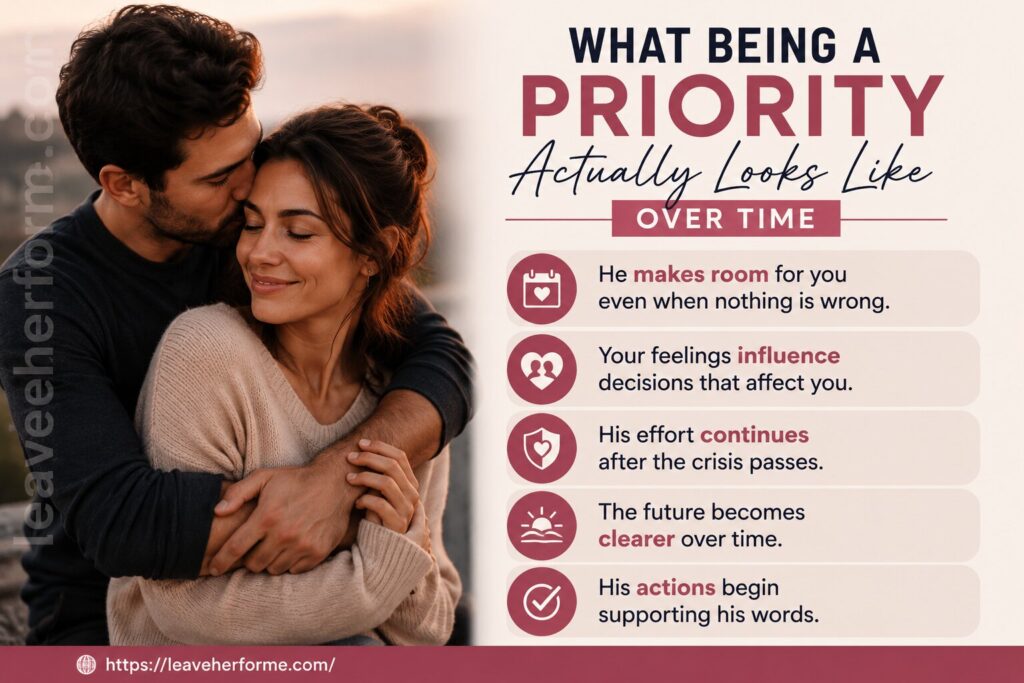
Once you stop measuring your importance by the most emotional moments in the relationship, a different picture begins to emerge. Priority is rarely proven by the night he could not stop calling you, the weekend when everything felt perfect, or the promise he made when he thought you were about to leave. Those moments can tell you something about his feelings, but the ordinary days often tell you much more about the place you actually hold in his life.
This is where patterns become more useful than promises.
A man who genuinely makes you a priority does not have to make you the centre of everything. Real life would make that impossible. There may be children who need him, work he cannot simply abandon, family responsibilities, financial obligations and circumstances that sometimes require his attention before yours.
The difference is that your importance does not disappear whenever those responsibilities return.
You remain someone whose feelings matter, whose needs are considered and whose presence influences how he thinks about the future. You are not important only inside the private emotional space the two of you share. Gradually, your importance begins showing itself in the way he handles the rest of his life.
That movement may be slow in a complicated relationship, particularly when another relationship or marriage is involved. Slow movement, however, is different from permanent suspension. One has direction. The other repeatedly asks you to survive on hope.
He Makes Room for You When Nothing Is Wrong
Think about when you receive the strongest version of him.
Is it mainly after something has gone wrong?
Perhaps his marriage becomes difficult and suddenly he wants to talk for hours. Work overwhelms him and he seeks your comfort. An argument leaves him feeling rejected, so he becomes unusually affectionate. When loneliness hits, your phone starts ringing.
Those moments can create tremendous closeness. The problem appears when the closeness repeatedly fades once his emotional crisis passes.
Being a priority usually looks different because the relationship has value beyond its usefulness during difficult moments. He wants to know how your day went even when his own day was perfectly fine. He makes plans because he wants to experience life with you, not simply because he needs somewhere emotionally comfortable to land. There is room for ordinary conversation, laughter, boredom, planning and the unremarkable details that make up real relationships.
This may sound less exciting than desperate midnight calls or emotional declarations, but ordinary presence is often more revealing. Anyone can become intensely focused on another person when frightened, lonely or distressed. Maintaining connection when there is no emotional emergency requires a different kind of investment.
Imagine that he has just had a good week. There has been no argument at home, no crisis at work and no reason for him to need reassurance. Does the relationship suddenly become quieter because the emotional function you normally provide is temporarily unnecessary? Or does he still reach towards you because your presence itself matters?
The second pattern tells you something important. You are not simply associated with relief. You are becoming part of the life he enjoys as well as the life he struggles through.
Your Needs Have Weight, Not Just Your Availability
One of the clearest differences between being needed and being prioritised appears when you need something.
Perhaps you have spent months understanding why his circumstances are difficult. You have accepted cancelled plans because of his children. You have listened when he was overwhelmed. You have given him patience when decisions took longer than expected.
Then eventually something matters deeply to you.
Maybe you need more consistency. Perhaps disappearing for several days has begun affecting you. You want more honesty about where the relationship is going. You may simply need him to be emotionally present during a difficult period in your own life.
Watch what happens when the emotional direction reverses.
A relationship becomes revealing when the person who usually gives understanding begins asking to receive some.
A man who sees you as a genuine priority may not always be able to give you exactly what you request. That is an important distinction. Prioritising somebody does not mean automatically agreeing with them, abandoning responsibilities or solving every problem they experience.
What matters is whether your need becomes real to him.
Does he listen carefully enough to understand why something is hurting you? If he cannot meet a particular request, does he explain honestly rather than dismissing it? When the same issue repeatedly causes pain, does he consider whether his own behaviour needs to change?
Compare that with a relationship where your needs are treated primarily as interruptions to an arrangement that works comfortably for him. Your questions become “pressure.” Wanting clarity becomes “overthinking.” Asking for consistency becomes evidence that you have changed. He may want all the emotional closeness you provide while becoming uncomfortable whenever that closeness creates expectations of him.
That imbalance matters.
If you are important mainly when you are understanding, available and undemanding, you may be valued deeply for the role you play without being given equal weight as a person with needs of your own.
He Considers How His Decisions Will Affect You
Priority becomes particularly visible before decisions are made.
Suppose something changes in his life. Perhaps work requires travel. Family circumstances shift. His living arrangements change. A decision involving his marriage has consequences for the relationship between the two of you.
Does he think about you only after everything has already been decided?
Or does the fact that you exist enter his thinking beforehand?
This does not mean you should have authority over every aspect of his life. Nobody should. It means that when decisions directly affect the relationship, your existence is not treated as an afterthought.
There is a significant emotional difference between hearing, “This is what I’ve decided, and I hope you understand,” and being told, “This is happening in my life. I know it affects us, so I want us to talk about what it means.”
Both situations may end with exactly the same practical outcome. The second one, however, recognises that there are two people carrying the consequences.
This is one reason priority is often quieter than romance. It appears in consideration. It is visible when someone remembers that their choices do not happen in isolation and begins treating your emotional reality as something worthy of thought before, rather than only after, the consequences arrive.
Over time, those small acts of consideration accumulate. They create the feeling that you are no longer standing outside his life waiting to discover what has happened. You have begun to occupy a legitimate place within the decisions that concern you.
You Begin Existing in His Future as More Than a Beautiful Idea
Future conversations can be intoxicating in complicated relationships.
Perhaps the two of you have imagined where you would live. You have talked about travelling together, waking up beside each other without having to hide, spending Christmas together, introducing families or simply experiencing an ordinary Sunday without watching the clock.
Those conversations can be genuine.
He may mean every word while imagining that future with you.
The problem is that imagination has very few consequences. A future discussed privately can remain perfect because reality has not yet been allowed to interfere with it.
Real movement usually becomes less romantic and more practical.
Questions begin appearing.
What would actually have to change?
Which obstacles can realistically be addressed?
What cannot change immediately?
What responsibilities will remain regardless of what happens romantically?
What conversations have been avoided because they are uncomfortable?
A man who is gradually prioritising the relationship does not necessarily have all those answers. What changes is his willingness to face the questions.
The future stops being something he uses only to reassure you during moments of uncertainty. It becomes something he is prepared to examine even when the examination is uncomfortable.
This is an important distinction because people sometimes mistake future language for future planning.
Future language says, “One day we will be together properly.”
Future planning eventually has to ask, “What stands between where we are now and that future, and what are we realistically doing about it?”
The second question may produce answers you do not like. Yet even difficult clarity is often more respectful than beautiful uncertainty that continues indefinitely.
If he says he will leave when the kids are older, the same distinction applies: a family milestone can make the future sound specific without showing how your position is changing now. Looking at what develops between today and that milestone can help you assess the promise more clearly.
He Protects the Relationship When Protecting It Is Inconvenient
Almost anyone can protect a relationship when doing so costs very little.
The deeper test appears when protecting the relationship becomes inconvenient.
Perhaps he knows that disappearing without explanation damages your trust. Changing that behaviour may require him to communicate when communication is awkward. Maybe certain promises have repeatedly been broken, and rebuilding credibility means accepting that reassurance alone will no longer be enough.
In other situations, protection may involve boundaries. If another person’s interference repeatedly destabilises the relationship, does he address it appropriately, or does he leave you to absorb the consequences while insisting there is nothing he can do?
Protection does not mean fighting everybody for you. It certainly does not mean creating unnecessary conflict or behaving recklessly to prove love.
Often, protecting a relationship is much quieter. It means refusing to repeatedly expose something valuable to avoidable harm.
For example, imagine that he knows a particular behaviour leaves you questioning the relationship for days. You have explained it clearly, and he agrees that the concern is reasonable. If the behaviour continues unchanged for another year, his apologies may remain emotionally sincere, but the pattern tells you that protecting the relationship has not become important enough to alter his behaviour.
That is why responsibility matters alongside affection.
Love may make somebody sorry after hurting you. Priority increasingly asks them to consider what could prevent the same wound from being created again.
Difficult Choices Do Not Always Mean Dramatic Choices
When women hear the phrase “he chooses you,” it can create an image of one enormous decision.
He leaves.
He moves.
He announces the relationship.
Everything changes.
Real relationships are often far less cinematic.
Difficult choices can be small but meaningful. He may need to become more honest about something he has avoided. Perhaps he must stop making promises he cannot realistically keep. He might need to establish clearer boundaries somewhere in his life or admit that a timeline he previously gave you was unrealistic.
Sometimes the difficult choice is simply telling you a truth he knows could disappoint you rather than giving you the answer most likely to keep you waiting.
That matters because honesty can itself be an act of priority.
A man who cares more about keeping access to you than respecting your ability to make informed decisions has a strong incentive to tell you whatever preserves the relationship.
Someone who respects your place in his life has another responsibility: allowing you to understand enough of reality to decide what is right for you.
That may mean admitting uncertainty.
It may involve saying, “I don’t know whether I can give you what you want,” instead of repeatedly promising that everything will change soon.
Painful honesty does not necessarily mean less love. Sometimes it shows more respect than reassurance that neither person knows will become reality.
This is why we should not measure priority only by whether he makes the decision you want. We should also look at whether he is willing to make honest decisions that acknowledge your right to know where you stand.
His Effort Does Not Appear Only When He Is Afraid of Losing You
There is a pattern many women recognise only after living through it several times.
You become tired.
You stop arguing.
Something inside you changes, and he notices.
Suddenly he becomes attentive again. The communication improves. He says the things you had been waiting to hear. Perhaps he makes plans, becomes affectionate or finally acknowledges problems he previously avoided discussing.
Your hope returns because this version of him looks exactly like the man you believed he could be.
Then the danger passes.
You are emotionally invested again. The relationship feels secure enough that you are unlikely to leave tomorrow.
Slowly, the old pattern returns.
This cycle can continue for years because the effort is real enough to restore hope but not consistent enough to change the structure of the relationship.
The important question is not whether he fights for you when he fears losing you. That reaction can reveal genuine attachment and even genuine love.
What matters is whether he also maintains the relationship when losing you no longer feels imminent.
Sustainable priority cannot depend entirely on crisis.
If the relationship receives its greatest care only when it is about to collapse, both people eventually become trapped in a painful rhythm where emotional security reduces effort and emotional danger restores it.
A healthier pattern develops when care continues after reassurance has returned.
Your Importance Survives When You Stop Being His Emotional Rescuer
Earlier, we looked at what can happen when you become his safe place. Now we need to examine the other side.
Suppose his life improves.
The marriage problems he complained about temporarily settle. Work becomes easier. His confidence returns. He is no longer lonely in quite the same way.
What happens to you?
This can be one of the most revealing periods in the relationship.
If your place was built primarily around emotional rescue, you may notice a dramatic reduction in closeness when there is less to rescue him from. Communication becomes lighter. The urgency disappears. He seems less emotionally dependent on you.
Then another problem arises and suddenly the depth returns.
That pattern does not automatically mean he feels nothing for you. What it suggests is that his emotional circumstances may strongly influence how much of the relationship he activates.
When you are genuinely becoming a priority, your importance is more stable.
He does not have to be suffering in order to want you near him.
You are not simply associated with fixing pain. You are also associated with companionship, enjoyment, curiosity, affection and the ordinary desire to share life with another person.
That is a much broader foundation for a relationship.
You Do Not Have to Keep Earning Your Place
One of the most exhausting relationship positions is feeling that your place depends on what you continuously provide.
You must remain understanding because his life is complicated. You should be patient because pressure might push him away. You need to stay attractive, interesting, supportive and emotionally available because somewhere in the background exists the fear that another woman already has advantages you do not.
Without noticing it, love begins feeling like an audition.
You become afraid that having needs will make you difficult. Setting boundaries feels dangerous because perhaps he will choose the easier relationship. Even normal disappointment may be suppressed because you do not want to become another source of pressure in a life he already describes as stressful.
That is not emotional security.
When someone genuinely makes room for you, you do not have to perform permanent usefulness to justify your existence in the relationship.
You can still disagree.
You can have bad days.
You can need reassurance too.
Your value is not erased because, for once, you are the person who needs support rather than the person providing it.
This does not mean unconditional tolerance of harmful behaviour. Both people remain responsible for how they treat each other.
It means the relationship has enough substance to survive the fact that you are a whole human being rather than a perfectly maintained emotional refuge.
His Words and His Life Begin Telling a More Similar Story
Perfect alignment between words and actions is unrealistic.
People make mistakes. They become afraid. Sometimes they genuinely intend to do something and later discover that circumstances are more difficult than expected.
The question is not whether every promise happens exactly when expected.
Look instead at the direction of the relationship.
If he tells you that you matter, does his behaviour increasingly reflect that importance? When he says he understands what has been hurting you, does anything change afterwards? If he asks for more time, can he explain what that time is for and what is actually happening during it?
Over months, his words and his life should begin telling a more similar story.
Not necessarily an identical story.
But a recognisable one.
When words repeatedly move towards one future while behaviour repeatedly protects another, the gap itself becomes information.
This is where our earlier cornerstone, How to Know If He Truly Loves You, becomes useful. That article goes much deeper into distinguishing love, attachment, attraction, comfort and commitment. If your deeper question is whether the feelings themselves are genuine, [How to Know If He Truly Loves You] is the natural next article to read.
Progress Matters More Than a Perfect Timeline
There is another trap I want this article to avoid.
We should not replace one simplistic rule with another.
Telling every woman, “If he hasn’t done X within three months, you’re not a priority,” would ignore the enormous differences between relationships.
A man with children, shared property, immigration issues, business interests or complicated financial arrangements may face practical realities that another man does not. Someone ending a twenty year marriage may move through a different process from someone leaving a relationship that lasted eighteen months.
Time alone therefore cannot tell you everything.
What matters more is what the time contains.
Six months filled with difficult conversations, increasing honesty, practical changes and clearer decisions is psychologically different from six months filled with the same promises, the same explanations and the same request for patience.
This is why movement matters.
A complicated path can still be a path.
If nothing changes except the date on the calendar, however, waiting itself may have become the relationship’s main activity.
Priority Is a Pattern, Not a Performance
A man can perform priority for a weekend.
He can create an unforgettable birthday. He may become intensely attentive after an argument, make a grand gesture or spend several days giving you everything you have been asking for.
None of those things is meaningless.
They simply need context.
The strongest evidence is not how impressive he can be when motivated. It is what remains after the emotional moment has passed.
Does consideration remain?
Does communication remain?
Does honesty remain?
Does responsibility remain?
Does some form of forward movement remain?
When those qualities become part of the ordinary relationship rather than appearing mainly during exceptional moments, you are looking at something much more substantial than romantic intensity.
Priority becomes less about proving that you matter and more about experiencing that importance consistently enough that you no longer have to investigate it every day.
That is an important psychological shift.
A woman who feels securely valued may still have questions about the future, especially in a complicated relationship. But she is less likely to spend every quiet period trying to calculate what she means to him because the relationship itself provides enough consistent information.
The Pattern Is More Honest Than the Promise
At this stage, you may still not know exactly what your relationship means.
That is all right.
The purpose of this section is not to hand you a verdict based on a checklist. It is to give you a more reliable way of looking at what is already happening.
Consider the relationship across months rather than moments. Notice whether care survives periods when he needs nothing from you. Pay attention to what happens when your needs require effort from him, whether difficult conversations eventually produce change, and whether the future becomes gradually clearer rather than merely being described more beautifully.
Those questions do not require you to judge him. They simply help you see the relationship more completely.
And once you begin seeing the pattern, another possibility becomes easier to understand: you may be genuinely important to him and still not occupy the priority you hoped that importance would eventually create.
That is where this article needs to go next.
Because sometimes the hardest relationship to understand is not one where a man feels nothing.
It is the relationship where the feelings may be real, but his life continues choosing something else.
That distinction takes us directly into Stage Four.
When You Are Important to Him but Still Not His Priority
This is where the conversation becomes harder, because there is a comforting answer I could give you that would make everything seem much simpler: if a man truly loves you, he will always put you first.
Real relationships do not consistently work that way.
A person can have genuine feelings for someone and still make decisions that protect other parts of his life. Love exists inside a human being alongside responsibility, fear, guilt, attachment, habit, identity, financial security and concern about consequences. When children, a marriage, shared property, family expectations or years of history are involved, those forces do not disappear simply because another relationship becomes emotionally important.
That does not mean you should use his complicated circumstances to explain away everything that hurts you. It means we need to understand the difference between having an important place in his heart and having enough priority to influence the direction of his life.
You may therefore be facing a reality that is much harder than discovering that he feels nothing. He may care about you deeply. He may genuinely fear losing you. What remains uncertain is whether those feelings have enough influence over his choices to create the kind of relationship you are waiting for.
Love and Priority Answer Two Different Questions
Love asks what someone feels towards you. Priority asks what weight your relationship carries when feelings have to compete with the rest of life.
Those questions overlap, but they are not interchangeable.
Imagine a man who genuinely loves his children. Their wellbeing may influence almost every major decision he makes. At the same time, he may love a woman outside his marriage and feel emotionally closer to her than he has felt to anyone in years. If leaving immediately would mean moving away from his children, changing their financial circumstances or disrupting their daily lives, his hesitation does not automatically prove that his feelings for the other woman are false.
The same principle can apply to responsibilities that have accumulated over many years. A marriage is not only a romantic relationship. Depending on the couple, it may also be a home, financial arrangement, parenting structure, family identity, friendship, social network and collection of obligations.
This is why asking, “If he loves me, why doesn’t he simply choose me?” can sometimes produce an incomplete answer.
He may not be choosing between two feelings alone.
He may believe he is choosing between two entire versions of his life.
Understanding that distinction can help you stop measuring your worth against every responsibility he has. If he prioritises a child’s wellbeing in a particular decision, for example, that is not necessarily evidence that you are less lovable or that another woman has somehow defeated you.
At the same time, complexity cannot become an unlimited explanation.
There eventually has to be room for another question: within all those competing responsibilities, what place is he actually making for you?
Children Can Change the Meaning of a Man’s Hesitation
Children are one of the strongest reasons complicated relationships cannot be understood through simple slogans.
A father may fear that leaving his marriage will damage his relationship with his children. He may worry about custody, where they will live, whether he will see them every day, how they will react emotionally, or whether they will blame him for changing the family.
Some of those fears may be realistic. Others may be exaggerated by guilt or uncertainty. Usually, an outsider cannot know which is which from one conversation.
What matters for you is understanding that a man can genuinely love another woman while experiencing powerful resistance to any decision he believes could hurt his children.
That creates a difficult emotional position for everyone involved.
You may understand why his children matter and still feel hurt that your relationship remains hidden or uncertain. Those feelings are not mutually exclusive. Compassion for his responsibilities does not require pretending that waiting has no emotional cost to you.
The more useful question becomes whether children are a responsibility he is genuinely trying to navigate or an explanation that permanently prevents every difficult conversation.
A responsible father might move cautiously. Caution makes sense when decisions affect children. Yet genuine caution can still involve honest conversations, realistic planning and acknowledgement of what the uncertainty is doing to you.
If the explanation is always “the children” but nothing can ever be discussed beyond those two words, you are not being given enough information to understand whether there is a difficult process taking place or whether the explanation has become a permanent shield against decision making.
A Marriage Can Continue for Reasons That Have Little to Do With Romantic Happiness
From outside a marriage, staying can look like the clearest possible choice.
You see him returning home.
He still attends family occasions.
Perhaps he takes holidays with his wife, handles responsibilities with her and continues participating in the marriage publicly.
Naturally, you may think: If he stays there, that must be where his heart really is.
Sometimes it is.
But staying does not tell us everything about why someone stays.
Long relationships accumulate structures that are difficult to separate. There may be mortgages, businesses, retirement plans, extended families, religious expectations, friendships and routines that have existed for decades. A person can become deeply dissatisfied with the romantic part of a marriage while remaining attached to the life surrounding it.
Habit also deserves more respect than people usually give it. Familiarity can feel safe even when it no longer feels fulfilling. Human beings frequently remain in situations they complain about because the known difficulty feels less frightening than an unknown future.
None of this proves that a particular man is secretly unhappy. You should be especially cautious when the only evidence about his marriage comes from what he tells you. You cannot see every private conversation, every affectionate moment, every conflict or every reason the two of them continue choosing their marriage.
What you can observe is how he handles your relationship.
If you want to understand the wider reasons someone may remain in a marriage despite describing himself as unhappy, our article Why Married Men Stay in Unhappy Marriages explores that question in much greater depth.
Sometimes He Is Protecting an Identity, Not Only a Relationship
Leaving a long term relationship can threaten more than companionship.
It can threaten identity.
A man may have spent twenty years thinking of himself as a husband. Perhaps being a provider is central to how he understands himself. His family may see him as dependable, traditional or responsible. Friends know him as part of a couple. His children may see the family structure as something permanent.
Now imagine what happens internally when his feelings begin pulling him towards a life that conflicts with that identity.
He is not only asking, “Which woman do I want?”
He may also be asking, “What kind of man does this make me?”
Will his children respect him?
What will his parents think?
Will friends blame him?
Does leaving mean admitting that a marriage he spent years protecting has failed?
Can he live with becoming the person everyone believes caused the family to break apart?
Those questions can create genuine paralysis.
For the woman waiting, however, understanding his identity conflict can become dangerous if understanding slowly turns into endless self sacrifice. You can recognise why a decision frightens him without agreeing that fear should determine your life indefinitely.
This is one of the balances we need throughout this article: understanding explains behaviour; it does not automatically make every behaviour acceptable.
Fear Can Make Someone Protect the Life He Says He Wants to Change
People often imagine fear as something obvious.
A frightened person should look frightened.
Relationship fear is not always that visible. Sometimes it looks like delay, overthinking, contradictory behaviour or an endless search for the “right time.”
A man may genuinely imagine another future with you while repeatedly choosing the security of the life he already understands.
That is not necessarily because the existing life makes him happier.
Certainty itself has value.
He knows where he sleeps tonight. He knows his financial obligations. He understands the family routine. He knows what people expect from him. Even an unhappy arrangement can offer predictability.
A future with you may represent love, possibility and emotional fulfilment, but it can also represent uncertainty. Where will he live? How will money work? What happens with his children? How will the relationship between the two of you change once secrecy and stolen time are replaced by ordinary life?
That last question matters more than people realise.
A relationship can feel extraordinary while protected from everyday responsibilities. Moving from an affair or hidden relationship into an ordinary partnership means discovering whether the connection survives bills, routines, disagreements, tired mornings and all the unromantic parts of sharing a life.
He may want that future and still fear discovering whether the imagined version matches reality.
Again, fear explains something. It does not answer everything.
If fear has been controlling the same decision for years, the question eventually changes from “Is he afraid?” to “Is he willing to do anything about the fear that keeps determining our future?”
Stability Can Compete With Happiness More Strongly Than People Expect
There is a reason people remain in jobs they dislike, cities they have outgrown and relationships they describe as unhappy.
Change has a cost.
In relationships, that cost can be enormous.
Suppose leaving a marriage means selling a home, dividing finances, changing children’s routines, explaining the decision to relatives, losing mutual friendships and rebuilding everyday life from the beginning.
Now compare that with staying.
Staying may feel emotionally unsatisfying, but many of the practical structures remain intact.
That can create a strange equation in which someone chooses the life that feels emotionally poorer because it feels practically safer.
From your side, this can be extremely painful because you may interpret his willingness to remain there as evidence that you are not valuable enough to justify the risk.
Try not to turn his tolerance for stability into a measurement of your worth.
His willingness or unwillingness to change his life tells you about his readiness, fears, priorities and circumstances. It does not provide an objective measurement of how lovable you are.
But there is another side to this.
You should not have to prove your worth by waiting indefinitely for someone else to become ready.
Both truths can exist at the same time.
He May Be Trying to Avoid Losing Either Woman
There is another possibility that deserves more honesty.
Sometimes indecision is not only about children, money or responsibility.
Sometimes he does not want to lose either relationship.
With one woman, he may have history, family, stability and familiarity. With the other, he may experience emotional intimacy, attraction, understanding, excitement or a version of himself that feels more alive.
Choosing one future could mean grieving the other.
So he delays.
From inside his experience, delay may feel like avoiding irreversible harm. From your side, the same delay can feel like being kept in emotional suspension.
This is where judging the situation entirely through his feelings becomes insufficient.
He may be genuinely conflicted.
He may genuinely love two women in different ways.
But his inability to choose does not prevent his indecision from affecting both of them.
If this part sounds particularly close to your situation, Can Someone Love Two Women at the Same Time? explores exactly how romantic love, attachment, loyalty, responsibility and competing emotional bonds can coexist without automatically producing a clear decision.
The important lesson for this article is slightly different.
Even when his conflict is genuine, you still have to live inside the consequences of that conflict.
Understanding Him Can Quietly Become a Reason You Stop Listening to Yourself
This is where empathy can become complicated.
Perhaps you know his story extremely well.
You understand his childhood.
You know why conflict frightens him.
You understand what happened in his previous relationships. You know how much his children mean to him, how his parents raised him, why financial instability terrifies him and why disappointing people creates enormous guilt.
Because you understand all of this, every disappointment arrives with an explanation.
He cancels, but you know why.
He delays, but you understand the pressure.
He becomes distant, but you know he is overwhelmed.
He avoids a difficult conversation, but you understand that confrontation is hard for him.
Any one of those explanations may be completely legitimate.
The problem appears when understanding him becomes the reason your own experience is never allowed to matter equally.
You can become so skilled at explaining his behaviour that you stop asking what living with that behaviour is doing to you.
There is a subtle difference between compassion and self abandonment.
Compassion says, “I understand why this is difficult for you.”
Self abandonment begins when the sentence quietly becomes, “Because this is difficult for you, I am no longer allowed to have limits.”
Those are not the same thing.
You can understand his fear and still need clarity. You can respect his responsibilities while acknowledging that uncertainty is exhausting you. You can believe his feelings are genuine and still decide that genuine feelings alone are not creating enough security for you.
Maturity in complicated love requires room for both people’s realities.
Being Important Is Not a Consolation Prize
There is something else I do not want you to misunderstand.
If you discover that you are emotionally important to him but not currently his priority, that does not mean everything between you was meaningless.
Relationships do not become worthless simply because they fail to become what one person hoped.
The conversations still happened.
The intimacy was still experienced.
The affection may have been genuine.
What changes is your understanding of what those experiences can reasonably promise about the future.
This distinction matters because disappointment can make people rewrite their entire history.
A woman who once believed a man loved her may discover that he is unwilling to change his life and conclude, “Then none of it was real.”
Sometimes that conclusion is accurate. People do deceive.
But sometimes something more painful is true: the feelings were real, yet they were not powerful enough, mature enough or prioritised enough to create the future she expected.
That reality is harder because there is no simple villain.
There may only be two people whose feelings and capacities did not lead to the same destination.
Recognising that possibility allows you to assess the relationship without needing to turn him into a monster or yourself into a fool.
The Real Question Becomes Whether Anything Is Moving
Once you accept that someone can love you without immediately making you his highest priority, the next danger is obvious.
How long can that explanation continue?
This is where movement becomes essential.
You are not looking for dramatic proof every week. You are looking for evidence that the relationship is developing rather than merely repeating itself.
Perhaps communication becomes more honest. Maybe previously avoided decisions are finally being discussed. Boundaries change. A practical obstacle begins being addressed. He stops giving timelines he cannot guarantee and starts having more realistic conversations about what is actually possible.
Movement can be imperfect.
It can be slower than either person wants.
Sometimes progress even includes setbacks.
What matters is whether the overall direction of the relationship changes as time passes.
Compare that with another pattern: every few months the same crisis happens, the same conversation follows, the same explanation is offered and the same promise restores hope. Nothing fundamental changes, but the emotional intensity of each conversation makes it feel as though something has.
That repetition can have another effect that is easy to miss: every new period of warmth may strengthen your attachment even when the relationship itself remains almost unchanged. Why mixed signals can make you more emotionally attached explains why repeated uncertainty and reconnection can make a relationship feel increasingly powerful without necessarily giving it greater direction.
That is not necessarily progress.
Sometimes it is repetition wearing the language of progress.
If you are struggling to decide whether his hesitation reflects genuine emotional conflict or a pattern of delay that keeps resetting itself, How to Tell If He’s Confused or Simply Keeping You Waiting can help you examine the difference.
The longer a relationship continues, the more important that distinction becomes.
There Is a Difference Between Giving Someone Time and Giving Uncertainty Your Life
Patience can be loving.
Some decisions genuinely deserve time.
A person ending a marriage, protecting children, restructuring finances or confronting years of emotional history may not be able to move at the speed another person wishes.
But patience needs context.
If you are giving somebody time, it helps to understand what the time is allowing to happen.
Is he thinking?
Planning?
Having difficult conversations?
Resolving practical problems?
Learning what he actually wants?
Or is time simply passing because no decision feels easier than making one?
That distinction changes everything.
You can give someone six months and discover that those six months contained enormous emotional and practical movement. You can also give someone five years and realise that every year contained essentially the same conversation.
This is why a calendar alone cannot tell you whether waiting makes sense.
The content of the waiting matters.
There is also a personal question that becomes harder to avoid as time passes: what is waiting requiring from you?
Are you postponing parts of your own life?
Have you become afraid to make plans because everything depends on what he eventually decides?
Do you turn away other possibilities because you feel emotionally committed to a future that still has no shape?
Those questions are not ultimatums.
They are reminders that his timeline is not the only timeline involved.
You Do Not Have to Deny His Love to Take Your Own Needs Seriously
This may be one of the most important distinctions in this entire article.
Women sometimes believe they need to prove that a man does not love them before they are entitled to question the relationship.
You do not.
You can believe that he loves you and still acknowledge that the relationship is hurting you.
You can understand why he is afraid and still recognise that his fear has consequences for your life.
You may accept that his children should remain a major priority without accepting that you should permanently have no meaningful place at all.
You can even believe that he is doing the best he currently knows how to do and decide that what he can currently offer is not enough for the future you want.
None of those conclusions requires hatred.
They require clarity.
The question is no longer simply whether his heart contains feelings for you. The deeper question is whether the relationship those feelings are producing gives you enough honesty, security, reciprocity and direction to continue building your own future around it.
That brings us closer to something even more uncomfortable.
Because sometimes a woman knows she matters.
She has seen enough affection to believe the connection is genuine. She understands the obstacles. She has tried to be patient.
Yet whenever she looks at the actual relationship, she still finds herself giving considerably more emotional support than she receives and waiting for movement that never quite arrives.
At that point, the question begins changing again.
It is no longer only:
“Why am I not his priority yet?”
The next question becomes:
“What is keeping this relationship going if priority and commitment are still missing?”
That is where we need to look more closely at emotional dependence, because sometimes the strength keeping two people connected is not only love. It is also what they have come to rely on each other to provide.
And that takes us naturally into Stage Five.
When Emotional Dependence Keeps the Relationship Going
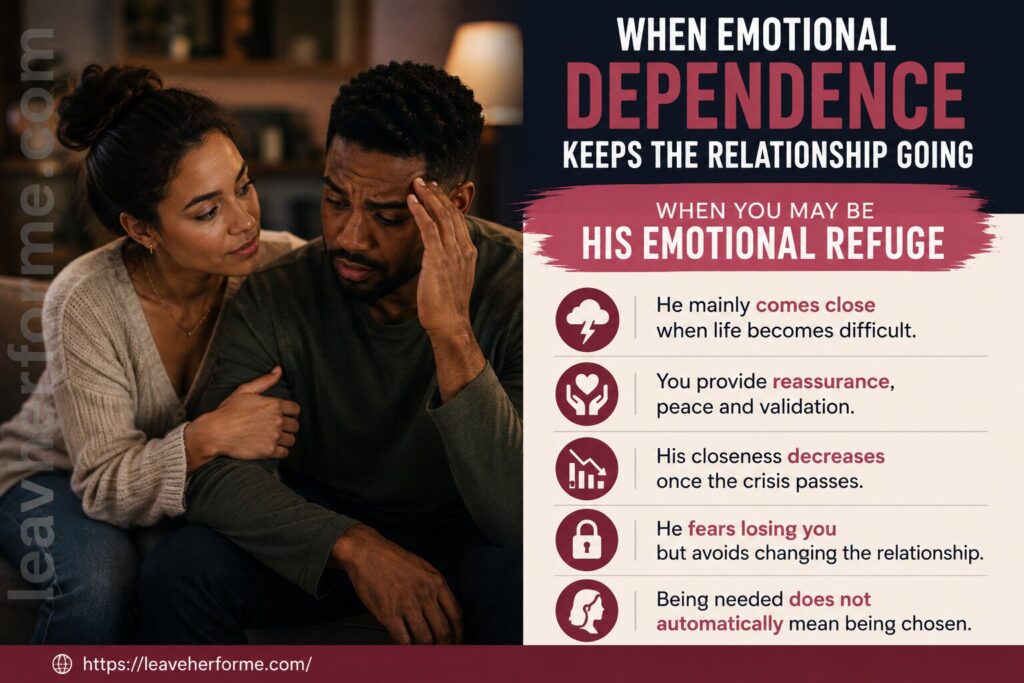
By this stage, we have established something important: a man can care about you deeply without yet making you a genuine priority. There may be children, marriage, fear, financial realities, identity or responsibilities complicating his choices. Those explanations can be real.
But they do not explain every relationship.
Sometimes the relationship continues with such intensity because each person has begun receiving something emotionally powerful from the other. For him, you may have become the person who makes life feel easier, warmer, more exciting or more bearable. For you, his repeated return may provide reassurance that the connection must eventually become something more.
This can create a bond that feels almost impossible to leave.
The difficult part is that emotional dependence does not necessarily replace love. It can grow inside love. A man may genuinely love you while also depending heavily on what your presence does for him emotionally.
That is why simply asking whether his feelings are real will not take us far enough.
We need to understand what keeps drawing him back, what happens after he returns, and whether the relationship is developing beyond the emotional needs it satisfies.
The deeper question becomes: does he only need what you give him, or is he building something with you?
Sometimes He Returns Because You Are Where He Feels Understood
Feeling understood can become enormously powerful, particularly for someone who feels misunderstood elsewhere.
Perhaps he tells you that talking to his wife always becomes an argument. At home, he may feel criticised, dismissed or unable to express certain parts of himself without consequences. Friends might know the social version of him but not the private one. Family may expect him to remain strong and responsible rather than admit that he is struggling.
Then he talks to you.
You listen differently.
Instead of immediately correcting him, perhaps you try to understand what he means. You notice what sits beneath his anger. When he says he is tired, you recognise that he may mean emotionally exhausted rather than physically tired. He does not have to explain every detail because you already know much of the history.
Over time, being understood by you can become something he does not want to lose.
This may explain why he repeatedly returns even after arguments, periods of distance or attempts to end the relationship. He is not necessarily returning only because he wants romance or sex. He may be returning because losing you would also mean losing one of the few places where he feels psychologically known.
That can be genuine intimacy.
However, intimacy becomes complicated when understanding flows mainly in one direction.
If he can spend two hours explaining why his life is difficult but becomes impatient when you explain what the relationship is doing to you, the two of you may not be sharing emotional understanding equally. You may be providing a space in which he feels understood, without receiving the same depth of understanding yourself.
The distinction is subtle but important. A relationship should eventually become more than one person’s sanctuary.
Validation Can Make Your Presence Difficult for Him to Give Up
There is another emotional need that is rarely discussed openly: validation.
Most people want to feel desirable, respected and significant. We want to believe that somebody sees something valuable in us.
A complicated relationship can provide enormous amounts of that feeling.
Perhaps you admire qualities in him that have gone unnoticed elsewhere. You remind him that he is attractive. You believe in his ambitions. When he doubts himself, you tell him what you see in him. Around you, he may feel interesting again, wanted again, capable again.
That experience can become intoxicating, especially if another part of his life leaves him feeling inadequate.
Imagine a man who goes home feeling criticised for everything he has failed to do. Then he speaks to a woman who looks at him as though he is extraordinary. The emotional contrast can be enormous.
This does not mean your admiration is false or that he deliberately sought you out to repair his ego. You may genuinely respect him, and he may genuinely love being seen through your eyes.
The concern begins when his need for validation becomes one of the strongest engines keeping the relationship alive.
What happens when you disagree with him?
What happens when you stop reassuring him?
Can he tolerate you seeing his faults without becoming distant or defensive?
Does he still value your presence when you are no longer reflecting back the version of himself he most wants to believe?
A mature relationship gradually makes room for a more complete view of each other. Admiration can remain, but neither person needs to perform perfection in order to keep receiving love.
If his strongest attachment to you depends on how you make him feel about himself, that is worth distinguishing from the deeper question of what he is willing to create with you.
Peace Can Become Something He Comes to You to Borrow
Sometimes what you provide is not excitement at all.
It is peace.
He may associate his everyday life with conflict, responsibility and noise. Perhaps there are arguments at home, pressure from work, demands from children, financial concerns or family problems that never seem to end.
Then he sees you.
For a few hours, nobody needs anything from him except his presence. You laugh. You eat together. Perhaps you lie beside each other and talk about ordinary things. His body relaxes. The tension disappears from his face.
He tells you, “This is the only place I feel at peace.”
It is difficult to hear something like that without feeling that the relationship must represent his real home.
Emotionally, perhaps part of it does.
But there is an uncomfortable possibility worth understanding.
If you repeatedly provide relief from the problems he refuses or feels unable to confront, the relationship can unintentionally help him continue living with those problems.
He becomes overwhelmed. He comes to you. You help him feel calmer. Once emotionally restored, he becomes more capable of returning to the same life.
Nothing fundamental has changed.
Then pressure builds again and the cycle repeats.
In that pattern, your relationship can become both deeply meaningful and strangely connected to the continuation of the circumstances you hoped it would eventually replace.
That is why being someone’s peace should not automatically be confused with being the future they are preparing to build.
The real question is whether the peace he experiences with you eventually inspires him to create greater honesty and stability in his life, or whether he mainly borrows peace from you whenever the rest of his life becomes difficult.
Sexual Connection Can Deepen a Bond Without Deciding Its Future
Sexual intimacy deserves a more mature discussion than either extreme usually receives.
One extreme says that if a man keeps returning for sex, he is obviously using the woman. The other assumes that powerful sexual chemistry proves an extraordinary emotional destiny.
Neither interpretation is reliable on its own.
Sex can create closeness. It can reinforce attachment, vulnerability and affection. For some couples, physical intimacy becomes one of the places where emotions that are difficult to express verbally are communicated most strongly.
In a hidden or complicated relationship, sexual intimacy may feel even more powerful because time together is limited. Anticipation builds before you meet. Privacy is precious. Physical closeness may temporarily erase every external complication.
During those moments, there is no wife, no waiting, no difficult future and no uncertainty. There are simply two people together.
Then the moment ends.
That contrast matters.
If sexual closeness repeatedly produces emotional certainty while everyday reality produces uncertainty, it becomes easy to use the intensity of intimacy as evidence for a future that has not yet been built.
Again, this does not make the intimacy meaningless.
The more useful question is what surrounds it.
Does he want to know you outside sexual moments? Can you spend time together without physical intimacy and still feel connected? Is he interested in your fears, ambitions and ordinary life? Does he remain emotionally present after intimacy rather than disappearing until desire brings him back?
Most importantly, does the relationship develop in areas that require more than chemistry?
Sex can strengthen an existing relationship. It cannot make decisions on behalf of the people inside it.
Excitement Can Make an Ordinary Life Feel New Again
Not every emotional escape is an escape from pain.
Sometimes it is an escape from sameness.
Long relationships inevitably become familiar. There are routines, responsibilities and predictable conversations. Life may not be terrible at all. It may simply have lost some of its novelty.
Then someone new enters.
Suddenly there are messages to anticipate. There is somebody discovering his stories for the first time. A compliment feels different because it comes from someone who has not heard the same jokes for fifteen years. Meeting requires planning. Time together feels valuable because it is limited.
The man may begin feeling younger, more attractive or more alive.
You may experience exactly the same thing.
That excitement can be real without telling either of you what the relationship would look like after novelty becomes familiarity.
This is particularly important when somebody compares the intensity of a newer relationship with a marriage that has existed for many years.
The comparison is rarely equal.
One relationship may currently carry mortgages, school runs, household chores, ageing parents and years of unresolved history. The other may contain stolen afternoons, emotional conversations, anticipation and carefully protected time.
That does not prove the newer love is superficial. Many lasting relationships begin with exactly that excitement.
It simply means that intensity cannot be used as the only measure of compatibility or commitment.
The real test begins when the relationship is asked to become more ordinary. Can it survive responsibility? Can both people disagree without the connection collapsing? Can affection remain when there is no secrecy or anticipation creating extra intensity?
A future requires more than feeling alive together. Eventually, it requires learning how to live together, emotionally if not physically.
Admiration Can Become a Refuge From Who He Feels He Has Become
There is another reason a man may keep returning that has less to do with what he thinks about you and more to do with who he feels like when he is with you.
Perhaps his everyday identity is dominated by responsibility.
He is somebody’s husband, somebody’s father, an employee and a provider. The person expected to solve problems. Around you, perhaps he becomes something else.
He feels desirable, Interesting, spontaneous, masculine, wanted and seen.
You may remind him of a version of himself that became buried beneath routine and responsibility.
This can make the relationship feel almost transformational.
He may say, “You brought me back to life,” and genuinely mean it.
That is a powerful thing to hear. It can make you believe that because you awaken something important inside him, he will eventually choose the life associated with that version of himself.
Sometimes people do make major changes after discovering that they have been living in ways that no longer fit them.
Sometimes they do not.
A person can enjoy visiting a different version of himself without being prepared to reorganise his entire identity around it.
That is why we should distinguish between being the woman who makes him feel different and becoming the partner with whom he is prepared to live differently.
The first can happen very quickly.
The second requires choices.
Escape From Conflict Can Make You Feel Like the Better Relationship
If his marriage or existing relationship is full of conflict, the contrast between the two relationships can become especially powerful.
He argues there.
He relaxes with you.
She criticises him.
You understand him.
Home feels heavy.
You feel light.
From inside that contrast, the conclusion can seem obvious: Surely he will eventually choose the relationship where he is happier.
But comparisons like this can hide an important difference.
You may be experiencing different versions of the same man because the two relationships currently require different things from him.
His wife may be discussing school fees, unpaid bills, household responsibilities, parenting decisions or promises he has failed to keep. Those conversations naturally create more friction than a relationship that is still largely protected from shared responsibilities.
That does not mean her criticism is automatically justified, nor does it mean your peace with him is somehow fake.
It means you should be careful about comparing relationships without considering the environments in which they exist.
If you eventually became his full time partner, ordinary responsibilities would enter your relationship too.
Would the communication between you remain respectful when money became stressful?
Would he still feel understood when you were the person asking him to fulfil an obligation?
Could you disagree without becoming another person he needs to escape from?
Those questions are not intended to frighten you. They help separate compatibility from contrast.
Sometimes a relationship feels unusually peaceful partly because it has not yet been required to carry the weight another relationship already carries.
The Return Itself Can Become Proof in Your Mind
Repeated return has enormous psychological power.
You may have ended the relationship several times.
Perhaps you blocked him.
You promised yourself you were finished.
Weeks later, somehow, he returned.
Every return can strengthen a particular belief: There must be something between us that neither of us can escape.
Perhaps there is.
But repeated return can happen for different reasons.
He may return because he loves you. He may miss the emotional intimacy. Perhaps he misses the sexual connection, the validation, the peace or the version of himself he experiences around you.
Most likely, several of those things are mixed together.
The mistake would be treating the fact that he returns as complete evidence of why he returns.
Return proves that separation has not ended the bond.
It does not automatically tell you what he intends to do with that bond.
This distinction becomes especially important when the pattern has repeated for years. If every separation ends with reunion but every reunion returns to the same unresolved structure, the relationship may have become extremely good at restarting without developing.
That can feel like destiny because neither person manages to stay away.
Sometimes, however, it is a powerful attachment repeatedly restoring itself without resolving the reasons it keeps breaking down.
The future is revealed less by whether he comes back than by what changes after he does.
If this cycle of distance, return, reassurance and renewed uncertainty has become familiar, Why He Keeps Coming Back but Won’t Commit explores why repeated return can coexist with continued avoidance of commitment.
You May Also Be Emotionally Dependent on What His Return Gives You
It would be unfair to examine only his emotional dependence.
These relationships can create dependence on both sides.
When he returns, you receive something too.
Relief.
Confirmation.
Hope.
The fear that you never mattered disappears for a while. His return seems to prove that the relationship was real after all.
Perhaps you had spent weeks questioning yourself. Then his name appears on your phone, and the uncertainty suddenly becomes easier to bear.
That relief can make it difficult to ask whether anything has actually changed.
You are simply grateful that he is back.
This is one reason repeated separation and reunion can become so emotionally powerful. The pain of distance increases the emotional reward of reconnection.
Over time, both people can become attached not only to each other but also to the cycle itself.
Distance creates longing. Reunion creates relief. Relief restores hope. Hope makes the unresolved situation tolerable again.
Eventually, another disappointment begins the cycle from the beginning.
Recognising this pattern does not mean your love is fake.
It means the relationship may contain psychological forces that make it harder to evaluate clearly while you are inside it.
The Most Important Question Is What Happens After His Need Is Met
If you want to understand whether emotional dependence is carrying too much of the relationship, pay attention to what happens after he receives what he came looking for.
After you comfort him, does he remain interested in your emotional world?
Once the argument at home settles, does he still maintain the same closeness?
After sexual intimacy, does connection continue?
When reassurance restores his confidence that you are not leaving, does the effort remain?
Once you have helped him feel understood, does he become equally willing to understand what you need?
You are looking for reciprocity, not perfection.
Healthy relationships naturally contain periods when one person needs more than the other. Someone can go through bereavement, work pressure, family difficulties or emotional exhaustion and temporarily require considerable support.
The problem is not that he sometimes needs you more.
The problem appears when needing you becomes the main structure of the relationship.
If his emotional need consistently creates closeness while your emotional needs consistently create distance, that imbalance deserves attention.
Need Can Keep a Relationship Alive Without Moving It Forward
This may be one of the hardest truths in the article.
A relationship can remain emotionally alive for years without becoming structurally different.
There can still be affection.
Sex.
Jealousy.
Arguments.
Reconciliation.
Deep conversations.
Promises.
Longing.
None of those necessarily means the relationship is progressing.
They mean the relationship is active.
Progress is different.
Progress changes something.
Perhaps trust improves because behaviour changes. Greater honesty replaces secrecy where possible. Difficult decisions that were previously avoided begin being addressed. The relationship gains a clearer direction, even if circumstances mean that direction takes time.
Emotional dependence can maintain enormous intensity without producing any of those changes.
That is why a relationship can feel incredibly powerful while remaining almost exactly where it started.
The heart experiences movement because emotions are constantly moving.
The relationship itself may not be.
Once you recognise that distinction, you can begin asking a much more useful question than “Why does he always come back?”
You can ask:
“What becomes different because he came back?”
That question is harder to answer with another romantic promise.
Love and Emotional Need Can Exist Together
At this point, I want to protect the nuance we have been building.
Do not turn emotional dependence into a verdict that the relationship is false.
Human beings naturally become emotionally dependent on people they love. Partners comfort each other. We seek reassurance. We miss each other. We sometimes need another person’s perspective to regain balance.
Dependence becomes concerning when the relationship is organised primarily around one person’s emotional needs while the other person’s needs, boundaries and future remain secondary.
A man can therefore love you and rely heavily on you.
If you want to understand how emotional reliance develops and how it can differ from commitment, Signs He Is Emotionally Attached to Another Woman explores the behaviours and patterns that often reveal a deeper attachment.
The more revealing issue is what love does alongside that reliance.
Does affection gradually become responsibility?
Does emotional intimacy become reciprocity?
Does needing you develop into considering you?
Does fear of losing you become a willingness to address the things that repeatedly make you want to leave?
Does talking about a future eventually create movement towards one?
Those transitions matter because they show that the relationship is becoming more than a source of emotional supply.
It is becoming something both people are responsible for building.
When the Relationship Gives Him Everything Except a Reason to Change It
There is a difficult possibility that deserves careful consideration.
Imagine that he receives much of what he emotionally needs from you while maintaining the rest of his existing life.
He has stability there.
He has emotional understanding here.
Perhaps family and social identity remain intact there.
Romance and excitement exist here.
When life becomes difficult, he has somewhere to escape. When the possibility of losing you appears, he can offer enough reassurance to restore the relationship.
From his emotional perspective, the arrangement may be painful and complicated, but it may also allow him to postpone the losses that a clear decision would create.
This does not mean every man consciously designs such an arrangement.
Often, nobody sits down and decides, “I want both worlds, so I will keep everything exactly like this.”
Human beings can drift into arrangements that protect them from difficult choices simply because each individual decision feels easier than confronting the whole situation.
One more month feels manageable.
One more explanation feels reasonable.
One more promise restores peace.
Years can be built from decisions that each felt temporary when they were made.
That is why understanding his intentions is not enough. You also need to look at the outcome his behaviour repeatedly creates.
Even good intentions can maintain a situation that works far better for one person than the other.
When Love Begins Looking Too Much Like Convenience
There is a point where another question naturally appears.
Perhaps he genuinely cares about you. Perhaps the emotional bond is undeniable. Yet the relationship consistently provides him with understanding, affection, sexual intimacy, reassurance, excitement and emotional refuge while requiring remarkably little change from the rest of his life.
At that point, asking whether love exists may no longer be enough.
You may need to ask whether convenience has become mixed into the love.
Convenience does not necessarily mean he feels nothing.
That distinction is important.
A relationship can contain genuine affection and still become convenient for one person. He may not be staying because of convenience alone, but convenience can reduce the pressure to confront difficult choices.
Likewise, you may remain because hope has become emotionally easier than accepting the possibility that the future you imagined may not arrive.
This deserves its own deeper conversation because love and convenience can become so intertwined that neither person recognises where one ends and the other begins.
That is exactly why our next supporting article, Love or Convenience: How to Recognize the Difference, will examine that question separately rather than forcing the entire subject into this section.
Love or Convenience: How to Recognize the
When You Know You Matter but Something Still Isn’t Moving
Perhaps this is the part of your story that has been hardest to explain to other people.
You do not feel as though the relationship is meaningless. Too much has happened between you for that explanation to fit. You have seen his vulnerability, felt his attachment and experienced moments when his feelings seemed impossible to doubt.
Yet when you step away from those moments and look at the relationship over time, something remains painfully unchanged.
You may have communicated.
You have tried patience.
Perhaps you stopped pressuring him because you wanted any decision he made to be genuine rather than forced. You gave him space when he asked for it and tried to understand responsibilities that existed before you entered his life.
Still, you find yourself returning to essentially the same question.
If I matter this much, why is nothing moving?
There is no responsible answer to that question based on one behaviour.
For one man, fear may be stronger than readiness. Another may genuinely be navigating difficult responsibilities. Someone else may be emotionally dependent on a relationship he has no serious intention of building into something more. In another situation, several of those realities may exist together.
This is precisely why generic statements such as “If he wanted to, he would” can sometimes be useful as reminders about action but inadequate as complete explanations of complicated relationships.
Human beings are capable of wanting something and still avoiding the consequences required to pursue it.
The question is not simply whether he wants you.
It is what he is capable and willing to do with that wanting.
For now, you do not need to turn that question into an immediate decision. What matters is recognising that repeatedly being needed is not the same thing as watching a relationship develop.
Once that distinction becomes clear, the focus can finally move away from everything happening inside him and towards something we have not examined closely enough yet:
What is this relationship creating inside your life?
Because even if his feelings are genuine, even if his dependence is understandable and even if his circumstances are complicated, you are still the person living with the consequences.
That is where we go next.
What His Place for You Is Creating in Your Life
There comes a point in some complicated relationships when understanding him becomes almost a full time emotional occupation.
You know why he pulls away. You understand why he comes back. You can explain what makes him afraid, what he feels responsible for, why his children matter, why leaving a marriage may be more complicated than outsiders realise and why someone can genuinely love another person without immediately being ready to change his life.
Perhaps you have become so good at understanding his situation that you could explain it better than he can.
Yet there is another side of the relationship that may have received far less attention.
Your life.
While you have been trying to understand what is happening inside him, what has been happening inside you?
What has waiting changed about the way you live? What has uncertainty done to your peace? How much emotional energy goes into interpreting messages, silences, promises, changes in tone and periods of distance? Have you been building your own life while loving him, or has more and more of your life begun waiting for his situation to change?
These questions do not make his feelings irrelevant. They simply restore something that can gradually disappear in complicated love: your experience deserves to be examined with the same seriousness as his.
When Your Life Starts Organising Itself Around His Availability
At first, adjusting to someone’s circumstances can feel completely reasonable.
Perhaps you cannot call whenever you want because he is married. Certain evenings are difficult. Weekends may belong to family responsibilities. Holidays are complicated. Plans sometimes have to be made around work, children or the possibility of somebody asking questions.
You understand the situation, so you adapt.
There is nothing automatically unhealthy about compromise. Every relationship requires some form of it.
The problem begins when compromise stops being something both people do and becomes the structure of your entire relationship.
You may notice that you keep certain evenings free because he might be available. When friends invite you somewhere, part of your mind wonders whether he could call. Perhaps you hesitate to make plans too far ahead because you never know when an opportunity to see him will appear.
Your schedule begins developing invisible spaces reserved for a man who may or may not occupy them.
Eventually, this can influence more than your calendar.
You become used to flexibility from yourself while expecting very little flexibility from him.
If he suddenly becomes available, you rearrange things. If you become available unexpectedly, he may still be unable to change anything because his life has structures that yours is expected to work around.
Again, this does not automatically mean he is exploiting you. His restrictions may be genuine.
What matters is the cumulative effect.
If loving him requires your life to remain permanently adjustable while his remains largely protected from adjustment, the relationship may be asking you to carry more of its inconvenience than he does.
That deserves to be noticed.
When Waiting Quietly Becomes Part of Your Identity
Most women do not decide one morning, “I am going to spend the next several years waiting for someone.”
Waiting usually begins in much smaller pieces.
He needs a little more time.
Something has to settle at home.
The children are going through a difficult period.
Work is chaotic.
The timing is wrong.
A conversation needs to happen first.
Perhaps each explanation makes sense when you hear it. Another few weeks does not seem unreasonable. Then another complication appears, followed by another delay.
Because there is no single moment when you consciously chose years of uncertainty, you may not realise how much waiting has accumulated until you look backwards.
The danger is not simply the number of months or years.
It is what waiting can gradually do to your relationship with your own future.
You may stop thinking confidently about where you want to be next year because the answer depends on what he decides. Plans become conditional. Dreams begin containing invisible question marks.
Instead of asking, “What do I want my life to look like?” you begin asking, “What will my life look like if he finally chooses me?”
That is a major psychological shift.
Love has moved from being part of your life to becoming the condition upon which the rest of your life seems to depend.
Hope Can Keep You Strong, but It Can Also Keep You Suspended
Hope is not the enemy.
Without hope, very few complicated relationships would survive difficult periods. People need the ability to imagine that circumstances can improve, that misunderstandings can be resolved and that difficult seasons do not have to become permanent.
Hope becomes dangerous only when it stops responding to evidence.
Perhaps you have been holding onto a particular conversation for months. He told you that things would eventually change. You saw emotion in his face. You believed him, and perhaps he genuinely believed himself too.
Every time doubt appears, you return mentally to that moment.
It helps you continue.
But as time passes, hope needs something new to feed on.
Not another version of the same promise, but some evidence that the relationship is developing.
Without that, hope can become strangely detached from reality. Instead of helping you endure movement towards something, it begins helping you endure the absence of movement.
That distinction is important.
Healthy hope says, “This is difficult, but I can see what we are working towards.”
Suspended hope says, “I have no idea whether anything will change, but I am afraid to stop believing because then I would have to face what all this waiting may mean.”
One helps you move through uncertainty.
The other can keep you living inside it.
You May Have Become More Anxious Than You Used to Be
Think about the woman you were before this relationship became so emotionally important.
Were you always this sensitive to changes in communication?
Did a delayed reply always make your mind race?
Were you always checking whether somebody was online, wondering what a shorter message meant or replaying conversations to determine whether something had changed?
Perhaps you were.
But perhaps the uncertainty of this particular relationship has taught you to become unusually alert.
When access to someone is inconsistent, small changes can begin feeling significant. If he normally calls at night and suddenly does not, your mind searches for an explanation. When his messages become shorter, you wonder whether something happened at home. If he seems distant after a particularly intimate period, you may question whether he regrets getting close.
Eventually, you can become highly skilled at detecting tiny emotional changes.
That skill can feel like intuition.
Sometimes it is.
At other times, it is what happens when a person has spent so long without enough security that the mind begins monitoring the relationship for signs of danger.
This does not mean you are weak, irrational or “too much.” It may simply mean the relationship has trained you to expect that closeness can disappear without warning.
If loving someone has gradually turned you into a detective of their moods, there is value in asking why so much interpretation has become necessary.
The Relationship Can Begin Taking More Emotional Space Than the Time You Actually Spend Together
A complicated relationship may occupy only a few hours of your week physically while consuming far more of your emotional life.
You may see him twice a week but think about the relationship every day.
A conversation lasts thirty minutes, yet you spend another three hours analysing what was said. He disappears for a weekend, and although you continue working, cooking, socialising or looking after your family, part of your mind remains with him.
This is one of the hidden costs of uncertainty.
Certainty allows the mind to rest.
When you know where you stand with someone, you do not have to continually reconstruct the relationship from the latest interaction.
Uncertainty creates unfinished emotional business.
The brain dislikes unfinished stories, particularly when the outcome matters deeply. It keeps returning to the problem as though enough thinking might eventually produce the missing answer.
That is why you can become exhausted by a relationship even during periods when very little is happening.
The exhaustion does not always come from what he is doing.
Sometimes it comes from the amount of mental work required to understand what nothing happening means.
You Can Love Him Without Making His Decision the Centre of Your Worth
One of the most damaging shifts happens when his choice begins feeling like a judgement of your value.
If he chooses you, perhaps you imagine it will prove that the connection was real, that you were worth fighting for and that all the waiting meant something.
If he stays where he is, another interpretation may appear: Maybe she was better than me. Maybe I was never enough. Perhaps I misunderstood everything.
That turns his decision into a verdict on you.
It should not be.
His decisions are shaped by far more than your worth.
As we explored earlier, children, identity, fear, finances, habit, responsibility, emotional attachment and readiness can all influence what someone does. A man can even believe that you are the person he feels most emotionally connected to and still lack the courage or readiness to build a different life.
Likewise, another woman does not automatically become “better” because he remains with her.
Relationships are not competitions where the woman with the greatest value always receives the man.
Human beings make complicated decisions for complicated reasons.
Separating your worth from his decision is important because otherwise every delay becomes personal. His uncertainty starts changing how you see yourself, and you may begin trying harder to become impossible to reject.
You become more understanding, more available, more patient and less demanding.
You may tolerate things you once believed you never would because somewhere inside you exists the hope that enough love will eventually make you the obvious choice.
But priority cannot be permanently earned through self erasure.
When You Begin Competing With a Woman Instead of Looking at the Man Making the Choices
Another shift can happen almost without you noticing.
The relationship begins with him.
Eventually, however, much of your emotional attention moves towards her.
What does she have that you do not?
Why does he still go home to her?
Are they intimate?
Does he still love her?
What did they do over the weekend?
Why has he not left?
If you are the wife reading this from the opposite side of the situation, the questions can become equally consuming. What does the other woman give him? Why did he choose her attention? Is she younger, more exciting or somehow able to reach a part of him that you could not?
In either position, another woman can become the centre of a story that is ultimately also about his decisions.
Comparison feels useful because it creates the illusion that if you can understand what she has, you can understand what you need to change.
But relationships rarely work like mathematical equations.
You may be comparing appearance when the issue is emotional avoidance. You may compare sexual attraction when the deeper problem is unresolved conflict. Perhaps you are analysing her personality while the real issue is his difficulty making decisions.
The more energy you spend trying to defeat another woman psychologically, the less attention remains for the question that affects your life directly:
What is he actually offering you?
That question is often far more revealing than anything you could discover about her.
Your Boundaries May Have Moved Without You Realising It
Think back to the beginning.
There may have been things you believed you would never accept.
Perhaps you told yourself you would never tolerate disappearing without explanation. You would never remain hidden indefinitely. You would not accept being contacted only at certain times, or continue a relationship without knowing where it was going.
Then reality became more complicated, you learned his circumstances and you fell in love.
Something that once looked unacceptable from outside suddenly had a human explanation attached to it.
So one boundary moved.
Then another.
This is not necessarily evidence that you lack self respect. Relationships often require us to reconsider rigid expectations once real human circumstances enter the picture.
The question is whether your boundaries evolved because your understanding became wiser or because you became afraid that maintaining them would cost you the relationship.
That difference matters.
A boundary should not exist merely to control another person’s behaviour. It helps you recognise what you can participate in without gradually becoming someone you no longer recognise.
If every boundary eventually disappears whenever he becomes frightened, affectionate or persuasive enough, then the relationship may be teaching you that keeping him requires abandoning pieces of yourself.
No future should require that price indefinitely.
You May Have Stopped Asking Whether You Are Happy
This question sounds almost too simple for a relationship this complicated.
Are you happy?
Not “Do you love him?”
Not “Does he love you?”
Not “Could the two of you be happy one day?”
What is your experience of the relationship now?
Perhaps there is genuine happiness. Maybe the two of you laugh constantly. You feel understood in ways you never experienced before. There are moments of extraordinary closeness, affection and peace.
Those moments count but so do the other ones.
The nights you cannot sleep.
The plans that cannot be made.
The jealousy you try not to show.
The questions you are afraid to ask because you know they may change his mood.
The celebrations you experience separately.
The future you keep imagining but cannot yet touch.
A relationship does not need to feel good every day to be worthwhile. No mature relationship does.
The more useful question is whether the overall experience gives you enough nourishment to justify what it asks you to carry.
That is a far more serious question than whether you are happy in any single moment.
There Is a Difference Between Temporary Sacrifice and Becoming Smaller
Love sometimes requires sacrifice.
People move cities for relationships. They support partners through illness, financial hardship, grief and difficult careers. Parents sacrifice enormous amounts of freedom for children they love.
Sacrifice itself is not evidence of an unhealthy relationship.
What matters is what the sacrifice is serving.
Temporary sacrifice often has meaning because both people understand why it is necessary and what they are trying to protect or build.
Becoming smaller feels different.
You stop saying what you really think because honesty creates distance.
You avoid asking for what you need because you do not want to become another source of pressure.
Perhaps you stop making plans, pursuing opportunities or imagining alternatives because every major decision has become attached to the possibility that he may finally change his situation.
Eventually, you are not simply sacrificing something for love.
Your world is shrinking around the uncertainty of the relationship.
That deserves attention regardless of how genuine his feelings may be.
The Future You Are Waiting for Is Also Using Your Present
People often talk about waiting as though time simply sits there until the desired future arrives.
It does not.
Every year spent waiting is still a year of your life.
That does not mean waiting is always a mistake. Some things are worth waiting for. A complicated relationship may genuinely need time to develop responsibly.
The point is that time has value whether the relationship succeeds or not.
Suppose you knew with absolute certainty that everything would change eighteen months from now. You could make an informed decision about whether eighteen months felt worth giving.
But uncertainty is different.
You may not know whether you are waiting eighteen months, five years or for something that will never happen.
That uncertainty does not automatically mean you should leave.
It means your present deserves consideration alongside the future you hope to receive.
What are you building now?
Who are you becoming now?
What parts of your life remain alive regardless of what he eventually decides?
A relationship that may become your future should not require you to stop having a present.
What If You Stopped Asking Only What He Feels?
There is a reason your mind keeps returning to him.
Understanding his feelings seems as though it could solve everything.
If you could know with certainty that he truly loves you, perhaps waiting would feel safer. If you could know whether he intends to leave, you could decide what to do. If you understood why he keeps returning, the relationship might finally make sense.
Those questions matter.
We have spent much of this article taking them seriously.
But there is a point where understanding him cannot answer the question you now need to ask about yourself.
Imagine that tomorrow you somehow received perfect confirmation that he loves you.
Nothing else changes.
His circumstances remain the same. His availability remains the same. The uncertainty remains. The waiting remains.
Would knowing that he loves you be enough?
For some women, the answer may genuinely be yes for now. They understand the circumstances and consciously choose the relationship as it exists.
For others, that thought experiment reveals something important.
The problem was never only uncertainty about his feelings.
The problem was what those feelings were failing to create.
That is a very different realisation.
The Question Changes From “Does He Need Me?” to “What Are We Building?”
This is the Progressive Movement I want this article to create.
At the beginning, you may have arrived asking whether you are his priority or merely his emotional escape.
We examined how being needed can feel like being chosen. We separated emotional attachment from priority. We looked at the possibility that he genuinely loves you while other parts of his life still carry greater weight. Then we examined the emotional needs that can keep two people strongly connected even when the relationship itself does not progress.
Now the question has matured.
It is no longer enough to ask whether he needs you.
You need to understand what the two of you are building.
A relationship does not have to follow society’s standard timetable to have value. It does not have to look like somebody else’s marriage or partnership. Two people may choose a path that makes sense to them even if outsiders would not understand it.
What matters is whether both people understand what they are participating in and whether the relationship is moving towards something they genuinely want.
That requires more than emotion.
It requires honesty about what is possible, what is changing, what is not changing and what each person is willing to contribute.
If only one person is building while the other is receiving, eventually the difference becomes impossible to ignore.
A Relationship Should Not Require You to Disappear Inside His Story
You can care about what he has been through.
You can understand his marriage, his children, his fears, his responsibilities and the reasons decisions are difficult.
You can even decide that some of those reasons are strong enough to justify giving the situation more time.
But his story cannot be the only story in the relationship.
There is yours too.
Your need for security.
Your future.
Your emotional energy.
Your boundaries.
Your desire to feel chosen rather than continually reassured.
Your right to understand what kind of relationship you are investing yourself in.
When those things disappear from the conversation, you can become extraordinarily knowledgeable about his pain while becoming increasingly disconnected from your own.
That is not the kind of understanding we are trying to create here.
Real understanding should make the whole picture clearer.
And you are part of that picture.
A Quiet Question Worth Asking Yourself
You do not need to make a dramatic decision because of what you have just read. Nor do you need to confront him tonight with a list of questions taken from an article.
Instead, look at your life as honestly as you have been looking at his.
If nothing about this relationship changed during the next year, what would that year feel like for you?
Not what he might promise during that year. Not what could happen if every obstacle disappeared. Imagine the relationship continuing essentially as it is now.
Would you still recognise yourself inside it?
Would you feel that you were consciously choosing a complicated love because it still brought enough meaning, honesty and movement into your life?
Or would another year feel like another part of yourself being placed on hold?
There is no universal answer.
Your history matters. His circumstances matter. How long the pattern has existed matters. What has already changed matters. What each of you has genuinely attempted matters.
This is precisely why complicated relationships eventually reach a point where generic advice begins losing its usefulness.
An article can help you recognise patterns.
It cannot know the complete story behind yours.
And that distinction prepares us for the next stage.
Because when you understand the psychology, recognise the pattern and have already tried communication, patience or boundaries, yet something still refuses to make sense, you may begin wondering whether there is another layer to your situation that you have not yet explored.
That is where Miko Kana’s approach can enter naturally, without replacing the practical understanding we have built and without pretending that spiritual guidance can guarantee another person’s choices.
When the Connection Is Real but You Still Never Become the Priority
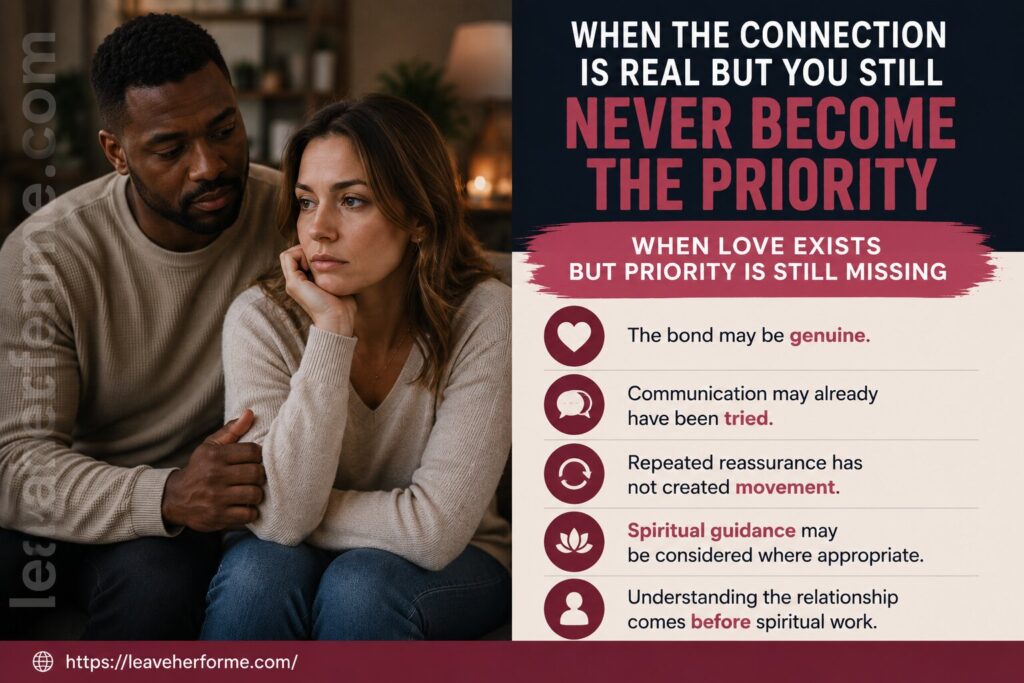
There are situations where the psychological explanation makes sense, the emotional bond feels genuine, and yet the relationship still remains stuck in almost the same place.
You have talked.
You have tried to be patient.
Perhaps you have given him space, stopped pushing, allowed him time to think and made a real effort to understand the pressures surrounding his life. You may already know about the children, the marriage, the fear, the responsibilities, the guilt, the habits and the emotional attachment that make change difficult.
You understand all of that.
What you still do not understand is why the relationship never seems to cross the line from deep emotional importance into clear priority.
That is the point where many women become exhausted with ordinary advice.
Not because psychology is useless. It may have helped you understand the pattern better than you ever did before.
The frustration comes from something else.
You understand the pattern, but the pattern is still there.
You understand why he hesitates, but he still hesitates.
You understand why he returns, but the return still does not create a different future.
That can leave you with the uncomfortable feeling that you have become very knowledgeable about the problem without becoming any closer to resolving your own situation.
When Understanding Him No Longer Changes What You Are Living
There is a stage in complicated relationships where explanation starts losing its emotional power.
At first, understanding brings relief. You finally have language for what is happening. His behaviour stops feeling random. You begin seeing how fear, attachment, responsibility and emotional dependence can coexist.
That matters.
But after enough time, another thought begins to grow.
“I understand why this is happening. I still do not know why nothing is changing.”
That is a different kind of frustration.
You may have already adjusted the way you communicate. Perhaps you stopped arguing because conflict only made him withdraw. You may have tried being more direct, more patient or more emotionally balanced. Maybe you gave him the breathing room he said he needed.
Still, you remain in the same position.
He loves you privately, but does not prioritise you openly.
He needs you emotionally, but your future still feels uncertain.
He talks about change, but the structure around the relationship remains intact.
This is the point where another generic article can start feeling repetitive.
You are no longer asking what emotional attachment means.
You want to understand your relationship, not relationships in general.
Sometimes a Woman Is Not Asking for More Love
There are women who know the connection is real.
They are not sitting there wondering whether every affectionate moment was fake. They have seen enough of the man to believe that there is genuine feeling between them.
What hurts is the gap between that feeling and his choices.
Miko Kana Insight: Sometimes a woman is not asking for more love. She is asking for the love that already exists to become visible in his choices.
That is a very different problem from simply wanting affection.
You may already have affection.
Perhaps you have emotional intimacy, attraction and a bond that has survived distance, arguments, silence and repeated attempts to pull away.
What you want is movement.
You want to feel that you matter when decisions are made.
You want his attention to become more consistent, not only more intense when he fears losing you.
You want the relationship to move from private importance towards clearer priority and commitment.
That is often the point where some women begin looking beyond ordinary relationship advice.
When Communication Has Been Tried but the Same Pattern Keeps Returning
Communication is important.
I would never tell someone to ignore it.
But communication has limits when the same conversation has already happened many times.
You explain what hurts.
He understands.
He reassures you.
For a while, things improve.
Then the pattern returns.
That can happen even when both people are sincere.
A person can understand your needs and still fail to change behaviour that is deeply tied to fear, habit, competing attachments or the structure of their life.
The danger is assuming that one more conversation will automatically produce a result that the previous twenty conversations did not.
Sometimes another conversation is exactly what is needed.
Other times, the issue is no longer lack of communication.
It is that the relationship has reached a pattern where understanding does not automatically become action.
This is where I think people deserve more than a prepared answer.
They deserve someone willing to look at the whole relationship and ask what may actually be keeping it stuck.
I Do Not Believe Every Woman Who Feels Secondary Needs Spiritual Work
This is important enough to say clearly.
I do not believe every woman who feels secondary needs spiritual work. First, I want to understand why she is secondary.
That distinction matters.
A woman may feel secondary because the man has genuine responsibilities he is actively working through.
Another may be dealing with a man who is emotionally dependent on her but not ready for commitment.
Someone else may be involved with a man who likes the relationship exactly as it is because it gives him emotional comfort without forcing him to change anything.
Those situations are not the same.
Treating every one of them as a spiritual problem would be irresponsible.
That is why my approach begins with understanding.
What has already been tried?
What keeps repeating?
Where does the relationship move?
Where does it remain stuck?
What does he say?
What does he actually do?
Only after looking at those details can I decide whether I believe spiritual guidance is appropriate for the situation.
Where Spiritual Guidance May Fit
For people who already believe in spiritual work, there are situations where they feel ordinary relationship approaches have taken them as far as they can.
They have communicated.
They have waited.
They understand the psychology.
They know the practical obstacles.
And still, the relationship remains caught in the same emotional pattern.
Where I believe spiritual guidance is appropriate, my work may focus on the relationship itself: the emotional bond, the obstacles surrounding it, the intention of greater closeness and the movement towards being taken more seriously in his life.
The intention is not to pretend another human being has no choices.
It is not to promise control.
It is not to guarantee that somebody will suddenly abandon every responsibility because spiritual work has been done.
That would be dishonest.
The purpose is to work within my spiritual tradition towards strengthening the connection and supporting movement in the direction the client is hoping for, where I believe that aim is appropriate for the situation.
For some women, that means wanting greater emotional closeness.
For others, the concern is consistency.
Another may want the relationship to move beyond being an emotional refuge and towards clearer commitment.
What matters is understanding the actual situation before deciding what spiritual focus, if any, makes sense.
The Difference Between Spiritual Support and Making Promises About Another Person
When somebody is emotionally exhausted, certainty can be extremely tempting.
You want someone to tell you:
“Yes, he will choose you.”
“Yes, he will leave.”
“Yes, this will happen by a certain date.”
I understand why.
Uncertainty is painful.
But certainty that is invented does not help you.
That is why I do not believe responsible spiritual guidance should be built on guarantees about another person’s future choices.
Spiritual work, in my approach, is not about pretending human behaviour stops mattering.
It works alongside the realities we have already discussed in this article.
His character still matters.
His choices still matter.
His responsibilities still matter.
Your boundaries still matter.
The relationship still needs honesty.
Spiritual guidance may be part of the path you choose, but it should not ask you to ignore everything reality is already showing you.
That balance is important to me.
When the Goal Is Greater Priority, the Relationship Has to Be Understood First
If a woman tells me, “I want to become his priority,” I do not think the right response is immediately recommending the same spiritual work for everyone.
First, I want to know what “priority” means in her particular relationship.
Does she want more consistent attention?
Does she want the man to stop disappearing whenever his life becomes complicated?
Is she asking for greater emotional commitment?
Does she want a relationship that has been hidden for years to finally move towards something more visible?
Is another relationship creating a repeated obstacle?
Those details change the meaning of the goal.
A woman who is already deeply loved but dealing with genuine practical obstacles is in a very different situation from someone who has become an emotional escape for a man who enjoys the comfort but has shown no real intention of changing anything.
That is why my work begins with the pattern, not the promise.
When You Want the Relationship to Move Beyond Feelings
This is the point where my spiritual work may become relevant for some readers.
If the bond feels real, but the relationship remains stuck in a place where you are emotionally important without becoming a clearer priority, the first step is understanding what keeps creating that gap.
Where I believe spiritual work is suitable, I may focus on strengthening the connection, addressing what I understand spiritually as obstacles around the relationship and supporting the intention of greater closeness, attention, priority and commitment.
I am deliberately saying may.
Because I do not believe every situation has the same spiritual cause or deserves the same recommendation.
The purpose is to understand first and work second.
That is a far stronger foundation than promising a result before knowing the relationship.
The Relationship Still Has to Show You Something in Real Life
Even when a person chooses spiritual guidance, reality still matters.
If communication continues becoming worse, that matters.
If he repeatedly makes promises and breaks them, that matters.
If he becomes more honest and consistent, that matters too.
You should not be asked to ignore behaviour because you are hoping spiritual work will eventually change everything.
The purpose of guidance should be to help you work towards the relationship you want while remaining aware of what is actually happening.
A healthy spiritual approach should make you more observant, not less.
It should not turn every disappointment into a reason to keep waiting indefinitely.
That distinction protects both your hope and your judgment.
If You Recognise Your Story Here
Perhaps you already know that the connection is not casual.
You have seen enough to believe the feelings are real.
The pain is that the relationship remains emotionally strong but structurally weak.
You keep wondering why something that feels so important still does not carry enough weight in his decisions.
If that describes your situation, the next step is not automatically to decide that you need spiritual work.
The next step is to understand the relationship properly.
That is where personal guidance becomes useful.
Tell me how the relationship began, what has changed, what has already been tried, what he says, what he does and what you genuinely want from the relationship.
Only then can I tell you whether I believe spiritual guidance has an appropriate place and what the work would be intended to support.
That is the difference between selling a service and actually understanding a person.
Your Relationship Cannot Be Understood From One Sign
By this point, you may have noticed something important about complicated relationships: one sign rarely tells the whole story.
A man calling every day does not automatically mean you are his priority. A man needing space does not automatically mean he does not love you. A married man remaining where he is does not automatically prove that his feelings for you are false, just as repeated affection does not automatically prove that he is building a future with you.
This is exactly why checklists have limits.
They can help you notice patterns. They can give you language for experiences that previously felt confusing. But they cannot know the history behind your relationship, the timing of important changes, what has already been tried, what he says when nobody else is listening, or whether his behaviour has actually shifted over time.
Two women can read the same article, recognise the same five signs, and still be living in completely different situations.
One may be loved by a man who is genuinely struggling through difficult responsibilities but gradually moving towards clarity. Another may be emotionally important to a man who depends heavily on her yet has shown no meaningful intention of changing his life. A third may be dealing with someone whose words remain powerful while his behaviour repeatedly protects a comfortable arrangement.
From the outside, all three relationships might look similar.
From inside them, they are not.
That is why personal understanding becomes valuable.
The Same Behaviour Can Mean Different Things in Different Relationships
Consider something as simple as delayed communication.
In one relationship, he may become less available because his children are going through a difficult period and his attention is temporarily divided. In another, reduced communication may happen every time the woman asks for more clarity. In a third, he disappears whenever he feels emotionally secure that she will still be there when he returns.
The behaviour looks similar.
The meaning may be completely different.
The same applies to promises.
A man may say, “I need more time,” because he is actually working through decisions that affect his family, finances and future. Someone else may use almost identical words because keeping the situation undefined allows him to avoid losing either relationship. Without knowing what has happened before and after those statements, one sentence cannot reliably explain the relationship.
This is where personal assessment becomes more than simply asking, “Does he love me?”
The stronger questions are often about pattern, context and direction.
What happened before the relationship became complicated? What usually triggers distance? What happens after he returns? Which promises have produced action? Which promises have simply been repeated? How has the relationship changed over six months, one year or several years?
Those details begin revealing what a general checklist cannot.
Sometimes You Are Loved but Caught in Difficult Circumstances
There are relationships where the emotional bond appears real, but practical circumstances genuinely slow movement.
Perhaps there are children involved. Maybe there is shared property, financial dependence, immigration concerns, cultural expectations or a long marriage that cannot be untangled quickly without consequences.
In a situation like that, the problem may not be lack of feeling.
The problem may be the weight surrounding the feeling.
That does not mean endless waiting is automatically justified. It means the relationship has to be understood according to what is actually happening inside those circumstances.
Is he becoming more honest?
Are practical obstacles being confronted?
Does he take responsibility for the effect of the delay on you?
Is the relationship slowly gaining more direction?
If the answers are yes, even imperfectly, that is a very different situation from one where the same explanation has been repeated for years without movement.
A personal assessment helps separate genuine complexity from indefinite postponement.
Sometimes You Are Emotionally Important but Still Not Prioritised
Another woman may be living a different reality.
She may be deeply important to him.
He may contact her regularly, confide in her, miss her when she pulls away and genuinely fear losing the relationship.
Yet his choices remain almost completely unchanged.
This is one of the most confusing situations because there is enough emotional evidence to make the relationship feel meaningful, but not enough practical evidence to make the future feel secure.
The central question becomes whether emotional importance is slowly developing into priority.
Does your wellbeing affect his decisions? Does he protect the relationship from repeated harm? Does he make room for your needs when doing so is inconvenient? Are your future concerns treated as legitimate rather than as pressure?
If not, the relationship may contain real affection without enough priority to create the life you expect.
That distinction can be painful, but it is far more useful than simply asking whether he loves you.
Sometimes You Have Become His Emotional Refuge
There are also relationships where a woman becomes the safest emotional place in a man’s life.
He comes to her when he is lonely, frustrated, disappointed or overwhelmed. She provides understanding, affection, validation and peace.
That connection can become very deep.
Yet the role itself can hide an imbalance.
If he repeatedly seeks her when he needs emotional relief but offers much less support when she is struggling, the relationship may be functioning partly as an emotional refuge.
Again, that does not automatically mean he is deliberately using her.
He may genuinely love her.
The question is whether the relationship has developed beyond what she provides emotionally.
Does he remain present when he needs nothing?
Does he become curious about her life?
Does he build anything that exists outside the moments when she is helping him feel better?
Those patterns help distinguish emotional dependence from a more mutual form of commitment.
Sometimes You Are Being Kept Waiting
There are relationships where the pattern becomes clearer only when time is examined honestly.
The same explanations repeat.
The same emotional conversations happen.
Each time you begin pulling away, urgency returns. He becomes attentive, reassuring and affectionate. Once he feels secure that you are staying, the urgency fades again.
The relationship remains active, but it does not really move.
That is an important distinction.
A relationship can contain enormous emotional activity without meaningful development.
There may be messages, arguments, reunions, tears, promises and strong attraction. None of that automatically means the structure of the relationship is changing.
If years pass and the fundamental questions remain the same, the issue may no longer be temporary uncertainty.
It may be a pattern of avoidance.
A personal assessment helps look at the relationship over time rather than through the emotional intensity of the latest conversation.
Sometimes the Relationship Is Genuinely Moving Towards Something Deeper
Not every complicated relationship is stuck.
Some are actually developing, even if the process is slower than either person would like.
Communication becomes more honest. Difficult subjects are discussed instead of avoided. The man stops giving vague reassurance and begins having realistic conversations. Boundaries change. Practical decisions are made. The woman does not have every answer, but she can see that the relationship is not standing still.
That matters.
Progress does not always look dramatic.
Sometimes the strongest evidence is simply that the same problem is no longer being handled in exactly the same way.
A personal assessment should be capable of recognising movement as well as warning signs.
Otherwise, it becomes another form of pessimistic advice where every complicated relationship is automatically treated as hopeless.
That is not balanced guidance.
Why the Full Story Matters More Than the Latest Problem
When people contact someone for help, they often begin with what happened most recently.
“He stopped calling.”
“He said he needs more time.”
“He went away with his wife.”
“He came back after I tried to leave.”
Those events matter.
But they make much more sense when placed inside the full relationship.
What was happening three months before that?
Was there already tension?
Did the same pattern happen last year?
Has he previously made promises that became reality, or only promises that were repeated?
Has he ever taken responsibility for the effect of his decisions?
Has the relationship become more secure, less secure or essentially unchanged?
The latest event is often only one chapter.
The pattern across all the chapters tells a much more reliable story.
This is why my approach begins with the relationship as a whole rather than one dramatic moment.
What a Personal Relationship Assessment Is Actually For
A Personal Relationship Assessment is not there to hand you a magical verdict after one message.
Its purpose is to help make sense of a relationship that has become too complicated for generic advice.
I want to understand the timeline, the emotional pattern, the practical obstacles, what has already been tried and what you genuinely hope will happen.
That gives me a clearer basis for understanding whether the main issue appears to be emotional dependence, lack of priority, genuine external obstacles, avoidance, unresolved attachment, or a relationship that is actually moving but at a slower pace.
Only after that understanding can I explain whether I believe spiritual guidance may have an appropriate place in the situation.
That sequence matters.
Understanding first.
Then interpretation.
Then, where appropriate, spiritual work.
The goal is not to force every relationship into the same explanation. It is to understand what kind of relationship you are actually living inside.
The Stronger Question Is Not “Can You Help Me?” but “What Is Really Keeping This Stuck?”
This is where Conversion Depth becomes most important.
By now, you may already know that another article will not completely answer your situation.
You may recognise yourself in several different patterns.
Perhaps he is emotionally dependent on you and genuinely loves you. Maybe there are real responsibilities keeping him where he is, but those responsibilities have also become a reason nothing changes. You may be his emotional refuge while still seeing genuine signs of commitment in other areas.
Real relationships often contain more than one explanation at the same time.
That is why the most useful question is not simply:
“Can somebody help me?”
It is:
“What is actually keeping this relationship in the same place?”
Once that question becomes clearer, the next step becomes much easier to understand.
If You Want Me to Look at Your Situation Personally
If this article has helped you recognise the pattern but you still cannot tell which explanation fits your relationship, you can share the story with me.
Start My Personal Relationship Assessment
Tell me how the relationship began, what changed, how long the current pattern has existed, what he tells you, what he actually does, and what you want the relationship to become.
I will look at the situation as a whole before suggesting any spiritual direction.
If I believe spiritual guidance may be appropriate, I can explain what I would focus on and what the work would be intended to support, whether that is greater emotional closeness, more consistent attention, movement towards priority or stronger commitment.
If your deeper concern is not only understanding where you stand but whether the relationship can realistically move towards a clearer choice and shared future, How to Make Him Choose Me Over Her explores that question from the next stage of the journey.
If I do not believe your situation should be approached that way, I would rather say so than pretend every relationship needs the same answer.
That is the purpose of the assessment.
Not to sell you the same solution.
To understand what your relationship actually needs.
Frequently Asked Questions About Being His Priority or His Emotional Escape
How do I know if I am really his priority?
Being a priority is less about dramatic gestures and more about what consistently happens over time. A man can make you feel incredibly important during emotional moments and still fail to give the relationship meaningful weight in his real decisions.
Look at whether your needs influence his behaviour, whether he makes room for you when nothing is wrong, and whether the relationship is becoming clearer rather than repeatedly returning to the same uncertainty. Priority is usually visible in consistency, consideration, honesty and movement.
No single action proves it. The pattern matters more than the performance.
What does it mean to be someone’s emotional escape?
An emotional escape is a relationship or person someone turns to for relief from stress, loneliness, conflict, boredom or dissatisfaction elsewhere.
That does not automatically mean the connection is fake. A man may genuinely love you and still rely on the relationship because you provide peace, validation, understanding, excitement or emotional safety.
The concern appears when the relationship functions mainly to help him feel better without developing into something more mutual. If he repeatedly comes to you in crisis, receives comfort and then disappears once life stabilises, the relationship may be doing more emotional work for him than either of you has realised.
Can a man love me and still not make me a priority?
Yes.
Love and priority are connected, but they are not identical. A man may care deeply about you while still prioritising children, marriage, financial security, family expectations, fear or the stability of the life he already has.
That does not mean you should excuse endless delay. It means his feelings and his choices need to be examined separately.
He may love you. The harder question is whether his love is strong enough, mature enough or supported enough by action to create the place you want in his life.
How can I tell if he only comes to me when he needs something emotionally?
Pay attention to timing.
Does he become closest after arguments, loneliness, stress or conflict? Once he feels better, does the intensity fade? When you need support, does he offer the same depth of attention you give him?
A relationship naturally contains moments where one person needs more support than the other. The issue is not occasional imbalance. The issue is whether that imbalance becomes the normal structure of the relationship.
If his emotional need consistently creates closeness while your needs create distance, that pattern deserves attention.
Does it mean he is using me if I am his emotional escape?
Not necessarily.
That phrase can sound harsher than the reality.
Some people consciously use others. Others drift into emotionally dependent relationships without fully understanding what they are doing. He may genuinely love you while also depending on what the relationship provides.
The more useful question is whether he values you beyond the role you play for him.
Does he remain interested when he needs nothing? Does he care about your emotional wellbeing? Is he building something with you, or mainly using the relationship to recover from other parts of his life?
That tells you more than the label itself.
Why does he keep coming back if he will not commit?
Repeated return can happen for many reasons. Love may be one of them, but it may not be the only one.
He may miss the emotional intimacy, the sexual connection, the comfort, the validation, the excitement or the sense of safety he experiences with you. Several of those forces can exist at once.
The important question is not simply why he returns. Ask what becomes different after he does.
If every reunion restores the same relationship without changing anything underneath it, the bond may be strong while the commitment remains weak.
Can emotional dependence feel like love?
Absolutely.
Emotional dependence can create powerful closeness. Someone may feel that they cannot cope without you, think about you constantly, fear losing you and seek reassurance whenever the relationship feels threatened.
Those experiences can look almost identical to love from the inside.
The distinction appears in how the relationship functions. Love with maturity gradually creates reciprocity, responsibility and concern for your wellbeing. Dependence may remain focused mainly on what your presence does for the other person’s emotional state.
The two can exist together, which is why the pattern needs to be examined carefully.
How do I know if he is emotionally attached to me?
Emotional attachment often shows through repeated emotional reliance, strong reactions to distance, the need for contact, deep disclosure and difficulty letting go.
But attachment alone does not tell you what the future will become.
If your deeper concern is whether his bond reflects love, comfort or dependency, the article Signs He Is Emotionally Attached to Another Woman explores that subject more fully.
Should I keep waiting if he says I am important to him?
Importance matters, but it is not enough by itself.
Ask what the waiting contains.
Is the relationship becoming more honest? Are practical obstacles being addressed? Does he take your concerns seriously? Is there visible movement, even if it is slow?
Waiting with direction is different from waiting inside repetition.
You do not need to reject his feelings in order to ask whether the relationship is developing in a way that supports your future too.
Can I become more of a priority to him?
Relationships can change, and people can begin giving greater weight to someone they previously treated as secondary.
That change usually involves more than getting more attention. It often requires clearer communication, stronger boundaries, greater emotional reciprocity and a shift in how decisions are made.
For people who already believe in spiritual work, there are situations where I may also consider spiritual guidance aimed at strengthening the connection and supporting movement towards greater closeness, priority and commitment.
But I do not assume every woman who feels secondary needs spiritual work. First, I want to understand why she is secondary.
Can spiritual guidance help me become more of a priority?
For some people, spiritual guidance is part of how they choose to approach a relationship that feels emotionally real but repeatedly stuck.
Where I believe it is appropriate, my spiritual work may focus on the bond, the obstacles surrounding it, emotional closeness and the intention of movement towards greater attention, priority and commitment.
That does not mean I can guarantee another person’s choices. His character, responsibilities and real life decisions still matter.
The value of spiritual guidance is strongest when it is grounded in a clear understanding of the relationship rather than used as a replacement for reality.
Why does he make me feel important and then become distant?
One common reason is that emotional closeness can be easier for some people during intense moments than during ordinary life.
He may open up when stressed, become affectionate when he fears losing you, or seek comfort when another part of his life feels difficult. Once the emotional pressure reduces, he may return to familiar routines.
That distance does not automatically prove he was dishonest. It may reveal a pattern where intimacy rises and falls according to emotional need.
The question is whether he recognises that pattern and becomes more consistent over time.
How do I know if I am important to him or just convenient?
Convenience often becomes visible when the relationship works mainly on his terms.
He contacts you when he wants comfort, affection or intimacy. Your availability is expected, but his remains restricted. The relationship gives him something valuable without requiring much change in the rest of his life.
Love can still exist inside that arrangement.
That is why our upcoming article Love or Convenience: How to Recognize the Difference deserves its own deeper treatment. The question is not always whether love is present, but whether convenience has become too large a part of what keeps the relationship going.
What if he says he wants a future with me but nothing changes?
Future language can be sincere and still remain only language.
A person may genuinely imagine another life but remain unprepared to face the consequences required to create it. That is why future talk should eventually be compared with present movement.
Are difficult decisions being discussed? Are obstacles becoming clearer? Is anything practical changing? Or does the future mainly appear when you are uncertain and need reassurance?
The stronger the promise, the more important the pattern becomes.
When should I consider a Personal Relationship Assessment?
A personal assessment becomes useful when you already understand the general advice but still cannot tell which explanation fits your situation.
You may be loved but caught in genuine complications. You may be emotionally important without being prioritised. You could be his emotional refuge, or you may be in a relationship that is genuinely moving but more slowly than you hoped.
The same behaviour can mean different things in different relationships.
A Personal Relationship Assessment allows the full timeline, patterns, obstacles, promises and changes to be considered before any recommendation is made.
Tired Of Waiting For Him To Leave Her For You, Then Make Him Leave Her For You Now
Get your boyfriend to leave his wife for you. Make him leave her for you now regardless of what. Save him from his unhappy marriage or relationship.
Before You Decide What This Relationship Means
You may have arrived at this article hoping for a simple answer.
Perhaps you wanted a clear sign that would tell you whether you are truly his priority or simply the person he turns to when another part of his life becomes difficult.
By now, you can probably see why the answer cannot responsibly be reduced to how often he calls, how passionately he speaks, how jealous he becomes, how quickly he returns after distance or even how deeply he appears to need you.
Those things can matter. They simply do not tell the whole story.
A man can miss you terribly without building a future with you. He can depend on your emotional support without giving equal weight to your needs. He may genuinely love you while remaining frightened of the consequences of changing his life. In another relationship, the same intensity may exist because a man has discovered that he can receive affection, understanding, intimacy and emotional refuge without confronting the decisions that would make the relationship more secure.
The difference becomes clearer when you stop looking only at individual moments and begin looking at what the relationship has become over time.
That is where I want to leave you.
Not with another checklist.
With a clearer way of looking at your own story.
Do Not Judge the Whole Relationship by Its Most Beautiful Moments
Every complicated relationship has moments that seem to answer everything.
Perhaps there was a night when he opened up completely and told you things he had never told anyone else. Maybe he held you differently, cried in front of you, admitted how afraid he was of losing you or spoke about a future together with such conviction that you stopped doubting him.
Those moments matter.
They may have been completely genuine.
But one beautiful moment cannot carry the entire weight of a relationship.
The same is true of the painful moments. One argument, one period of distance or one cancelled plan does not necessarily define everything either.
Patterns tell you more.
When you look across months rather than hours, what do you see? Is there more honesty than there used to be? More consistency? Greater consideration for your feelings? Is the relationship becoming easier to understand because both of you are creating clarity, or are you still depending on intense moments to reassure yourself whenever reality becomes uncertain?
This distinction protects you from two extremes.
You do not have to dismiss everything meaningful simply because the relationship is complicated. At the same time, you do not have to use the most beautiful moments as evidence that every painful pattern should be tolerated.
Both deserve to be seen.
Pay Attention to Who You Have Become Inside This Relationship
Sometimes the clearest information about a relationship is not found in his behaviour.
It is found in what has happened to you while loving him.
Have you become calmer because the relationship has gradually created trust, or more anxious because you never know when closeness will disappear?
Do you feel increasingly able to speak honestly, or have you learned to hide certain needs because you fear pushing him away?
Are you still building your life, pursuing your goals, enjoying friendships and making plans, or has your future quietly become organised around what he may eventually decide?
None of these questions alone tells you whether to stay or leave.
Their purpose is different.
They help you notice the cost of the relationship alongside its value.
That matters because love can make us extremely attentive to what another person is experiencing while becoming surprisingly disconnected from what the experience is doing to us.
You can understand him deeply and still need to understand yourself.
Being Needed Is Powerful, but Being Considered Is Different
There is something deeply emotional about knowing that a man needs you.
Perhaps he tells you that nobody understands him the way you do. When life becomes difficult, you are the person he calls. He misses you when you withdraw. If you attempt to leave, suddenly you see an intensity that reminds you how important the connection really is.
Being needed can make you feel irreplaceable.
But there is another kind of importance that is quieter and often more revealing.
Being considered.
Consideration appears before a crisis.
He thinks about how a decision will affect you even when you are not standing in front of him asking to be remembered. He does not only protect the relationship when he fears losing it. Your feelings have weight during ordinary life, not merely during emotionally intense moments.
That is one of the differences between being someone’s emotional refuge and gradually becoming part of how they organise their life.
You should not need to threaten disappearance every time you want evidence that you matter.
You Do Not Need to Make Him a Bad Man to Admit That Something Is Missing
This distinction deserves to remain with you after you leave this page.
You do not need to prove that he manipulated you before you are allowed to question the relationship.
Perhaps he is genuinely conflicted.
Maybe he does love you.
His responsibilities may be real. His children may genuinely influence his decisions. Fear may genuinely be holding him back. The emotional connection between you may be every bit as meaningful as it feels.
All of that can be true.
You can still need more.
More consistency does not mean you are demanding perfection. Wanting greater clarity does not mean you have no compassion for his circumstances. Needing your relationship to develop does not automatically mean you are trying to force someone into a decision.
Understanding another person’s difficulty should create compassion.
It should not require the permanent disappearance of your own needs.
There Is a Difference Between a Difficult Journey and a Permanent Waiting Room
Some relationships genuinely take time.
A complicated situation involving children, marriage, finances, family responsibilities or major life changes may require patience. Expecting every problem to disappear immediately would be unrealistic.
The question is not simply whether the journey is taking a long time.
It is whether there is a journey.
A difficult journey has movement. There may be delays, setbacks and uncertainty, but something develops. Conversations become more honest. Problems that were once avoided begin being addressed. Decisions become clearer. Both people gradually understand what they are trying to create.
A permanent waiting room feels different.
The scenery never really changes.
There is always another reason.
Another delay.
Another emotional conversation that restores hope without altering the situation underneath it.
Months pass, sometimes years, yet the fundamental questions remain almost exactly the same.
This is why time alone cannot tell you whether patience is wise.
You have to look at what the time is producing.
Perhaps the Question Was Never Only Whether You Are His Priority
You started with one question:
Am I really his priority, or am I simply his emotional escape?
But after everything we have explored, perhaps the question has changed.
Maybe you already know you are important to him.
Perhaps you even believe he loves you.
What you do not know is whether the place you occupy in his heart is capable of becoming the place you need in his life.
That is a deeper question.
Because ultimately, you are not only asking whether you matter.
You are asking whether this relationship can become something you can safely build your future around.
Those are not the same thing.
A person can matter enormously and still remain trapped inside a relationship structure that never gives them enough security, visibility or direction.
Recognising that does not erase the love.
It simply prevents love from becoming the only evidence you consider.
If You Have Already Tried Everything You Know How to Try
Perhaps you have already had the conversations this article recommends.
You have tried patience.
You have given space where space seemed necessary.
You have communicated what you need without demanding impossible answers.
Maybe you have tried walking away, only for the relationship to pull both of you back together. You understand the psychological pattern far better than you once did, yet understanding has not changed the position you occupy.
This is where repeating generic advice may no longer help.
You do not necessarily need someone to tell you to “communicate better” for the twentieth time.
You may need somebody to understand why your particular relationship keeps returning to the same place.
That is the point where my approach becomes personal.
I do not begin by assuming there is a spiritual problem. Neither do I assume that every woman who wants to become more of a priority needs spiritual work.
First, I want to understand the relationship.
Only then can I consider whether spiritual guidance has an appropriate place in what you are trying to achieve.
When Your Desire Is Not for More Love but for Greater Movement
Some women who reach me are not trying to create feelings from nothing.
Their frustration is almost the opposite.
There is already affection.
There is already attachment.
There may be years of emotional history, physical intimacy, repeated reconciliation and a bond neither person seems able to walk away from.
What is missing is movement.
The woman wants the relationship to become more consistent. She wants greater attention outside moments of crisis. She wants to feel considered when decisions are made. In some situations, she wants a relationship that has remained secondary or hidden to begin moving towards greater priority and commitment.
Where I believe spiritual work is appropriate, that is the kind of intention my spiritual guidance may work around: the existing bond, the obstacles surrounding the relationship, emotional closeness and movement towards greater attention, priority and commitment.
But I will repeat something important because it defines how I want this work approached:
I do not believe every woman who feels secondary needs spiritual work. First, I want to understand why she is secondary.
Without that understanding, recommending the same spiritual solution to everyone would tell me very little about the woman standing in front of me and far too much about the person trying to sell her something.
One Question I Want You to Take With You
Before you decide whether to wait, confront him, step back, seek personal guidance or simply give yourself more time to think, ask yourself something more demanding than:
“Does he need me?”
Ask:
“Is the place he is giving me in his life becoming closer to the place he says I hold in his heart?”
Do not answer from yesterday’s beautiful message.
Do not answer from your worst argument either.
Look at the relationship.
Look at the pattern.
Look at the movement.
Look at what has changed and what has remained unchanged.
Then look at yourself.
That answer may tell you considerably more than another promise ever could.
If Your Story Needs to Be Understood Personally
If you have reached the end of this article and still feel caught between several explanations, that does not necessarily mean you missed the answer.
Your relationship may simply be more complicated than one article can responsibly interpret.
You may be loved but caught in difficult circumstances. You may be deeply important to him without yet being prioritised. Perhaps emotional dependence has become mixed with genuine love, or the relationship may be developing more slowly than you expected.
If you want me to look at your situation personally, tell me the story rather than trying to reduce it to one question.
Tell me how the relationship began, how long you have been together, what changed, what keeps repeating, what he has promised, what has actually happened and what you want the relationship to become.
From there, I can look at the pattern as a whole.
Where I believe spiritual guidance is appropriate, I can explain what I would focus on and what the work would be intended to support. Where I do not believe spiritual work is the right starting point, I would rather tell you that than manufacture a spiritual explanation simply because you came looking for one.
You do not need another person promising to understand you before they have even heard your story.
Let your story come first.