
When He Has Feelings but Still Cannot Give You a Decision
One of the most confusing places to find yourself in is a relationship where the feelings no longer seem to be the biggest question. You have seen enough to believe that something real exists between you. Perhaps he tells you he loves you, misses you when you are apart, becomes deeply affected when he thinks he might lose you, or talks about a future that sounds as though he has imagined you in it. There may be tenderness between you that is difficult to dismiss, conversations that go far beyond physical attraction, and moments when his feelings seem so obvious that questioning them almost feels unnecessary. Yet after all of that, the one thing you actually need from him remains unsettled: a decision.
That can be much harder to understand than simply discovering that somebody does not love you. If there were no feelings, at least the explanation might appear straightforward. Instead, you are left trying to understand how a man can seem emotionally certain about you in one moment and still be unable to become certain about what he is going to do with those feelings. He may speak with conviction when you are alone together, then become hesitant when the conversation turns towards consequences, timelines or the practical reality of changing his life. What feels emotionally clear between the two of you can suddenly become complicated when that connection has to become a choice.
Perhaps you have heard some version of the same explanation many times. He needs more time. There are things he has to sort out first. He does not want to hurt anyone. The children need to be considered. His marriage or existing relationship is complicated. Finances are involved. Families will be affected. He needs to know that he is making the right decision rather than reacting emotionally. Some of those concerns may be completely genuine. Others may become clearer only when you look at the pattern over time. Either way, hearing reasonable explanations does not necessarily make waiting easier, particularly when every explanation seems to postpone the same unanswered question.
The situation becomes even more confusing when his behaviour gives you enough hope to stay emotionally invested. He may become closer whenever you start questioning the relationship, reassure you that what you share matters, or become frightened by the possibility of losing you. Perhaps he tells you that nobody understands him the way you do, that things would be different if circumstances were easier, or that he can see himself eventually building a life with you. These moments can feel like evidence that a decision must be getting closer. Yet weeks become months, or months become years, and the emotional intensity of the relationship continues to grow without producing the clarity you expected it eventually would.
This is often where a woman begins trying to solve the decision for him in her own mind. She compares herself with the other woman. She wonders whether their history is stronger than what she shares with him, whether children will always outweigh romantic feelings, whether financial security matters more than happiness, or whether she simply needs to become more patient. If he is married, she may wonder whether staying with his wife means that he ultimately loves his wife more. If he repeatedly returns to her after trying to create distance, she may reach the opposite conclusion and believe that his inability to let her go must mean she is the person he truly wants. Neither interpretation necessarily explains the whole situation.
When Love Seems Clear but the Future Does Not
The assumption underneath much of this confusion is understandable: if a man knows whom he loves, surely he should know whom he wants to be with. Real relationships are rarely that simple. Love can influence a decision enormously without being the only force involved in making it. A man may feel deeply connected to one woman while also carrying attachment, responsibility, history or genuine affection towards another. He may know where he feels most emotionally alive while remaining frightened of what choosing that life would require him to lose. In other situations, he may genuinely be uncertain about the feelings themselves. These situations can look similar from the outside while being psychologically very different on the inside.
This is also why the question “Who does he love more?” can sometimes send you in the wrong direction. Even if you could somehow measure love precisely, it would not automatically tell you what he is prepared to do. Human beings do not make major life decisions using emotion alone. We also respond to fear, identity, responsibility, habit, anticipated regret, family expectations, financial realities, attachment and our understanding of who might be hurt by what happens next. A decision involving two relationships can therefore become a decision about two possible lives, and the emotional weight of those lives may extend far beyond the people at the centre of them.
For a married man, for example, choosing another relationship may also mean changing how he sees himself as a husband, father, provider or member of a family. Remaining married may protect continuity while costing him another relationship that matters deeply to him. Leaving may create the possibility of a life he wants while introducing losses and consequences he cannot fully predict. None of this proves that staying is right, leaving is right, or that one relationship contains the more genuine love. It simply explains why a decision that appears obvious to somebody waiting for it can feel far less simple to the person who has to live through everything that follows.
Why His Words Can Be Sincere and Still Leave You Waiting
Another difficult possibility deserves to be taken seriously: he may mean some of what he tells you even when his actions have not caught up with it. A promise made during an emotionally intense conversation is not automatically calculated deception. In that moment, he may genuinely imagine the future he is describing. Once the emotional moment passes and the practical consequences return, however, fear, responsibility or uncertainty may regain their influence. This does not make the effect on you insignificant. It does mean that understanding the difference between sincerity and readiness becomes important.
That distinction can explain why repeated reassurance eventually stops reassuring you. Hearing “I love you” may once have answered the question you were asking. After enough time, however, a different question takes its place: What is that love actually leading towards? You may no longer need another declaration of how important you are. You may need to know whether he is moving towards a life in which your importance has a clear place, or whether the relationship is becoming increasingly dependent on promises about a future that remains permanently somewhere ahead.
This is where prolonged indecision begins affecting more than the relationship itself. You may find yourself organising parts of your life around possibilities rather than decisions. Plans remain flexible because something might change. Emotional energy goes into interpreting conversations, setbacks and renewed promises. A good week can make the future feel close again, while a difficult conversation can make you wonder whether you misunderstood everything. The uncertainty becomes its own emotional environment, because you are not completely moving forward with him, but you may not feel free to move forward without him either.
Staying Is a Decision, but It Does Not Always Tell You the Whole Story
There is another conclusion we need to handle carefully. When a man does not make the decision you are waiting for, it can be tempting to say that his lack of action has already answered everything. Sometimes behaviour does reveal a direction that words have avoided acknowledging, and there comes a point where repeated inaction deserves to be taken seriously. Yet even here, we should resist reducing every complicated situation to “If he wanted to, he would.” That phrase can occasionally describe reality, but it can also erase the genuine psychological, emotional and practical forces that make major relationship decisions difficult.
At the same time, understanding those complications should not require you to pretend that indefinite uncertainty has no meaning. There is a difference between recognising why somebody struggles to make a decision and assuming that every delay must therefore be justified. Both realities can exist together: his conflict may be genuine, and living inside that conflict may still be deeply difficult for you. Understanding him does not require condemning him, just as understanding him does not require ignoring what prolonged indecision is creating in your own life.
The more useful question, therefore, is not simply “Does he love me enough?” It is “What stands between what he feels, what he wants, what he is prepared to decide, and what he is finally willing to do?” Those are not four different ways of asking the same question. A person can feel something deeply without knowing what future they want, want something without accepting its consequences, make a private decision without acting on it, or take action before feeling completely certain. Once those differences become visible, prolonged indecision begins to make much more psychological sense.
And that is where we need to begin. Before asking what finally makes a man choose one relationship, we first have to understand why love alone may not be capable of making the decision for him.
H2: Why Love Alone Does Not Always Tell a Man What to Do
One of the easiest conclusions to reach when a man is caught between two relationships is that eventually his feelings will reveal the answer. If he loves one woman more deeply, surely that love will become strong enough to determine where he belongs. From the outside, the situation can appear almost mathematical: compare the feelings, discover which relationship matters more, and the decision should follow. The difficulty is that people rarely make life changing relationship decisions by measuring love in isolation. Love can be one of the strongest forces influencing a choice while still competing with other emotional, practical and deeply personal forces that carry their own weight.
This is why asking “Who does he love more?” may answer only part of the question. A man can feel intensely drawn towards one woman while remaining strongly attached to the life he has built with another. He may experience excitement, emotional intimacy and a sense of being understood in one relationship while feeling history, loyalty, familiarity, family connection and responsibility in another. Those experiences are different, but difference does not automatically make one genuine and the other false. Human attachment is capable of holding several forms of emotional significance at the same time, which is why the question of whom he ultimately chooses can become much more complicated than identifying where the strongest romantic feeling exists.
Different Relationships Can Hold Different Kinds of Emotional Weight
Not every important relationship occupies the same place inside a person’s emotional life. One relationship may represent passion, possibility and a version of himself that feels newly alive, while another represents years of shared experiences, family memories, familiarity and a person who has witnessed large parts of his adult life. Trying to compare those relationships as though they are competing versions of the same thing can therefore be misleading. He may not simply be comparing two women. He may be comparing different kinds of connection and different parts of himself that have developed around each relationship.
This becomes particularly important when a newer relationship feels more emotionally intense than an established one. Intensity can be meaningful, but it does not automatically erase attachment created through years of living, struggling, parenting, building and changing alongside another person. Equally, history does not prove that an established relationship contains the deeper romantic connection simply because it has lasted longer. A long relationship can contain powerful attachment even when some aspects of romantic intimacy have weakened, just as a newer relationship can contain genuine love even though it has not yet accumulated decades of shared history.
That is one reason simplistic advice about choosing between two women often fails. Telling a woman that “he will choose whoever he truly loves” assumes that love exists in only one place and in only one form. Some situations are certainly that clear, but others are not. As we explored more deeply in Can Someone Love Two Women at the Same Time?, the existence of feelings for one person does not automatically prove the absence of meaningful feelings for another. What matters for our present question is what happens when those overlapping feelings eventually have to become a decision.
Attachment Can Remain Powerful Even When a Relationship Is Unhappy
Love and attachment are closely connected, but they are not identical. A person can become deeply attached to a relationship because it has become part of how life feels normal. The routines, familiar conversations, shared home, mutual friends, family traditions and knowledge of one another can create an emotional structure that is difficult to imagine losing. Even when parts of the relationship are unhappy, that structure may continue to provide familiarity and psychological continuity.
This helps explain something that can otherwise look contradictory. A man may complain about an existing relationship, describe feeling emotionally disconnected or acknowledge that important needs are not being met, yet still experience powerful resistance when he imagines actually leaving. The unhappiness may be real, but so may the attachment. One does not automatically cancel the other. He can want something to change while simultaneously fearing the disappearance of everything that has become familiar around the relationship.
From the perspective of the woman waiting for him, this can be frustrating because the problems he describes may make leaving seem obvious. If he repeatedly says he is unhappy, why remain? Yet dissatisfaction tells us what is wrong with a relationship; it does not necessarily tell us how psychologically prepared someone is to lose it. The emotional threshold required to admit that a relationship is no longer fulfilling can be very different from the threshold required to dismantle the life built around it.
Responsibility Can Influence a Decision Without Cancelling Love
Children are perhaps the clearest example of why romantic feelings alone may not settle a man’s decision. A father may imagine leaving his marriage and immediately begin thinking beyond the relationship between himself and his wife. He may picture different homes, changed routines, less daily access to his children, financial adjustments, questions from family members and the possibility that his children will experience pain because of a decision he made. Whether all those fears eventually become reality is another question. Psychologically, however, anticipated consequences can influence a person long before anything has actually happened.
Responsibility can extend beyond children as well. A man may feel financially responsible for a household, emotionally responsible for a partner who has shared difficult periods of his life, or responsible for promises he once made. Cultural and family expectations may add another layer. None of these automatically proves that he should remain where he is, nor do they prove that his feelings for another woman are less important. They simply mean that his decision may involve people and obligations that cannot be emotionally separated from the romantic choice as neatly as someone outside his position might expect.
This is where Narrative Neutrality matters. It would be easy to describe responsibility as an excuse whenever it delays the outcome the reader wants. Sometimes it may indeed become part of a pattern of postponement, but we cannot assume that before understanding the situation. For another man, responsibility may be one of the most serious moral conflicts inside the decision. Two men can use almost identical words about children or family while experiencing those words very differently, which is one reason individual circumstances eventually matter more than any universal rule about what men do when they are in love.
History Can Make a Relationship Part of His Identity
After many years with someone, a relationship can become intertwined with identity. A man may no longer think only in terms of “my relationship” but in terms of the life, family and social identity that have developed around it. Friends know them together. Families may be connected. Important memories belong to the relationship. Perhaps they became adults together, survived financial struggles, raised children or supported one another through losses and achievements. Leaving can therefore feel like more than ending a romance. It can feel like separating from a version of himself that has existed for years.
At the same time, another relationship may awaken a different identity. Perhaps he feels freer, more emotionally understood, more desired or more capable of imagining a different future when he is with the other woman. That does not necessarily mean one identity is authentic and the other false. People can experience different genuine parts of themselves in different relationships. The conflict becomes difficult precisely because both lives may contain something meaningful.
This is one reason a man’s words can sound contradictory without every contradiction necessarily being dishonest. He may genuinely say that he cannot imagine losing the woman he has fallen in love with, while also struggling to imagine completely leaving the life he already knows. To the person waiting for a decision, those statements may sound impossible to reconcile. Inside his experience, however, they may represent two losses he is desperately trying not to face at the same time.
Every Real Decision Creates a Loss as Well as a Gain
The psychology of choosing becomes clearer when we stop looking only at what a man hopes to gain and begin considering what he believes he will lose. Choosing one future usually means closing the door on another. Even when the decision ultimately improves his life, making it can require accepting consequences that cannot be avoided simply because the new relationship feels right.
If he chooses the newer relationship, he may gain the closeness, emotional connection or future he has been imagining, while losing parts of his existing family structure, routines, financial stability, social identity or daily life. If he stays where he is, he may preserve continuity while risking the loss of another person he genuinely loves and the future he associated with her. Remaining undecided can temporarily protect him from confronting either loss completely. He does not yet have to fully surrender one life because, psychologically, he is still keeping both possibilities alive.
That does not mean indecision is harmless. The people around him may be living with uncertainty while he postpones the emotional cost of choosing. Still, understanding that mechanism is more useful than immediately deciding that hesitation proves a lack of love. Sometimes the obstacle is not that he feels too little. The difficulty may be that choosing requires him to accept a loss he has not yet become psychologically prepared to carry.
Fear of Regret Can Become Stronger Than the Desire to Decide
Major relationship decisions contain another uncomfortable possibility: what if he chooses and later discovers that he was wrong? A man considering leaving a long term relationship may wonder whether the problems he currently experiences could have been repaired. Someone considering giving up another relationship may fear spending years wondering what would have happened if he had followed it. When children, property, marriage or significant history are involved, the imagined cost of making the wrong choice can become enormous.
Fear of regret can therefore keep a person searching for a level of certainty that relationships rarely provide. He may wait for a moment when one relationship becomes unquestionably right and the other unquestionably wrong. He may hope circumstances will change enough to make the decision obvious, or that one woman will eventually make the decision for him by leaving. The attraction of this position is understandable: if circumstances decide, he does not have to carry the full responsibility for choosing. The problem is that life may never provide the perfect certainty he is waiting for.
Over time, this creates an important distinction. Not knowing what to do and being unwilling to accept the uncertainty involved in deciding are not necessarily the same thing. A person can understand his options very well and still remain stuck because neither option protects him from loss, regret or responsibility. That is why more conversations about his feelings may eventually stop producing new information. The unresolved issue may no longer be whether he understands what he feels. It may be whether he is prepared to accept what choosing those feelings will cost.
The Woman He Loves Most Is Not Automatically the Life He Feels Ready to Choose
This may be one of the hardest ideas in the article, particularly for someone who has spent a long time waiting for love to become decisive. A man can feel profoundly connected to a woman and still hesitate before building his life around that connection. Conversely, remaining in an existing relationship does not automatically tell us that the existing partner is therefore the person he loves most. Behaviour matters enormously, but interpreting behaviour requires understanding what the behaviour is responding to.
This distinction prevents us from making two opposite mistakes. The first is romanticising love so completely that we assume strong feelings must eventually overcome every obstacle. The second is dismissing feelings entirely whenever someone’s actions fail to match them quickly enough. Neither position captures the complexity of major relationship decisions. Feelings matter, actions matter, consequences matter, and the relationship between those things is precisely what we need to understand.
For the woman waiting, this does not mean accepting uncertainty forever. Understanding complexity is not the same as surrendering your own future to it. It simply gives you a more accurate starting point. Instead of endlessly asking whether you can become more lovable than another woman, the more revealing question may be: What does choosing this relationship require him to become willing to face?
That question moves us into the next stage of the article, because once we understand that love is only one part of the decision, something deeper becomes visible. He may not simply be choosing between two women at all. He may be choosing between two different lives, two identities, different responsibilities and two versions of the future, each carrying something he wants and something he fears losing.
What He Is Really Choosing Between May Be Bigger Than Two Women
When a relationship involves two women, it is natural to see the decision as a direct comparison between them. Which woman makes him happier? Who understands him better? Where is the stronger attraction? Which relationship feels more like love? Those questions may matter, but they can create the impression that somewhere inside his mind he is simply placing two women side by side and deciding which one he prefers. In many complicated relationships, that is not the decision he experiences at all. He may be comparing two entire versions of his life, and each woman may have become connected to what one of those futures represents.
That distinction changes how prolonged indecision can be understood. Choosing a person is one thing; choosing everything that may come with that person can feel much larger. A married man who wants another woman, for example, may not experience the decision only as “Do I want her more than my wife?” Leaving could mean changing where he lives, how often he sees his children, how money is organised, how relatives perceive him, which friendships survive, what happens to a shared home and how he understands himself after the marriage ends. At the same time, remaining where he is may mean accepting the possibility of losing another relationship that has become emotionally significant. What looks from the outside like an inability to choose between two women may therefore be an inability to accept which life he is prepared to lose.
The Life He Knows Versus a Future He Cannot Fully See
Familiarity has enormous psychological power because the known life has evidence behind it. He knows what mornings look like there, how the household works, where he belongs at family gatherings, what his responsibilities are and what tomorrow will probably resemble. Even when parts of that life are unhappy, disappointing or emotionally complicated, they are still familiar. The alternative may feel emotionally exciting and deeply meaningful, but it also contains questions that cannot be answered until it is actually lived.
A future with another woman may therefore carry both hope and uncertainty. Perhaps he imagines greater emotional intimacy, affection, freedom or companionship, yet he may also wonder how the relationship would change once it became ordinary life rather than a relationship existing partly outside his current responsibilities. Would they still feel the same when bills, routines, family pressures and everyday disagreements became part of their relationship? Would the connection survive the consequences of leaving? Would resentment eventually appear over what had been sacrificed to make the new life possible? These questions do not prove that the new relationship is unrealistic. They explain why a future that feels emotionally powerful can still be frightening precisely because it has not yet been tested by ordinary life.
This creates an important imbalance between the two options. The existing life may be imperfect but known, while the alternative may appear more emotionally promising but partly unknown. Human beings do not always choose what seems capable of making them happiest. Sometimes they protect what feels predictable because uncertainty itself carries emotional cost. That is one reason a man can repeatedly imagine another future without becoming immediately ready to exchange the life he knows for it.
Fatherhood as He Knows It Versus a Family Structure He Cannot Yet Imagine
When children are involved, the decision can become substantially more complicated because leaving a marriage is not experienced only as leaving a partner. A father may begin imagining what happens to bedtime routines, school mornings, weekends, birthdays, holidays and the ordinary moments of parenting that currently happen without planning. Even where separation could eventually produce a healthy and workable family structure, the version he imagines beforehand may be dominated by what he fears losing.
This does not mean children automatically explain every delay, nor should their existence become a convenient answer that prevents us from examining the rest of the relationship. Some parents separate and build stable co-parenting arrangements. Others remain together partly because family continuity carries genuine importance to them. What matters psychologically is that a man may experience his decision about romantic love and his identity as a father as deeply connected. If choosing another relationship feels in his mind like choosing less access to his children, he may resist the decision even while believing that the other relationship matters enormously.
The woman waiting can easily experience this as being placed below the children, but that comparison may not accurately describe what is happening. Romantic partnership and parenthood occupy different emotional categories. His concern for his children does not automatically measure the strength of his romantic feelings for either woman. At the same time, recognising the legitimacy of fatherhood does not mean the woman waiting must accept indefinite uncertainty. Narrative Neutrality allows us to hold both truths: his concern may be genuine, and the consequences of his indecision for her may also be genuine.
Security Versus Desire Is Not Always a Choice Between Happiness and Misery
Another common mistake is imagining the existing relationship as nothing more than security while treating the other relationship as pure love. Reality can be considerably more complicated. Security itself may contain affection, companionship, shared humour, sexual history, mutual care and a sense of belonging. Likewise, desire for another woman may contain far more than excitement. It may include emotional intimacy, genuine love, compatibility and a future he sincerely wants to explore.
This is why we should be careful with the word comfort. Comfort is not evidence that a relationship is false. Most healthy long term relationships eventually contain familiarity and security. The important question is what else exists alongside them. A marriage can be comfortable and loving, comfortable but emotionally distant, deeply conflicted yet strongly attached, or some changing mixture of these depending on the period being examined. The other relationship can also contain love and uncertainty simultaneously. Human relationships rarely organise themselves into convenient categories where one woman represents everything meaningful and the other represents everything practical.
For the man trying to decide, however, security and desire can pull in different directions even when both relationships contain genuine feeling. The existing life tells him what he already has; the alternative asks him to trust what might be possible. That can create a painful psychological conflict because choosing possibility means surrendering some certainty, while protecting certainty may require surrendering something he deeply desires.
History Versus Possibility Can Feel Like Choosing Between Two Versions of Time
History has a particular emotional weight because it cannot be recreated quickly. Years together contain ordinary memories that outsiders rarely see: private jokes, illnesses survived, financial struggles, family deaths, celebrations, mistakes forgiven, children raised and thousands of small experiences that gradually become part of a shared identity. Even where romantic love has changed, those years do not disappear. A man considering leaving may therefore feel that he is not simply ending a current relationship but making a decision about what all those years now mean.
Possibility carries a different kind of power. Another relationship may represent the future rather than the past. He may see in it the possibility of feeling understood differently, loving differently or living in a way he had stopped imagining. That possibility can become especially powerful when his existing life has felt emotionally limited for a long time. Yet possibility cannot provide the same certainty as history because its most important promises have not happened yet.
Neither history nor possibility automatically deserves to win. History can become a reason to protect something meaningful, or it can become a reason people remain inside situations they would not freely choose today. Possibility can represent genuine renewal, or it can sometimes look simpler before it has faced everyday reality. The point is not to tell the reader which interpretation applies. The point is to understand why a man may feel the weight of both without being able to dismiss either.
This is also where Why Married Men Stay in Unhappy Marriages becomes relevant. Remaining in an unhappy marriage cannot always be explained by saying that the man secretly prefers unhappiness, just as leaving cannot automatically be explained by saying another woman was more lovable. History, attachment, children, responsibility, identity, uncertainty and hope for improvement can all influence why somebody remains inside a marriage even when important parts of it are no longer working for him.
Responsibility Versus Personal Longing Can Create a Moral Conflict, Not Just a Romantic One
There are situations in which a man knows what he personally wants but remains troubled by what pursuing it may mean for other people. This is different from not knowing whom he loves. He may believe that following his strongest romantic desire will create pain for a spouse, children or extended family. The resulting hesitation can become a conflict between personal fulfilment and his understanding of responsibility.
Guilt often enters here, but guilt itself deserves nuance. It can arise because someone has acted in ways they regret, because they anticipate hurting another person, because their desires conflict with values they have held for years, or simply because there is no available decision in which everyone walks away happy. A person can therefore experience guilt even when he believes a particular relationship is right for him. The presence of guilt does not automatically prove that his desired choice is wrong, just as the absence of guilt would not automatically make it right.
From the other woman’s position, however, endless sensitivity towards everybody else’s pain can begin to raise another legitimate question: where does her emotional reality fit? She may understand the children, respect the history and recognise that ending a marriage can be painful while still wondering whether her own years of waiting count for anything. A neutral article should not answer that by deciding whose pain matters most. It should recognise that a difficult decision can contain several legitimate emotional realities at once, and eventually the person making the decision has to accept that avoiding all pain may be impossible.
Who He Has Been Versus Who He Might Become
Some relationship decisions threaten identity more than people realise. A man may have spent years seeing himself as a married person, family man, provider, dependable partner or someone who keeps commitments regardless of personal difficulty. Choosing a radically different life can challenge that self image. He may ask himself not only “Who do I want?” but “What kind of man does this decision make me?”
Another relationship can simultaneously represent a different version of himself. Perhaps he feels more emotionally expressive there, more adventurous, more desired or simply more like the person he believes he has become. That creates a conflict that extends beyond romance. Returning fully to his established life may feel like suppressing a part of himself that has become important, while leaving may require abandoning an identity he has spent years constructing.
People sometimes underestimate how strongly identity can resist change. A person may remain in circumstances that no longer fit perfectly because those circumstances still support a coherent story about who they are. Major decisions require rewriting that story. When marriage, parenthood, family expectations and another meaningful relationship all intersect, the psychological work of becoming a different version of oneself can be as frightening as the practical consequences of the decision.
Sometimes He Is Trying to Avoid Losing Either Life
Once these competing forces are understood, prolonged indecision begins to look different. There may be periods when remaining undecided allows him to preserve important parts of both worlds. He can maintain the family structure, history and familiarity of one life while retaining emotional connection, possibility or intimacy in another. This arrangement may not have been deliberately designed, and it may cause him genuine distress, but it can still reduce the immediate pressure to accept the full loss attached to either decision.
That matters because indecision can gradually become psychologically functional. As long as neither relationship ends completely and no irreversible choice is made, he does not have to discover whether his fears about either future were correct. He may continue hoping that circumstances will eventually make the answer easier, that his feelings will become clearer, that one relationship will naturally weaken, or that an external event will make the decision for him. What began as genuine uncertainty can therefore develop into a pattern that sustains itself.
Recognising this does not require us to label him manipulative. Some people consciously maintain arrangements that benefit them, while others become trapped in patterns they themselves do not know how to resolve. The effect on everyone involved can still be painful regardless of intention. Narrative Neutrality means we examine what the pattern is doing before claiming to know exactly why the person created it.
The Decision May Become Possible Only When He Accepts That No Option Preserves Everything
A great deal of prolonged indecision is built around an impossible hope: finding a choice that delivers the desired future without requiring meaningful loss. He may want the new relationship without losing family closeness, want his family structure without losing the other woman, want certainty before taking risk, want everyone to understand, or want enough time for the difficult parts of the decision to somehow disappear. The problem is that some relationship decisions cannot be made without accepting consequences.
This does not mean a man must rush. Major decisions deserve thought, particularly where children and established families are involved. But there is a difference between carefully considering consequences and waiting for consequences to stop existing. Eventually, clarity may require accepting that no available path protects every person, preserves every relationship and keeps every version of his life intact.
That is a much deeper psychological threshold than deciding which woman produces the strongest feelings. He may already know what he wants emotionally while remaining unable to accept what choosing it would require him to surrender. In another situation, he may genuinely remain emotionally divided as well. Those differences matter because they tell us that two men who both say “I can’t decide” may be experiencing completely different internal problems.
And that prepares us for the next stage. If a man can feel strongly without choosing, can want something without deciding, and can even privately decide without acting, then we need to stop treating those states as interchangeable.
The next question is no longer simply “Who does he want?”
It becomes:
Where exactly between feeling, wanting, deciding and acting is he getting stuck?
That is where Decision Integrity becomes essential.
Feeling, Wanting, Deciding and Acting Are Not the Same Thing
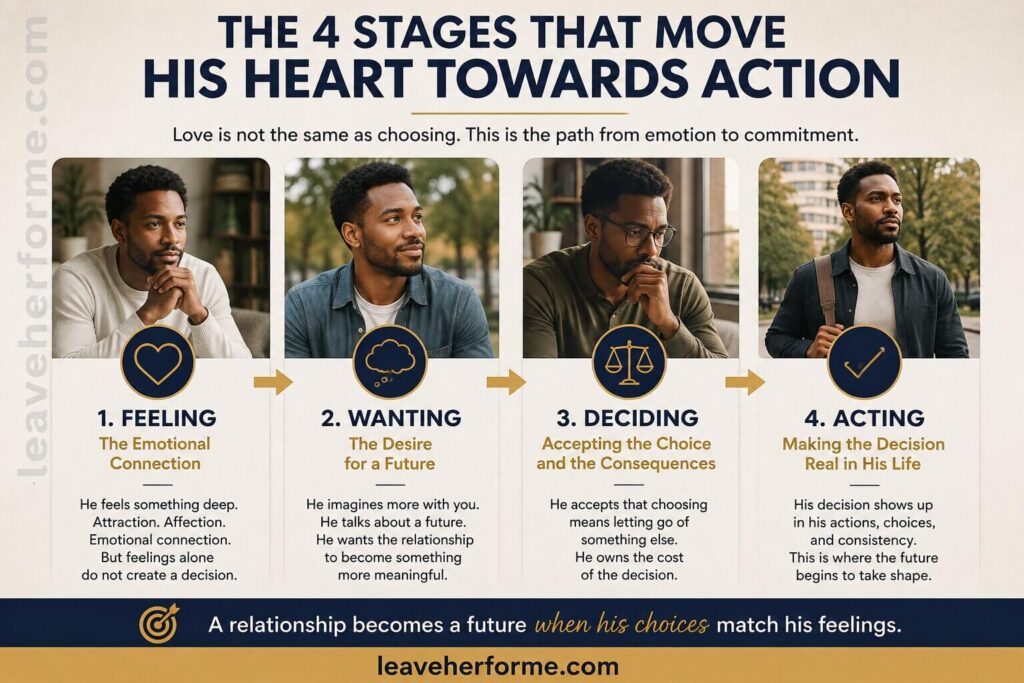
By this point, one distinction becomes essential. A man can have genuine feelings for a woman, want a future with her, believe that choosing her is what he ultimately wants, and still fail to take the actions that would make that future real. From the outside, those states can look contradictory because we naturally expect strong feelings to create strong intentions, strong intentions to produce decisions, and decisions to result in action. Sometimes they do. In complicated relationships, however, there can be a considerable psychological distance between each stage, and understanding that distance can explain why words that sounded completely sincere have still not produced the change you expected.
This is the foundation of what we are calling Decision Integrity throughout this article: feeling is not wanting, wanting is not deciding, and deciding is not acting. Each stage asks something different of a person. Feeling can arise without permission. Wanting requires imagining a preferred direction. Deciding means accepting one direction over competing possibilities. Acting requires living with the practical and emotional consequences of that decision. A man can move through these stages quickly, slowly, repeatedly or unevenly, which is why looking only at what he says he feels may tell you surprisingly little about how close he actually is to changing his life.
Feeling Can Be Real Before He Knows What He Wants to Do About It
Feelings are often the least deliberate part of this process. A man does not necessarily sit down and decide that he is going to become emotionally attached to someone, particularly when the connection develops inside circumstances where acting on it would complicate an existing life. He may recognise attraction first, then emotional intimacy, attachment, love or some combination of these. By the time he understands how significant the relationship has become, the feelings may already exist alongside responsibilities and commitments that were established long before the new relationship began.
This is particularly important when a woman assumes that the strength of his emotions must reveal his eventual choice. He may genuinely miss her, become deeply affected by distance, think about her constantly and feel emotionally different when she is absent. Those experiences tell us something meaningful about the connection, but they do not automatically tell us what he intends to do with it. Feelings answer a question about emotional significance. A life decision asks a different question about direction.
A man can therefore say “I love you” sincerely without that statement secretly containing a complete plan for the future. He may know that losing the woman would hurt while remaining uncertain about whether he can reorganise his life around keeping her. Conversely, he may initially underestimate what he feels and only understand its importance when distance or the possibility of permanent loss makes the attachment more visible. Neither pattern allows us to jump directly from emotion to outcome.
This distinction protects the reader from two extremes. We do not have to conclude that his feelings are false simply because he has not acted, but neither should we treat feelings as proof that action will eventually happen. Real emotion deserves to be recognised for what it is, without being asked to prove something it has not yet proved.
Wanting Begins When Feelings Start Becoming a Preferred Future
Wanting goes a step further because the man is no longer simply experiencing the relationship; he begins imagining what he would like to happen. Perhaps he says he wishes circumstances were different, imagines waking up beside her every day, talks about travelling together, wonders what living together would be like or describes a future in which they no longer have to hide the relationship. These conversations can feel enormously significant because the relationship has moved beyond “I have feelings for you” into “I can imagine a life with you.”
Yet wanting still exists in a psychological space where the desired future can be imagined without every consequence having to be accepted. A person can genuinely want something while simultaneously wanting to avoid what obtaining it would cost. He may want the new relationship and still want daily continuity with his children, want emotional freedom while preserving financial stability, want to leave an unhappy situation without causing pain, or want another future without completely surrendering the life that came before it. These desires are not necessarily calculated contradictions. They reveal why wanting alone cannot settle a difficult choice.
This is also why future conversations need to be interpreted carefully. Talking about a future can reveal desire, hope and emotional investment, but repeated future language does not automatically mean a decision has been made. The more revealing question becomes whether the imagined future is gradually acquiring practical substance. Is he beginning to confront what would have to change, or does the future remain safest when it exists only in conversation? Over time, that difference becomes increasingly important.
A woman can understandably hear “I want to be with you” as a decision because the words sound decisive. Psychologically, however, the statement may still describe a preference rather than a commitment. Wanting identifies the future he is drawn towards. Deciding requires him to accept that choosing that future may close the door on another one.
Deciding Means Accepting That One Direction Will Cost Something
A real decision begins when a person stops asking whether there is a perfect option and becomes prepared to accept the consequences attached to an imperfect one. This is why decision can be much harder than wanting. As long as a man remains in the wanting stage, he can imagine the best parts of another future while continuing to preserve much of his current life. Once he decides, however, the abstract future begins colliding with real questions about children, homes, finances, families, social identity, another partner’s feelings and his own fear of regret.
This threshold is especially difficult when neither option is emotionally empty. If he cared nothing about his existing life, the decision might be easier. If he cared nothing about the other woman, there might be little reason to consider changing it. The conflict exists precisely because something meaningful may be attached to both directions. A decision therefore does not always arrive when one side becomes completely worthless. Sometimes it arrives when a person becomes prepared to choose despite knowing that something meaningful may be lost.
That can be uncomfortable for the woman waiting because she may hope that certainty will eventually remove the conflict. She may expect him to reach a point where he simply knows, without fear or grief, that one future is right. Occasionally people do experience that kind of clarity. In other cases, mature decision making looks less dramatic. A person may still feel sadness, guilt, attachment or uncertainty while becoming sufficiently clear about which life he is prepared to take responsibility for.
The difference matters because certainty and decision are not identical. Someone can feel certain temporarily and later retreat, while another person can make a considered decision despite still carrying complicated feelings. If a man believes he must eliminate every doubt before choosing, he may remain undecided for a very long time. Major life choices rarely provide guarantees about what the future will feel like once they are made.
A Private Decision Is Still Different From an Acted Decision
There is another stage that can be particularly confusing: a man may tell you that he has decided, yet nothing externally changes. He may say that he knows whom he wants, that the relationship is over in his heart, that he has decided to leave, or that he intends to build his future with you. These statements can represent an important internal shift, but a private decision and an implemented decision are not the same thing.
Acting requires the decision to encounter reality. Conversations may need to happen. Living arrangements may change. Financial consequences may have to be faced. Children may need reassurance. Another partner may react in ways he cannot predict. Family members may have opinions. The relationship he has chosen may also begin demanding a different kind of responsibility once it is no longer sustained mainly by private moments, promises and imagined possibilities. An internal decision can therefore feel much easier than implementing everything it requires.
This helps explain why someone may appear extremely certain immediately after an emotional turning point and become hesitant when practical steps approach. That retreat does not automatically prove that the earlier decision was a lie. It may reveal that he had psychologically decided what he wanted before becoming emotionally prepared for the consequences of acting on it. At the same time, repeated private decisions that never survive contact with reality eventually become important evidence about the pattern. Sincerity can explain a promise, but sincerity alone cannot indefinitely substitute for movement.
For the woman waiting, this distinction can be painful because she may have experienced several moments that felt like the end of uncertainty. Perhaps he finally said the words she had been waiting for, only for the timeline to change when action became necessary. Understanding the difference between deciding and acting does not require her to dismiss those moments as meaningless, but it does allow her to stop treating every declaration as though the final threshold has already been crossed.
Why a Sincere Promise Can Still Fail to Become a Changed Life
One of the most important implications of Decision Integrity is that sincerity and follow through measure different things. When a man promises something during a deeply emotional conversation, he may be describing exactly what he believes he wants in that moment. The relationship feels immediate, the fear of losing it is strong, and the future he describes may feel emotionally obvious. Later, when the immediate emotional intensity decreases, other forces return: responsibility, fear, attachment, uncertainty, guilt, routine and the anticipated consequences we explored in the previous stage.
This can create a repeating cycle in which the same man appears certain and uncertain at different times. During moments when the possibility of losing the woman becomes emotionally immediate, his desire for the relationship moves to the foreground. When the existing life and its consequences become immediate again, the forces pulling him towards continuity regain their strength. Both experiences can be real, which is precisely why judging the relationship from its most intense moments can produce a distorted picture.
What matters over time is whether those moments of certainty begin producing progressive movement. Does he confront difficult conversations he previously avoided? Do timelines become clearer rather than continually resetting? Does he take responsibility for the consequences of what he says he wants? Do practical choices gradually begin supporting the future he describes? No single action proves everything, but patterns help distinguish a relationship moving through a difficult decision from one repeatedly returning to the emotional relief of making promises.
This is also where the reader needs protection from another simplistic conclusion. A delayed action does not automatically mean there will never be action, just as a promise does not guarantee that action will eventually arrive. The timeline, the obstacles and what changes after each declaration matter. That is why understanding the full relationship becomes increasingly important as the article progresses.
Sometimes the Difficulty Is Not Deciding but Accepting the Decision
A man may reach an internal conclusion and still resist what that conclusion means. Perhaps he knows that he wants one relationship but grieves the family structure he may lose. He may recognise that a marriage has reached its end while still loving aspects of the life created within it. In another situation, he may decide to preserve his existing relationship while struggling to let go of someone else he genuinely loves. Decision does not automatically switch off attachment, memory or grief.
This matters because people sometimes interpret continuing emotion as evidence that the decision was never real. Human beings are capable of choosing one direction while mourning another. A man who decides to leave can still feel sadness about his marriage, and a man who decides to stay can still feel genuine loss over another relationship. Those emotions do not necessarily reverse the decision; sometimes they are part of what accepting the decision requires.
The challenge arises when acceptance never develops. A person can repeatedly move towards one direction, become overwhelmed by what is being lost, retreat, reconnect with the other possibility and begin the decision process again. The relationship then starts revolving around repeated attempts to avoid the grief inherent in choosing. At that point, asking him to explain his feelings one more time may add very little. He may already understand the feelings. The unresolved issue may be his capacity to live with what his preferred decision requires him to give up.
Indecision Can Become a Place of Temporary Emotional Safety
There is a reason people sometimes remain undecided longer than outsiders believe makes sense. Indecision can postpone loss. As long as the future remains unresolved, a man may still psychologically hold onto more than one possibility. He has not fully surrendered the existing life, but he has not completely abandoned the alternative either. Although this position can be stressful, it can also protect him temporarily from the finality of choosing.
The problem is that temporary emotional safety can become a long term pattern. If each difficult moment is resolved through reassurance rather than decision, the immediate pressure decreases and the structure remains intact. He may feel better because the woman he feared losing has stayed, while she feels hopeful because his renewed closeness appears to signal progress. Neither person necessarily enters that moment intending to recreate the same cycle, yet the reduction in emotional pressure can make an actual decision less urgent again.
This does not automatically mean he is consciously keeping two women available. In some situations that may happen, while in others the man himself may feel exhausted by his inability to resolve the conflict. Narrative Neutrality requires us to distinguish the function of the pattern from assumptions about intention. A pattern can protect someone from choosing even when they sincerely wish they were capable of making the choice.
How to Tell Which Threshold He May Actually Be Struggling With
Instead of asking only “Why hasn’t he chosen me?”, it can be more useful to examine where movement appears to stop. If he struggles to acknowledge his feelings at all, the conflict is very different from a situation in which he openly expresses love and repeatedly imagines a future. If he knows what he wants but refuses to consider consequences, that differs again from someone who has begun making decisions but retreats whenever action becomes real.
The timeline often provides more information than individual conversations. What happens after emotional declarations? What happens after conflict? What changes after he asks for more time? Does each period of uncertainty eventually produce new clarity, or does the relationship return to the same starting point with different explanations? Looking at those patterns does not require assuming the worst about him. It simply moves the analysis from the intensity of what he says towards the relationship between what he feels, what he wants, what he decides and what he actually does.
That distinction also protects the woman from believing that her only task is to make him feel more strongly. If the emotional bond is already substantial, creating more emotion may not address the place where the process is stuck. The unresolved threshold could lie somewhere else entirely. He may need to determine what he genuinely wants, accept unavoidable consequences, make a decision he has been postponing, or become willing to act on a decision he already believes he has made.
And this gives us a much more precise understanding of prolonged indecision. The question is no longer merely whether his feelings are strong enough. The question is where those feelings stop becoming movement. Once we can see that, we are finally ready to examine the forces that can keep a man undecided even when the emotional connection itself is powerful.
What Keeps a Man Undecided Even When His Feelings Are Strong
Once you understand the difference between feeling, wanting, deciding and acting, another question becomes unavoidable: what keeps a man from crossing those final thresholds when his feelings already appear strong? It is tempting to assume that hesitation must mean the love is weaker than he says, but that conclusion can be too simple. Strong feelings can exist alongside strong resistance to change, particularly when a decision threatens several important parts of a person’s life at once. The more consequences he associates with choosing, the more possible it becomes for emotional certainty in one area to coexist with hesitation in another.
This does not mean every delay should be explained away. There is an equally important danger in constructing an endless list of reasons for someone who continues postponing the same decision. Fear, children, money, guilt and responsibility can be genuine influences, but their existence does not tell us whether a relationship is gradually moving through them or simply organising itself around them. The difference becomes visible over time. Real obstacles can slow movement, but the way a person responds to those obstacles tells you whether he is trying to work through them or learning to live permanently beside them.
Fear of Regret Can Keep Him Searching for Certainty That May Never Come
Regret is powerful because a major relationship decision is difficult to reverse without consequences. A man considering leaving an established relationship may wonder whether he is allowing the intensity of another connection to distort his judgement. He may question whether the marriage could improve, whether the newer relationship will feel the same once it becomes ordinary life, or whether he will eventually miss what he gave up. If he chooses to stay, the opposite fear can emerge: perhaps he will spend years wondering whether he abandoned the relationship that could have made him happier.
The problem is that neither future can be tested before the decision is made. He cannot live both lives for five years, compare the results and then return to the beginning with perfect information. At some point, choosing requires accepting uncertainty. A person who believes he must feel completely certain before making a major decision can therefore remain stuck for much longer than someone who accepts that even a carefully considered choice contains risk.
Fear of regret can also make circumstances appear responsible for decisions that the person is struggling to own himself. He may wait for one relationship to deteriorate enough that leaving becomes obvious, or for another relationship to become so compelling that staying feels impossible. Perhaps he hopes one woman will eventually walk away, removing the need for him to choose. None of this automatically means he is consciously manipulating either relationship. It can mean that being forced by circumstances feels psychologically safer than accepting responsibility for a choice whose outcome he cannot guarantee.
Guilt Can Make the Decision Feel Like a Judgement About Who He Is
Guilt becomes particularly influential when a man’s preferred future conflicts with his understanding of responsibility. If another person will be hurt by what he chooses, he may begin evaluating himself through the consequences of the decision. Leaving may stop feeling like a relationship decision and begin feeling like evidence that he has failed as a husband, father, partner or provider. Staying may create a different kind of guilt if he believes he is continuing to make promises to another woman that he cannot fulfil.
This is one reason guilt should not automatically be dismissed as an excuse. A person can genuinely want change and still struggle with the pain that change may create for others. At the same time, guilt does not always lead to a fairer outcome. Sometimes it simply postpones the moment when difficult realities have to be acknowledged. If every available decision hurts someone, refusing to decide may temporarily reduce his own sense of responsibility while extending uncertainty for everybody involved.
The more useful question is therefore not whether he feels guilty, but what he does with the guilt. Does it lead him towards honest conversations, clearer boundaries and careful decisions, or does every wave of guilt return the relationship to the same unresolved position? Emotional conflict deserves understanding, but over time its consequences also deserve examination.
Children Can Turn a Romantic Decision Into a Question About Family Life
Children can carry enormous weight because a parent may experience the consequences of separation through their lives as much as through his own. A father may fear losing ordinary daily contact, changing where his children live, disrupting school or family routines, or becoming someone who sees them according to a schedule rather than simply coming home to them. He may also worry about how they will understand the separation and whether they will eventually blame him for changing the family.
These concerns can be genuine even when the marriage itself is unhappy. They also do not automatically tell us what the correct decision should be. Some families become healthier after separation, while others find ways to repair relationships that had become deeply strained. The purpose here is not to argue that staying or leaving is better for children. It is to recognise that a father may experience choosing another relationship as inseparable from imagining what happens to his role within the family.
For the woman waiting, understanding that conflict can coexist with a legitimate need for clarity. Respecting his relationship with his children does not mean her own life must remain suspended indefinitely. Equally, wanting a future with him does not require treating his concern for his children as proof that he loves her less. These are different emotional relationships, and forcing them into a competition usually makes the situation harder to understand.
This distinction becomes especially important when the relationship depends on a future promise tied to his children’s age. Concern for his children can be sincere while the decision he will make later remains unresolved.
Financial Consequences Can Turn Emotional Clarity Into Practical Fear
Money may sound less romantic than love, but financial reality can strongly influence whether someone feels capable of acting on a decision. Separation can involve two households, property, legal expenses, maintenance, school costs, debt, business interests or a standard of living that cannot easily be reproduced once one household becomes two. A man may know which relationship he wants while remaining genuinely frightened by whether he can sustain the practical consequences of changing his life.
Financial concerns can also become intertwined with identity. Someone who sees himself as responsible for providing stability may experience financial disruption as a personal failure rather than simply an inconvenience. Another man may fear losing assets built over decades, while someone else may worry primarily about whether his children will remain secure. The words “I can’t afford to leave right now” can therefore describe very different realities depending on the person saying them.
Again, the pattern matters more than the existence of the obstacle. A genuine financial problem may require planning and time. What becomes revealing is whether planning actually occurs. If the same obstacle is mentioned year after year without any attempt to understand or prepare for it, the obstacle may no longer be the entire explanation. A difficulty that is being worked through behaves differently from a difficulty that has become the permanent reason nothing can change.
Attachment and Familiarity Can Pull Him Back Even After He Thinks He Has Decided
A long relationship creates emotional habits that do not disappear the moment someone imagines leaving. Familiar voices, routines, shared spaces, family rituals and ordinary companionship can produce a sense of home even when the romantic relationship itself has become complicated. A man may therefore move towards leaving, encounter the emotional reality of separation, and suddenly feel attachment more intensely than he did while everything remained familiar.
This can be confusing for everyone involved because the return of attachment may look like proof that his earlier feelings were false. It does not necessarily mean that. People often become more conscious of something when they are about to lose it. A man who has spent months focusing on what is missing from his marriage may become sharply aware of what still matters once separation feels real. Similarly, distance from another woman may intensify his awareness of what that relationship means to him.
The result can be movement in both directions. He moves towards change, feels the loss of his established life, retreats, then feels the potential loss of the other relationship and moves towards it again. Without understanding attachment, that pattern can look completely irrational. With attachment in view, it becomes easier to understand, although understanding it does not automatically make the repeated cycle sustainable for the people living inside it.
Social Identity Can Make Him Fear More Than the End of a Relationship
People do not live their relationships in isolation. Marriage can be tied to family reputation, religious expectations, friendships, community standing, business relationships and a person’s understanding of what a successful adult life is supposed to look like. A man who has spent years presenting himself as part of a stable marriage may fear not only losing the relationship but also explaining the new version of his life to everyone who knew the old one.
This can become especially difficult when another relationship began before the marriage formally ended. He may anticipate judgement, criticism or the assumption that one person alone caused a marriage to collapse. Whether those interpretations are fair is less important psychologically than whether he expects them. Anticipated judgement can make a decision feel socially dangerous even when he has become privately dissatisfied with the life he is living.
The same principle applies beyond marriage. Cultural expectations, family loyalties and religious beliefs can make an individual’s romantic preference conflict with a larger social identity. Narrative Neutrality requires us to acknowledge those pressures without automatically treating them as either noble responsibilities or cowardly excuses. Their significance depends on the person, the circumstances and what happens over time.
Uncertainty About the New Relationship Can Exist Alongside Genuine Love
A man may genuinely love another woman and still wonder whether the relationship can survive a completely different environment. A connection formed around limited time together, secrecy, distance or escape from existing pressures may eventually have to function under ordinary responsibilities. He may wonder whether the emotional intensity will remain once they share routines, finances, domestic responsibilities and the everyday frustrations that accompany a full partnership.
That uncertainty should not automatically be interpreted as doubt about the woman’s worth or about whether the relationship is genuine. In fact, asking whether a relationship can function in ordinary life can be part of responsible decision making. Problems arise when uncertainty becomes impossible to satisfy because the man wants proof about a future that cannot be fully known without living it.
This connects naturally with Love or Convenience: How to Recognize the Difference. A relationship can contain genuine love and still provide emotional comfort, escape, reassurance or excitement that has not yet been tested under different circumstances. The important question is not whether the relationship makes him feel good, because healthy love should contain comfort. The deeper question is whether he is prepared to take responsibility for the relationship when it asks more from him than emotional relief.
Avoiding Loss Can Become More Powerful Than Pursuing What He Wants
Much of indecision becomes easier to understand when we distinguish the desire to gain something from the fear of losing something. A man may strongly desire a future with one woman, but the immediate pain associated with losing his existing life may feel more powerful than the future reward he imagines. Human beings often respond more urgently to an approaching loss than to a possible gain, particularly when the loss involves familiar people, routines and identity.
This can produce behaviour that appears contradictory. When the other woman begins pulling away, losing her becomes immediate and he moves towards her. Once she feels secure again, the threat of that loss decreases and the consequences of changing his existing life become more psychologically immediate. He may then retreat. Later, if she withdraws again, the emotional balance changes once more.
We should not automatically describe this cycle as deliberate manipulation. Sometimes it can involve conscious attempts to preserve both relationships, but in other situations it reflects a person repeatedly reacting to whichever loss feels closest at the time. The distinction matters because the same outward behaviour can arise from different internal motives. What remains important for the woman experiencing it is that repeated movement caused by fear of loss is not necessarily the same thing as sustained movement towards a chosen future.
Indecision Itself Can Eventually Become Easier Than Choosing
At first, indecision may genuinely be temporary. A man needs time to understand what he feels, think about his children, assess finances or determine whether a relationship can realistically become a life. That period of uncertainty can be reasonable. The difficulty begins when the undecided position develops its own stability.
If both relationships remain available in some form, deciding carries an immediate cost while postponing may appear to preserve more of what he values. He may continue receiving familiarity and family connection from one part of his life while receiving intimacy, understanding or another kind of emotional connection from the other. This does not mean he necessarily created the arrangement intentionally. It means that the existing structure may gradually reduce the pressure that would otherwise force a decision.
This is where the distinction explored in How to Tell If He’s Confused or Simply Keeping You Waiting becomes particularly useful. Genuine confusion and prolonged avoidance can look remarkably similar from inside a relationship because both involve delay. The difference often appears through movement. Confusion that is being resolved tends to produce new understanding, difficult conversations, changed behaviour or increasingly specific decisions. A pattern that continually resets may indicate that remaining undecided has itself become easier than facing what choosing requires.
That does not mean we need to judge him before we understand him. A man can be genuinely distressed by an arrangement that simultaneously protects him from a decision he fears making. Human beings frequently remain inside patterns that hurt them because the alternative requires confronting something even more frightening. Recognising that possibility gives us a more useful question than simply asking whether he is confused: what keeps making the unresolved position possible?
An Obstacle Should Be Understood by What Happens Around It, Not Merely by Its Name
By now, we can see why lists of reasons men do not choose are not particularly useful on their own. Children can represent genuine parental responsibility or become part of repeated postponement. Money can require real preparation or become a permanent explanation. Guilt can lead towards honest resolution or endless retreat. Uncertainty can encourage thoughtful consideration or become a demand for impossible certainty. Attachment can be worked through or repeatedly pull someone back whenever change becomes real.
The name of the obstacle therefore tells us less than its behaviour over time. If children are the concern, what conversations or plans have happened around them? If finances are the problem, has anything been investigated or prepared? If he says he needs time, what has become clearer during that time? If guilt repeatedly changes his mind, has he begun confronting what he believes he is responsible for? These are not tests designed to trap him. They are ways of distinguishing a difficult process that is developing from one that continues returning to the same point.
This is also where compassion and clarity can exist together. You can understand why a man is frightened without pretending his fear has no consequences for you. You can respect the complexity of his responsibilities without making your own future irrelevant. You can believe that his feelings are genuine while still asking whether those feelings are becoming capable of carrying responsibility. Narrative Neutrality does not mean refusing to reach conclusions; it means allowing the evidence of the relationship to lead us towards them rather than deciding the story in advance.
Strong Feelings Become More Meaningful When They Begin Surviving Difficult Reality
The most revealing movement often happens when the relationship stops being emotionally easy. It is relatively simple to imagine another future during moments of intimacy, longing or frustration with the present. The deeper test comes when that future begins asking something concrete from the person imagining it. Does he remain engaged when difficult conversations appear? Can he tolerate uncertainty without abandoning the direction he said he wanted? Does he begin taking responsibility for consequences rather than waiting for every obstacle to disappear?
None of this requires dramatic overnight action. Major relationship decisions can take time, particularly when marriage, children and finances are involved. What matters is whether time is being used to move through the decision or merely to postpone it. Time can be part of progress, but time by itself is not progress.
That distinction takes us to the next major turning point in this article. We have spent enough time understanding why a man may remain undecided. If fear, guilt, children, money, attachment, identity and uncertainty can all hold him in place, the next question is not another version of “Why hasn’t he chosen?” We now need to examine the opposite side of the psychology:
What actually begins changing the balance strongly enough for a man to move towards a decision?
What Actually Begins to Move a Man Towards a Decision

Understanding why a man remains undecided is only half of the question. Eventually, something has to change inside the balance that has allowed him to remain between two possibilities. Fear may still exist, children may still matter, attachment does not suddenly disappear, and the consequences of choosing may remain difficult. What changes is not necessarily the disappearance of those forces. More often, the psychological weight of remaining undecided begins to change. The life he has been trying to preserve in its current form becomes harder to maintain, the future he has been postponing becomes more emotionally important, or he reaches a point where avoiding the decision creates consequences of its own.
This is why waiting for every obstacle to disappear can be misleading. A man may never reach a stage where leaving costs nothing, nobody is disappointed, his finances are untouched, his children have no questions, his history no longer matters and he feels completely certain about the future. Major decisions rarely become easy in that way. Movement often begins when he becomes more willing to face what the decision requires, even though some of the difficulties remain. The important shift is therefore not always from confusion to perfect certainty. It can be from avoiding the cost of choosing to accepting that a meaningful choice will carry a cost whichever direction he takes.
Clarity Begins When He Stops Asking Which Choice Is Painless
As long as a man is searching for a solution in which nobody gets hurt and nothing important is lost, he may remain trapped between possibilities that cannot realistically coexist forever. He may hope his marriage somehow resolves itself, that another relationship becomes easier to understand, that his children eventually make the decision less complicated, or that enough time will reveal an option without consequences. Waiting can feel responsible because he tells himself he is avoiding a rushed decision, but there can come a point where waiting is actually an attempt to avoid the nature of the decision itself.
Clarity can begin when the question changes. Instead of asking “Which decision allows me to keep everything?”, he begins asking “Which consequences am I prepared to take responsibility for because this is the direction I believe I need to take?” That is a much more difficult question, but it is also closer to how serious decisions are actually made. It acknowledges that staying has consequences just as leaving does, choosing one relationship has consequences just as letting it go does, and refusing to decide does not preserve a neutral position indefinitely.
This does not mean that the first moment of clarity becomes the final answer. People can move towards a decision and still experience fear, grief or doubt. What matters is that the centre of the process begins shifting away from the fantasy of a painless solution. He stops requiring the decision to feel comfortable before allowing himself to consider it seriously. Once that happens, some obstacles that previously appeared impossible may begin to look difficult but manageable.
The Cost of Remaining Undecided Can Eventually Become Impossible to Ignore
Indecision can feel protective while its costs remain less immediate than the costs of choosing. If a man can preserve his familiar life while maintaining another emotionally important relationship, the arrangement may temporarily protect him from the losses attached to either decision. Over time, however, that balance can become increasingly difficult to sustain. Relationships change under prolonged uncertainty, trust can weaken, emotional exhaustion can grow, and the effort required to keep different parts of life separated may become heavier.
The consequences are not limited to the women involved. A man living with unresolved conflict may begin experiencing his own dissatisfaction differently. What once felt like buying time can start feeling like losing time. Repeating the same explanations may no longer reassure him. Moments that once provided emotional relief may remind him that nothing fundamental has changed. He may begin recognising that remaining undecided is not postponing the decision without consequence; it is creating a particular kind of life in the present.
This is where one of the central principles of this article becomes important:
A decision often becomes possible when remaining divided starts carrying a greater emotional cost than choosing a direction.
That does not mean pain should be deliberately created to force a choice. It means the natural consequences of prolonged indecision can eventually change the psychological balance. A person who once feared choosing more than he feared waiting may reach a point where continuing to live between two futures feels more difficult than accepting the loss, responsibility and uncertainty attached to one of them.
The Possibility of Losing a Relationship Can Reveal What He Has Been Taking for Granted
People often understand the significance of something differently when its continued presence no longer feels guaranteed. In a prolonged triangle or uncertain relationship, a man may become accustomed to the idea that the woman he loves will still be there while he works through his circumstances. Her patience can feel reassuring, particularly if she has repeatedly understood his fears and accepted that his situation is complicated. Without anyone deliberately intending it, that reassurance can sometimes reduce the urgency of deciding because the relationship he fears losing still feels emotionally available.
If that certainty changes naturally, his understanding of the relationship may change with it. Perhaps she becomes clearer about what she can and cannot continue living with. She may stop arranging her future entirely around a decision she does not control, or simply reach a point where waiting no longer feels emotionally sustainable. None of this needs to be performed as a strategy designed to frighten him. In fact, deliberately threatening to leave simply to trigger pursuit can produce a reaction without producing genuine clarity.
The more meaningful shift occurs when he encounters the reality that another person’s life cannot remain indefinitely suspended around his uncertainty. He then has to consider not only what changing his current life could cost, but what continued indecision could cost as well. If the relationship genuinely matters to him, the possibility of losing it may make previously abstract questions about the future much more concrete. Yet even here, fear of losing someone should not be confused with a settled decision to build with them. What happens after the fear appears matters more than the intensity of the immediate reaction.
The possibility of losing you can reveal attachment, but what happens after he returns matters just as much. If your relationship repeatedly moves through distance, pursuit, reconciliation and renewed uncertainty, Why He Keeps Coming Back but Won’t Commit examines that cycle specifically.
A Future Becomes Easier to Choose When It Becomes More Than an Emotional Fantasy
Another important shift occurs when the future he is considering begins to feel imaginable as a real life rather than simply an emotional alternative to his current one. A man can love another woman deeply while still struggling to picture how the relationship would function once it carries everyday responsibilities. If most of their connection has existed through private time, messages, distance or moments separated from ordinary life, the future may remain emotionally powerful but practically vague.
Clarity can grow as the imagined future becomes more realistic. This does not require creating detailed plans before a decision has even been made, but it does mean thinking beyond the emotional promise of “one day.” What kind of relationship are they actually trying to build? Are their expectations compatible? How would children fit into the future? What would everyday partnership look like? Can the connection survive responsibilities rather than existing mainly as relief from them? These questions do not weaken romance. They help transform possibility into something a person can realistically evaluate.
A future that becomes more concrete may either strengthen his desire to move towards it or reveal concerns that need to be taken seriously. Both outcomes provide more clarity than indefinite fantasy. The purpose is not to make the alternative relationship look perfect. A believable future is psychologically more useful than an idealised one because a man can begin deciding whether he is prepared to live it rather than merely whether he enjoys imagining it.
He May Need to Recognise What He Cannot Continue Living Without
Some decisions become clearer not through comparison but through absence. A man may spend months analysing which relationship has more advantages and still remain divided because both contain something meaningful. Eventually, the more revealing question may concern what he believes would leave a lasting absence if it disappeared from his life. That is different from asking which woman makes him feel more excited in the present.
For one person, the answer may be the family life, history and partnership he has already built. For another, it may be the emotional connection and future he has discovered elsewhere. Someone else may realise that neither existing arrangement reflects the life he actually wants and that he needs a period outside both relationships before making another commitment. Narrative Neutrality requires us to allow each of these possibilities because the purpose of this article is to understand how decisions happen, not to decide in advance which woman should be chosen.
Recognising what feels indispensable can nevertheless change the emotional balance because loss stops being theoretical. A man may realise that preserving one part of his life requires accepting the permanent absence of another, and that awareness can expose priorities that were difficult to see while both possibilities remained available. Sometimes clarity does not arrive when he discovers whom he can live with. It begins when he understands which future he is genuinely prepared to live without.
Internal Conflict Can Reach a Point Where Maintaining Two Directions No Longer Feels Possible
Living between competing futures requires psychological energy. A man may have to manage different expectations, different versions of himself and different emotional responsibilities while continually postponing the point at which they can no longer coexist. At first, he may believe that more time will solve the conflict. If nothing fundamentally changes, however, time can make the contradiction more visible rather than less.
He may begin noticing that he cannot continue making promises in one direction while structuring his life in another. Perhaps he becomes uncomfortable with the difference between what he says and what he does, or recognises that the uncertainty is changing the way he relates to everyone involved. The internal pressure may also come from realising that his attempt to avoid hurting people has not prevented hurt; it has merely distributed it differently over a longer period.
This can become an important psychological turning point because the decision is no longer experienced as the event that creates disruption. The unresolved situation itself has become disruptive. Once that happens, choosing may still be painful, but remaining divided loses some of the emotional safety it previously provided. The person is no longer comparing a difficult decision with a stable present. He is comparing different difficult futures, including the future created by continuing not to choose.
Responsibility Changes When He Accepts That the Decision Belongs to Him
Another major shift occurs when a man stops waiting for circumstances, another woman or time itself to make the decision on his behalf. It can be psychologically tempting to hope that one relationship will end naturally, that someone else will issue an ultimatum, that a crisis will create an obvious answer, or that feelings will eventually become so overwhelming that choice no longer feels like choice. Each possibility reduces the burden of saying, “This is the direction I have decided to take, and I accept that my decision has consequences.”
Taking responsibility does not mean ignoring the needs of children, dismissing another partner’s feelings or acting impulsively. In fact, responsible decision making should consider those realities carefully. The difference is that consideration no longer becomes a substitute for deciding. A person can acknowledge the pain his decision may create, make reasonable efforts to handle the consequences with care, and still accept that he cannot guarantee an outcome in which everybody agrees with him.
This is where decision becomes more mature. Instead of asking other people to remove the emotional difficulty before he acts, he begins accepting ownership of the direction he chooses. He may still feel guilt, sadness or uncertainty, but those emotions no longer automatically reverse the decision. Responsibility stops meaning “I must prevent every painful consequence” and begins meaning “I must take ownership of the consequences of the choice I believe I need to make.”
Boundaries Can Create Clarity Without Becoming a Tool for Control
The woman waiting also has a role in the relationship, but that role should not be confused with making the decision for him. She is allowed to decide what she can continue participating in, what kind of relationship she wants and how long uncertainty remains compatible with the life she wants to build. A boundary expresses those realities honestly. It is different from creating a threat whose sole purpose is to frighten someone into choosing.
For example, there is a psychological difference between saying “Choose me by Friday or I will make you regret it” and recognising “I care about you, but I cannot continue indefinitely in a relationship with no direction.” The first attempts to manufacture a decision through fear. The second communicates that his uncertainty exists alongside another person’s autonomy and limits. He remains responsible for his choice, while she remains responsible for what she chooses to accept.
Healthy boundaries can therefore change the decision environment without dictating the outcome. They remove the assumption that every existing arrangement will remain available regardless of how long the decision takes. Sometimes that reality contributes to clarity. In other situations, it reveals that the man is still unable or unwilling to move in the direction the woman hopes for. Either outcome provides information that indefinite reassurance may have been preventing from becoming visible.
Movement Is More Important Than Repeated Moments of Certainty
A man who is genuinely moving towards a decision does not necessarily become perfectly consistent overnight. There may still be difficult days, fear, grief and moments when the magnitude of the change overwhelms him. The more useful distinction is whether the overall direction is becoming clearer. Conversations become more specific, previously avoided realities are confronted, decisions begin surviving beyond emotional moments, and practical behaviour increasingly supports what he says he wants.
This is why one dramatic declaration should never carry the entire weight of the relationship. A man can sound absolutely certain during an emotional conversation and still return to the same position a week later. Conversely, someone moving carefully through a difficult separation may appear less dramatic while steadily taking responsibility for each necessary step. Intensity can make a decision sound convincing; progression makes it increasingly real.
For the woman waiting, learning to recognise movement can reduce the exhausting need to interpret every individual conversation. Instead of measuring the relationship by the strongest promise or worst setback, she can look at the direction of the pattern. Is the relationship becoming clearer over time? Are difficult obstacles being addressed rather than renamed? Is the future becoming more concrete? Are decisions beginning to survive the moments when fear returns? Those questions tell her much more than another declaration of love.
The Real Turning Point Is Often Acceptance, Not Certainty
When all these elements come together, the psychology of decision begins to look very different from the romantic idea that one day a man suddenly realises whom he loves most and everything else becomes easy. Sometimes clarity can indeed arrive dramatically, but many serious decisions happen more quietly. The man accepts that he cannot preserve every possibility, that some loss is unavoidable, that uncertainty cannot be eliminated and that continuing not to choose is also shaping his future.
That acceptance can change the entire balance. Fear may remain, but it no longer controls every movement. Attachment may remain, but it is no longer treated as proof that change is impossible. Responsibility remains important, but it becomes something to manage honestly rather than a reason the decision can never happen. The future remains uncertain, but uncertainty becomes something he is willing to enter rather than something he must eliminate first.
This is why our central principle deserves to sit at the heart of this stage:
A decision often becomes possible when remaining divided starts carrying a greater emotional cost than choosing a direction.
Yet there is an important warning before we move further. Once we understand that psychological balance can change, it can be tempting to ask how to create enough pressure to make him decide. That is precisely where good relationship guidance can turn into manipulation if we are careless. Making indecision uncomfortable is not the same as helping someone reach genuine clarity, and provoking fear of loss can produce an immediate answer without producing a decision capable of surviving after the pressure disappears.
Why Pressure Can Produce an Answer Without Producing a Real Decision
When uncertainty has continued for a long time, the desire to force the situation towards an answer is understandable. Repeating the same conversations can become exhausting, particularly when a man seems capable of expressing strong feelings but remains unable to say what those feelings mean for the future. Eventually, a woman may feel that patience has achieved nothing and conclude that something stronger is required. An ultimatum, withdrawing suddenly, creating jealousy, demanding an immediate comparison between two relationships or repeatedly confronting him may appear capable of breaking the deadlock. Sometimes these approaches do produce an answer, but getting an answer and creating a genuine decision are not necessarily the same thing.
This distinction matters because pressure changes the question a person is answering. Instead of asking himself “Which direction am I prepared to take responsibility for?”, he may begin asking “What do I need to say or do to stop what is happening right now?” If he fears losing one woman, he may move towards her. If conflict at home becomes overwhelming, he may move away from it. If the pressure later decreases, however, the emotions and obstacles that existed before the confrontation can return. The immediate response may have been sincere in the moment while still failing to represent an internally settled decision capable of surviving once the crisis passes.
An Immediate Reaction Can Feel Like the Decision You Have Been Waiting For
Imagine a relationship that has remained uncertain for months. After another postponed promise, the woman finally says that she cannot continue. Suddenly, the man becomes emotionally intense. He tells her not to leave, says he knows what he wants and begins talking about changes that previously seemed impossible. After waiting so long for certainty, this moment can feel like proof that pressure was exactly what the relationship needed.
Something important may indeed have happened, but the meaning of that reaction still needs time to become clear. The possibility of losing the relationship has made one consequence immediate. Until that moment, he may have been primarily focused on what choosing would cost him. Now he is confronted with what not choosing could cost. That change can reveal feelings he had been avoiding, clarify priorities or push him to confront a decision he already knew he needed to make. In those situations, a difficult moment can genuinely become a turning point.
In other situations, however, the reaction primarily restores emotional safety. He becomes more affectionate, offers reassurance and makes promises because the relationship appears to be disappearing. Once the immediate danger passes and he feels secure that she is staying, the urgency decreases. The old concerns return, practical obstacles regain their weight and the relationship gradually settles into its previous structure. What looked like a final decision may therefore have been a response to imminent loss rather than a stable acceptance of the future he said he wanted.
The difference becomes visible in what follows. A reaction tries to resolve the immediate emotional emergency; a decision begins reorganising behaviour after the emergency has passed. This is why the days and weeks following a dramatic conversation can tell you more than the intensity of the conversation itself.
Ultimatums Can Create Clarity, but They Can Also Create Compliance
Ultimatums are complicated because they are not automatically unreasonable. There are situations where someone has every right to say that they will no longer participate in a relationship under particular conditions. After months or years of uncertainty, a woman may genuinely reach the limit of what she is prepared to continue accepting. Expressing that limit is not automatically manipulation simply because the other person now has to make a difficult decision.
The problem begins when an ultimatum is used primarily to manufacture an answer that the person issuing it has already decided must occur. If the message becomes “Give me the answer I want or I will create enough emotional pain to make the alternative impossible,” the resulting response may tell us more about the man’s desire to escape immediate pressure than about his settled relationship decision. He might agree because he fears losing her, retreat because he feels cornered, or say whatever seems most likely to stop the confrontation. None of those reactions necessarily tells us what he will still believe once the emotional intensity subsides.
This is why the intention and structure of the conversation matter. “I cannot continue indefinitely without knowing whether this relationship has a future” communicates a personal limit. “You must choose me immediately because if you loved me you would have no hesitation” interprets his entire emotional reality for him while demanding a particular outcome. Both statements may create consequences, but psychologically they are doing very different things.
A Boundary Defines What You Will Accept, Not What He Is Required to Feel
The distinction between pressure and boundaries becomes essential here. A boundary is primarily about the person setting it. It identifies what she can continue participating in, what she needs from a relationship and what she will do if the situation remains incompatible with those needs. She does not have to pretend that indefinite uncertainty is acceptable simply because his circumstances are complicated.
A woman might recognise, for example, that she loves him and understands why the decision is difficult while also acknowledging that she cannot continue organising her life around an undefined future. She may decide that she needs greater clarity, more consistency or visible movement before investing further. That boundary does not dictate whom he must choose. It tells him that his decision, including continued indecision, exists alongside another person’s freedom to make decisions about her own life.
This preserves the dignity of both people. He retains responsibility for deciding what future he is prepared to choose, while she retains responsibility for deciding what kind of relationship she is prepared to remain in. A healthy boundary does not remove his choice; it makes clear that he is not the only person who has one.
Consequences Are Different From Punishments Designed to Produce a Particular Choice
Every relationship decision creates consequences, but consequences are not the same as punishment. If a woman eventually decides she cannot remain in an uncertain relationship, the possibility that he may lose that relationship is a natural consequence of prolonged indecision. If trust has been damaged by repeated promises that were not followed by action, rebuilding that trust may take time. Neither outcome has to be deliberately manufactured to hurt him.
Punishment works differently because discomfort is intentionally created as leverage. Jealousy tactics are a common example. A woman may deliberately suggest that another man is interested in her, exaggerate attention she is receiving or strategically withdraw affection because she hopes fear of competition will finally force him to choose. Such tactics can certainly create emotional reactions, especially where attachment is strong, but jealousy tells us that someone fears losing access to the relationship. It does not automatically tell us that he has resolved the deeper conflict about what future he is prepared to build.
The same problem can occur with repeated threats of leaving that are never genuinely intended. Each threat may create renewed pursuit and reassurance, but over time the relationship can become organised around crisis rather than decision. One person creates the possibility of loss, the other reacts strongly enough to restore security, and once the relationship feels safe again the unresolved structure returns. Both people may experience genuine emotion throughout the cycle while remaining no closer to resolving the underlying question.
Constant Arguments Can Make Him Choose Relief Rather Than Direction
Repeated conflict can also create movement that looks more meaningful than it is. If every conversation about the future becomes an argument, a man may eventually say whatever seems capable of ending the immediate tension. He may promise to leave, promise to stay, ask for another period of time or temporarily withdraw from one relationship. The response can appear decisive because conflict has forced the issue into the open, yet its psychological purpose may simply be to restore peace.
This does not mean difficult conversations should be avoided. Serious relationships sometimes require uncomfortable discussions, particularly when expectations are no longer aligned. The difference lies in whether conversation creates greater understanding or merely increases emotional pressure until somebody gives an answer. A productive conversation can still contain frustration, sadness and disagreement, but it helps both people understand what the decision actually involves. Repetitive conflict often does the opposite: the emotional intensity becomes so dominant that resolving the argument replaces resolving the underlying problem.
Over time, this distinction becomes important because decisions made mainly to stop conflict may be vulnerable when calm returns. If the underlying fear, attachment, responsibility or uncertainty remains unexamined, those forces can reappear after the immediate confrontation has passed. A sustainable decision needs enough internal ownership to survive outside the moment that produced it.
Forced Comparisons Can Oversimplify What He Is Actually Deciding
Another tempting approach is demanding that a man compare two women directly. Who does he love more? Who makes him happier? Who does he think about first? Who would he miss more? Which relationship is better? These questions can appear to cut through confusion, but Stage Two has already shown us why the decision may be larger than a direct comparison between two people.
A man may love qualities in both women, feel different kinds of attachment to each relationship and associate each future with different gains and losses. Asking him to reduce all of that to “Who is better?” can create an answer without resolving the underlying conflict. Even if he says one woman’s name, he still has to confront what choosing that relationship means for everything attached to the other life.
There is also an important human reason not to turn the decision into a competition. One woman’s attractiveness, patience, sexuality, emotional intelligence or ability to understand him does not need to invalidate another woman’s worth for a decision to occur. Choosing a relationship is not the same as declaring one human being superior to another. Keeping that distinction clear protects the reader from believing that she must somehow outperform another woman strongly enough to become chosen.
Fear of Losing You Can Reveal Attachment Without Settling Commitment
Few experiences are more emotionally convincing than seeing how strongly a man reacts when he believes he may lose you. Perhaps he becomes more attentive, calls repeatedly, expresses feelings he normally struggles to communicate or suddenly talks about a future he previously avoided discussing. Those reactions can reveal something genuine. A person generally does not experience the possibility of loss intensely when the relationship means nothing to him.
However, attachment and commitment remain different questions. Fear of losing someone tells us that their absence matters. Commitment asks what responsibility the person is prepared to take for maintaining a future with them. A man can be deeply attached to a woman while still remaining conflicted about reorganising his life around that relationship. Recognising this distinction allows us to respect the emotion without asking it to prove more than it actually proves.
This becomes especially important when the same pattern has occurred repeatedly. If every withdrawal produces intense pursuit but every reconciliation returns to the same uncertainty, the strongest evidence is no longer the intensity of his return. The pattern itself becomes more informative. The question shifts from “Why does he fight so hard when I leave?” to “What becomes different after he has succeeded in keeping the relationship?”
A Decision Needs to Survive After the Pressure Disappears
The clearest way to distinguish reaction from deeper movement is to examine what remains once the immediate emotional pressure has passed. If a difficult conversation genuinely helped a man confront what he had been avoiding, the resulting clarity should gradually begin influencing behaviour. He may still be frightened, and practical obstacles may still take time, but the direction becomes more stable. Previously avoided conversations occur, decisions become more specific, and the future stops being continually reset whenever circumstances become uncomfortable.
If everything returns to its previous position once emotional safety has been restored, something different may be happening. The crisis changed his behaviour temporarily without changing the underlying decision structure. That does not necessarily mean his promises were calculated lies. He may have experienced the moment sincerely. Decision Integrity simply asks us to judge the movement by whether it survives beyond the emotional conditions that produced it.
This gives the reader a more reliable standard than asking whether she should pressure him harder. The goal is not to create the strongest possible reaction. It is to understand whether a decision is becoming internally strong enough to continue when nobody is forcing it.
You Can Stop Making Indecision Easy Without Trying to Control the Outcome
There is an important middle ground between endless patience and coercive pressure. A woman does not need to make uncertainty comfortable simply to prove that she understands him. She can ask direct questions, express what she needs, stop making promises she cannot continue keeping and make decisions about her own future. None of that requires deciding what he must feel or threatening consequences she does not genuinely intend to follow through on.
In fact, clarity on her side can sometimes make the relationship clearer for both people. If she has continually absorbed the emotional consequences of his uncertainty, he may not fully understand what the arrangement requires from her. When she communicates honestly about what she can sustain, the real consequences of indecision become more visible. The psychological balance changes not because she has manufactured pain but because the relationship is no longer protected from its own reality.
The outcome may still not be the one she hopes for, and that matters. A genuine decision must remain capable of going in more than one direction. If a method only counts as successful when he produces one predetermined answer, it is not really helping him decide; it is attempting to control which decision he makes. Decision Integrity requires us to care about movement while still respecting the difference between influence and ownership of another person’s choice.
Why This Distinction Matters Before We Talk About Helping a Relationship Move
This entire stage becomes particularly important as we move towards the deeper question at the centre of this article: what can be done when the feelings appear real, the relationship matters, ordinary conversations have happened and yet the same pattern keeps returning? Before exploring that territory, we need to be clear about what meaningful movement actually is.
Helping a relationship move towards greater closeness, attention, priority and commitment should not mean manufacturing panic until a man produces the desired words. Nor should it mean treating another person as though his feelings, responsibilities and internal conflicts do not matter. A relationship that changes only because someone feels cornered may produce an immediate result without resolving what originally kept the decision unstable.
The stronger objective is different. Where movement is possible, it should become increasingly consistent with what the person genuinely feels, wants and becomes prepared to take responsibility for. That principle allows us to explore deeper forms of guidance later without contradicting the psychological authority we have built throughout the article.
Stage Five showed us that remaining divided can eventually become more emotionally costly than choosing a direction. Stage Six adds an essential qualification: making indecision painful on purpose is not the same as helping genuine clarity develop. Pressure can produce words. Fear can produce pursuit. Jealousy can produce attention. An ultimatum can produce an immediate answer. None of those outcomes alone proves that the psychological journey from feeling to wanting, deciding and acting has actually been completed.
The next question therefore becomes more interesting than “How can I force him to decide?” It is this: when pressure is removed, what conditions make genuine movement towards a decision more likely to survive?
When You Understand Why He Is Divided but Nothing Is Moving
There can come a point when understanding the relationship stops bringing the relief it once did. You may already understand why he is divided. Perhaps children are involved, leaving would change his financial position, his marriage carries years of history, or he feels responsible for people whose lives would be affected by his decision. You may understand that his attachment to his existing life does not automatically cancel what he feels for you, just as his feelings for you do not automatically erase everything that came before. After everything we have explored in this article, his indecision may finally make psychological sense. Yet one important problem can remain exactly where it was: nothing is actually moving.
This is a very different position from the beginning of the relationship, when understanding him may have been the main thing you needed. Back then, learning why he hesitated could make patience feel reasonable because the situation appeared to be developing. Over time, however, explanations can become familiar while the outcome remains unchanged. You know why he is afraid. You know what he says he wants. You have heard what would have to happen before he feels ready, and perhaps you have watched several moments that seemed as though they would finally become turning points. When each one eventually returns the relationship to the same unresolved place, the question begins changing from “Why can’t he decide?” to “Why does understanding all of this still not create movement?”
That distinction matters enormously:
Understanding why he cannot decide and creating movement in a relationship that has remained stuck are not necessarily the same problem.
Psychological understanding can explain the pattern without automatically changing it. You can understand that someone fears loss without removing that fear. You can recognise the influence of history without changing its emotional weight. You can understand why guilt repeatedly pulls him backwards without making the guilt disappear. Even excellent communication can reach a limit when both people already understand what is happening but continue living inside the same structure. At that stage, repeating the explanation more clearly may no longer address the part of the relationship that remains unresolved.
You May Have Already Had the Conversations You Were Supposed to Have
Relationship advice often begins with communication, and for good reason. People cannot reasonably expect clarity about needs, fears, expectations or the future when important things remain unsaid. There are situations where one honest conversation changes everything because the real problem was misunderstanding. A man may not have realised how deeply the uncertainty was affecting the woman he loves, or she may not have understood what he believed had to happen before he could move forward. Once those realities become visible, the relationship can begin changing.
But not every stuck relationship is suffering from a shortage of conversation. Some couples have discussed the same decision many times and understand each other’s positions remarkably well. She knows why he hesitates, he knows why she needs clarity, both recognise the emotional cost of the current arrangement, and neither person needs another general explanation of what the problem is. They may even agree about what would need to change. What remains absent is movement from shared understanding into a different reality.
At that point, telling the woman simply to “communicate better” can become frustrating because it assumes that better words will solve a problem that may no longer exist primarily at the level of words. The same applies to endlessly encouraging the man to analyse his feelings. If he has already spent months or years analysing them, another round of introspection may produce a more detailed description of the conflict without changing his ability to resolve it. Communication is essential when something important remains unknown; it becomes less powerful when both people already know the problem but remain unable to move through it.
Patience Can Give a Difficult Decision Room, but Time Does Not Make Every Decision Easier
Patience can be appropriate when someone is facing a genuinely complicated decision. A divorce cannot always be organised immediately. Financial arrangements may require preparation, children may need careful consideration, and a person leaving a long relationship may need enough time to separate emotional certainty from a temporary reaction. Allowing that process to unfold can be very different from demanding an instant answer simply because uncertainty is uncomfortable.
Yet time does not automatically create progress. Sometimes additional time allows clarity to develop; in other situations, it allows an unresolved arrangement to become increasingly normal. A month becomes six months, six months become a year, and eventually both people learn how to function around the uncertainty. The woman learns how much not to ask, the man learns how to reassure her when the uncertainty becomes painful, and periods of closeness make the future feel possible again. Without anyone deliberately designing it, the relationship can become remarkably good at surviving without becoming better at deciding.
That is why the question eventually has to move beyond “Have I given him enough time?” and towards “What has the time actually produced?” If the obstacles are gradually being addressed, conversations are becoming more specific and behaviour increasingly supports the future being discussed, time may be serving a genuine process. If every new period ends with substantially the same explanations and the same arrangement, more time may simply extend the pattern. Understanding that distinction does not require blaming either person. It requires looking honestly at whether time has become a bridge towards a decision or a place where the decision continues to live.
Changing How You Respond Can Reveal the Pattern Without Automatically Changing It
Perhaps you have also changed your own behaviour. You stopped repeatedly asking for reassurance because you realised another declaration of love was not the answer. You became clearer about your boundaries, stopped trying to compete with another woman, gave him space to think or stopped carrying every difficult conversation for both of you. Those changes can be valuable because they allow the relationship to show you what happens when its familiar emotional structure changes.
Sometimes the response creates meaningful movement. A man who had relied on the assumption that everything would remain available may begin confronting decisions he had postponed. In other situations, the relationship simply develops a new version of the same pattern. He may respond strongly when distance appears, become more attentive and reassure the woman of her importance, only for the underlying indecision to return once the connection feels secure again.
Neither outcome means changing your response was pointless. It may have provided information that reassurance alone could never reveal. What it cannot guarantee is that another person’s internal conflict will resolve simply because you have changed your side of the relationship. You can change what you contribute to a pattern without possessing complete control over what the other person becomes ready to do. That distinction becomes particularly important before we consider any deeper form of guidance.
A Relationship Can Have Real Love and Still Develop a Repeating Pattern
One of the reasons prolonged uncertainty becomes so confusing is that the relationship may continue producing convincing evidence of genuine feeling. He misses you. You reconnect deeply after distance. He may become emotional when the possibility of losing you becomes real, and the connection may still contain tenderness, attraction, friendship and an understanding that neither of you experiences easily elsewhere. If the relationship were emotionally empty, recognising that it was stuck might be much simpler.
Real feelings, however, do not prevent patterns from forming. Two people can care deeply about each other while repeatedly moving through closeness, uncertainty, fear, reassurance and renewed closeness without changing the structure underneath. In fact, genuine attachment can sometimes help a difficult arrangement survive because neither person wants to lose the connection even when neither knows how to move it into a more settled form.
This is why I do not want to tell a woman that repeated indecision automatically proves the relationship is false. Nor would I tell her that strong love automatically guarantees eventual commitment. The relationship has to be understood as a whole: the bond, the obstacles, the history, the movement that has occurred, the movement that has not occurred, and what repeatedly happens whenever the possibility of real change approaches. That fuller picture becomes increasingly important from this stage onwards.
Sometimes the Pattern Has Become Stronger Than Another Conversation
Patterns gain strength through repetition. If every period of uncertainty eventually ends with enough reassurance to restore the relationship without requiring a decision, both people can unintentionally learn that this is how the relationship survives difficulty. The woman may become increasingly careful about raising the future because she fears creating distance, while the man may become increasingly skilled at calming the immediate fear of losing the relationship without becoming more capable of resolving the underlying decision.
No single moment has to be dishonest for this to happen. He may genuinely mean the reassurance, and she may genuinely feel renewed hope when she hears it. The problem lies in what the sequence repeatedly produces. Emotional closeness returns, immediate distress decreases, but the structural question remains untouched. Months later, another event activates the same uncertainty and both people find themselves having a conversation that feels painfully familiar.
Once a pattern reaches this point, another conversation may still matter, but conversation alone may not be enough to alter what the relationship has learned to return to. That is when I become interested not merely in what each person says, but in what repeatedly restores the old arrangement whenever change begins approaching. The answer can differ enormously between relationships, which is one reason I resist giving every woman the same explanation.
This Is Where I Begin Looking Beyond the Latest Argument
When a woman comes to me after reaching this stage, I do not want to hear only what happened yesterday. The latest argument may be emotionally important, but it can easily distract from the larger pattern. I want to understand when the relationship began, how the connection developed, what changed, when commitment first became an issue, what he has said about his existing circumstances, what has happened after previous promises, what seems to move him closer and what repeatedly pulls him back.
That fuller story matters because two women can tell me “He loves me but he cannot choose” while describing completely different situations. One man may be moving slowly through genuine practical obstacles. Another may be deeply attached but frightened of irreversible loss. Someone else may repeatedly move towards a decision and retreat whenever guilt becomes intense. Another relationship may be sustained mainly through emotional dependence, while a different one may genuinely be developing even though progress is slower than either person hoped.
This is also why my role should not begin with declaring that every stuck relationship has the same cause. Before I think about what might help create movement, I first want to understand what appears to be preventing movement. Without that distinction, any solution risks being generic, and complicated relationships rarely become clearer through generic answers.
I Do Not Assume That Every Stuck Relationship Has a Spiritual Cause
This is the point where spiritual guidance can begin entering the conversation, but it needs to enter carefully. I work spiritually, and I believe spiritual work can have a meaningful place in certain relationship situations. That belief does not require me to label every delay, every marriage problem or every undecided man as evidence of spiritual interference. Fear can be fear. Attachment can be attachment. Financial difficulties can be real. Children can genuinely matter. Sometimes the explanation for a difficult relationship is already visible in ordinary human behaviour.
That distinction is important to my work because recommending spiritual help simply because a relationship is painful would tell me very little about what actually needs attention. If a woman tells me that her man has been undecided for years, I first want to understand the relationship itself. What bond exists between them? What has kept it alive? What happens when they become closer? What repeatedly interrupts movement? Has he ever made a genuine decision and retreated, or has he never reached that threshold? What ordinary approaches have already been tried, and what happened afterwards?
Only after those questions become clearer does it make sense for me to consider whether spiritual guidance belongs in the conversation. I do not begin by deciding that your relationship has a spiritual problem. I begin by understanding why the relationship keeps returning to the same place.
Spiritual Guidance Becomes Relevant to Me When Understanding Alone Has Reached Its Limit
There are situations where a woman has already done a great deal of the ordinary work. She has communicated honestly, allowed reasonable time, stopped unnecessary pressure, tried to understand his fears and become clearer about what she herself wants. Perhaps the man also recognises the problem. Nevertheless, the relationship repeatedly approaches movement and then returns to the same unresolved position.
This is where I may begin exploring the situation spiritually, not as a replacement for everything we have already discussed but as another dimension of the relationship worth examining. My interest is not simply in attaching a spiritual label to indecision. I want to understand the bond between the people involved, the obstacles surrounding that bond, the repeated points at which movement weakens, and whether spiritual work is something I believe is appropriate for the client’s particular goal and circumstances.
That is an important difference. Spiritual work should not become the explanation merely because psychological explanations have become inconvenient. We have spent most of this article taking human psychology seriously precisely because those forces are real. Progressive Spiritual Integration means that spiritual guidance enters after those realities have been examined, allowing it to become part of a fuller understanding rather than an automatic answer to every complicated relationship.
The Goal Is Not Simply to Make Him Say “I Choose You”
After a long period of waiting, hearing those words may understandably feel like the entire goal. Yet Stage Six established why an immediate answer is not enough if the internal decision cannot survive once pressure disappears. The same principle needs to remain intact when we discuss spiritual work. I am not interested in presenting spiritual guidance as another form of pressure whose value is measured only by whether a man suddenly produces the words a woman wants to hear.
Where I believe spiritual work is appropriate, the intended direction is broader and more meaningful. The work may focus on strengthening an existing emotional bond, encouraging greater closeness and attention, addressing obstacles I believe are relevant to the relationship, and supporting movement towards greater priority, commitment and clarity. The exact focus depends on the relationship because a man who already knows what he wants but repeatedly retreats presents a different situation from someone whose feelings themselves remain divided.
That positioning matters because movement without Decision Integrity would contradict everything we have built in this article. The goal is not a frightened reaction that disappears when the immediate emotional intensity passes. The desired movement is towards a relationship in which feelings, intention, decision and action become increasingly aligned, where that direction is appropriate to the situation.
Before I Recommend Anything, I Need to Understand What Is Actually Stuck
This is where Miko Kana becomes part of the solution without pretending to be the solution to every relationship. A woman may arrive believing the problem is simply “He won’t choose me,” but the real obstacle could sit at very different points in the decision process. Perhaps the bond needs attention. Perhaps fear repeatedly overwhelms intention. Perhaps an existing attachment remains exceptionally powerful. Perhaps the relationship itself is emotionally intense but has never developed enough practical substance to support the future being imagined. There may also be situations where, after understanding the circumstances, I do not believe spiritual work should be the first recommendation.
That is why I want the story before the prescription. I need to understand what has happened over time, not simply which woman he says he loves today. The sequence matters: when he comes closer, when he retreats, what happens before each promise, what changes afterwards and which obstacles remain consistent regardless of what the two of you try. Those details help distinguish a relationship experiencing genuine movement from one repeatedly reproducing the appearance of movement.
Only then can the next question be approached responsibly: if ordinary understanding has taken you as far as it can, and the relationship still returns to the same place, what kind of movement are you actually hoping to create? Greater closeness is not identical to commitment. More attention is not identical to priority. Priority is not automatically a final decision. Knowing which change matters most is part of understanding what help, if any, makes sense.
Understanding the Pattern Comes Before Trying to Change It
There is a reason this article has taken so long to reach spiritual positioning. If I had introduced spiritual work immediately after the opening, every psychological explanation that followed would have felt like decoration around a predetermined sales message. Instead, we have examined love, attachment, history, children, responsibility, fear of regret, financial consequences, identity, boundaries, pressure, loss and the difference between feeling, wanting, deciding and acting. Those factors deserve to be taken seriously because they can genuinely explain why a relationship becomes stuck.
Only after that foundation is established can we ask whether understanding has reached its practical limit. A woman can know exactly why a man is divided and still find herself living the same relationship year after year. At that point, the question is no longer only “Why is this happening?” It becomes “What, if anything, can help this relationship move differently?”
That is where my spiritual work can begin to have a natural place in the conversation. Not because every difficult relationship requires it, and not because human psychology suddenly stops mattering, but because some women come to me precisely after communication, patience, understanding and ordinary attempts at change have taken them as far as they know how to go. My responsibility then is to understand the relationship before deciding whether I believe spiritual work is appropriate and, if it is, what aspect of the situation the work should focus on.
Where Spiritual Work May Fit When You Want the Relationship to Move Towards a Decision
By the time a woman reaches this point, she may no longer be asking whether the connection exists. She may already have seen affection, attachment, longing, emotional vulnerability and moments when the man seems certain that he does not want to lose her. Her frustration comes from somewhere deeper: those feelings have not consistently become priority, commitment or a decision about the future. She may have communicated, allowed time, changed the way she responds and tried to understand the responsibilities and fears influencing him. If the relationship still repeatedly approaches movement and then returns to indecision, it is understandable that she may begin looking beyond the approaches she has already tried.
This is where spiritual work can become a meaningful part of my approach, but I make an important distinction before discussing it with a client. I do not begin by deciding that your relationship has a spiritual problem. I begin by understanding what is keeping the relationship from moving. Sometimes what appears mysterious becomes understandable once the relationship’s history, emotional pattern and practical circumstances are examined properly. In other situations, a woman may have already reached the point where understanding the pattern has not been enough to change it, and she wants me to consider whether spiritual work may have an appropriate place in helping her pursue the relationship direction she desires.
Miko Kana Insight: Sometimes a woman is not asking me to create feelings that do not exist. She is asking for help because the feelings she already sees have never become strong enough in his choices.
That distinction describes the role spiritual work can have in this particular article. I am not asking the reader to disregard everything we have learned about psychology and replace it with a spiritual explanation. The psychological understanding remains important because it tells us where the relationship appears to be stuck. Spiritual work, where I consider it appropriate, becomes part of exploring whether movement can be supported around the bond, closeness, attention, obstacles, priority and commitment rather than simply repeating another conversation about feelings both people may already understand.
I Begin With the Existing Bond, Not With a Promise to Manufacture Love
The first thing I want to understand is the relationship that already exists. How did the connection develop? What keeps bringing the two people back towards one another? Is there affection, emotional intimacy, sexual attraction, attachment, friendship, longing or a combination of these? Does the man seek the woman only during difficult periods, or does he continue making room for her when the rest of his life is going well? Has the relationship deepened over time, or has its emotional intensity remained strong while its direction has stayed unchanged?
These questions matter because spiritual work should not begin from the assumption that every relationship contains the same foundation. A woman whose man openly loves her but repeatedly retreats from commitment presents a different situation from someone trying to understand a relationship that has never developed beyond occasional attention. Similarly, a long standing bond that has survived repeated separation may need to be understood differently from a new connection in which expectations have developed faster than the relationship itself.
My starting point is therefore not “What can I do to make him choose you?” before I know anything about the relationship. I first want to understand what is already there and what the client is hoping that existing connection can become. The stronger and clearer the foundation of the relationship is, the more precisely we can discuss where she believes movement has stopped.
Emotional Closeness Matters Because Decisions Rarely Grow From Distance Alone
A relationship cannot move towards deeper commitment if emotional closeness is continually weakening. Sometimes the problem is not that feelings have disappeared but that fear, conflict, guilt, misunderstanding, divided attention or repeated disappointment has created emotional distance around them. Two people may still care deeply about one another while finding it increasingly difficult to reach the kind of closeness that once made their future feel possible.
Where I believe spiritual work is appropriate, emotional closeness may therefore become part of the intended focus. The aim may be to support the connection the client wants to strengthen and the emotional movement she hopes to see within the relationship. This does not mean pretending that every disagreement can be spiritually removed or that ordinary communication becomes unnecessary. A couple still has to live their relationship. Spiritual work should not become a substitute for conversations, respect, practical decisions or the everyday behaviour through which commitment eventually has to be expressed.
What matters is that we identify the right problem. If the man already feels close to the woman but cannot act because of fear surrounding consequences, simply seeking more emotional intensity may not address the threshold where the decision is stuck. If emotional distance itself has become part of the obstacle, however, the intended spiritual direction may be different. The work needs to correspond to the relationship rather than forcing every relationship into the same spiritual formula.
Attention Can Matter When His Emotional Energy Has Become Scattered
Attention is another area women often describe when a relationship begins feeling stuck. She may say that he still loves her but has become inconsistent, that he thinks about the relationship only when something threatens it, or that other responsibilities repeatedly absorb the emotional energy he once gave more freely. In another situation, the problem may be the opposite: he gives considerable attention but uses that attention mainly to maintain closeness without becoming clearer about the future.
That is why I do not treat more attention as automatically equivalent to progress. A man can call more frequently, become more affectionate and still remain undecided. Within Decision Integrity, attention becomes meaningful when it begins supporting the direction of the relationship rather than merely calming the fear that the connection might disappear.
Where appropriate to the situation, spiritual work may therefore be intended to support greater emotional attention and focus within an existing bond. However, I still look at what happens around that attention. If increased closeness repeatedly ends in exactly the same indecision, the deeper obstacle may sit closer to priority, commitment or willingness to face consequences. Understanding those distinctions prevents us from mistaking temporary intensity for the movement the client actually wants.
Becoming Important to Him and Becoming a Priority Are Not Always the Same Thing
A woman can occupy an important emotional place in a man’s life without yet occupying the position she wants in his decisions. He may confide in her, miss her, seek her when life becomes difficult and become deeply affected when he fears losing her. Those behaviours can demonstrate attachment and importance, but priority asks a harder question: when important parts of his life compete, how much influence does this relationship actually have on the choices he makes?
This is often where a woman tells me that she does not need another declaration of love. She already believes the feelings exist. What hurts is that other forces repeatedly become stronger at the moment when those feelings would have to influence a decision. Fear becomes stronger. Familiarity becomes stronger. Guilt becomes stronger. The desire to preserve the current arrangement becomes stronger. Eventually, she is not asking whether she occupies his heart in some abstract sense; she wants to know whether the relationship can become sufficiently important in his lived priorities to create a different future.
Where spiritual work is appropriate, greater priority may therefore become part of the client’s intended relationship direction. I still would not reduce that goal to making every other person or responsibility irrelevant. A man may remain a father, carry responsibilities and care about people connected to his existing life. The question is whether the relationship the client wants can begin occupying a clearer and more consequential place within his choices.
Sometimes I Need to Look at What Keeps Interrupting Movement
One of the most revealing parts of a relationship is what happens immediately before progress disappears. Perhaps the man becomes closer, speaks seriously about the future and then retreats when guilt appears. Another may move towards commitment until family pressure intensifies. Someone else may become more decisive when the woman pulls away but lose urgency once the relationship feels secure again. In another case, practical obstacles may genuinely prevent immediate action even though the direction itself remains relatively consistent.
I want to understand those turning points because saying “he is stuck” is not precise enough. Where does he become stuck? What repeatedly changes when the relationship approaches a decision? Those questions help me distinguish the emotional bond from the obstacles surrounding its movement.
Where I believe spiritual work has a place, the obstacles surrounding the relationship may become part of what I consider in the work. I am careful with the word obstacle, however, because an obstacle is not automatically another person. A wife should not simply be reduced to an obstacle, children certainly should not be treated that way, and neither should genuine responsibilities. The obstacle may instead involve fear, emotional distance, instability around the bond, repeated conflict or another pattern that keeps preventing the relationship from developing in the direction the client wants.
This is Narrative Neutrality applied directly to spiritual positioning. My client’s desired outcome matters, but understanding everyone involved as human beings matters too. I can work towards the relationship direction my client hopes for without needing to turn another person into a villain in order to explain why that direction has been difficult to reach.
Commitment Requires More Than Intensifying Feelings
One of the greatest mistakes we could make at this stage would be assuming that stronger emotion automatically produces commitment. The entire article has demonstrated why that is unreliable. A man can feel intensely and still struggle with responsibility, consequences, identity and loss. If the emotional connection is already powerful, simply trying to make the relationship feel even more intense does not necessarily address the part that prevents him from choosing.
Commitment begins to matter when the relationship becomes something he is prepared to protect, take responsibility for and build around. That does not mean every committed decision must happen quickly. It means that the relationship gradually moves beyond being something he wants emotionally and becomes something he is prepared to organise meaningful choices around. Within the spiritual approach I am describing, commitment is therefore not merely about making him miss her more. It concerns the client’s desire for the bond to become stronger in the decisions shaping the relationship’s future.
This is where our earlier distinction between feeling and deciding becomes particularly valuable. If a client tells me that the man already expresses strong love but continually fails at the decision threshold, I do not need to pretend that the entire problem is a shortage of feelings. The focus has to correspond to what she is actually experiencing: feelings that exist but repeatedly fail to become sufficient movement towards the commitment she wants.
Movement Away From Indecision Has to Become More Than Another Emotional High
A stuck relationship can contain extraordinary emotional moments. After an argument or temporary separation, the couple may reconnect with enormous intensity. The man may say things he has struggled to express for months, and the woman may feel that the breakthrough has finally arrived. If the relationship later returns to its previous structure, however, the emotional high has not yet become the movement she was waiting for.
When I speak about helping a relationship move, I therefore mean something more substantial than creating another period of closeness. The intended direction is towards a pattern in which emotional connection, attention, priority and commitment become increasingly capable of supporting a clearer future. Movement should eventually become visible in the relationship itself, even though no responsible person can reduce a complicated human decision to a guaranteed timetable or outcome.
That distinction also protects spiritual work from being evaluated through isolated moments. A sudden call, affectionate message or emotional reunion may matter to the client, but it does not by itself tell us whether prolonged indecision has changed. The larger question remains consistent with Decision Integrity: are feelings becoming intention, is intention becoming decision, and is decision increasingly capable of becoming action?
The Client’s Desired Direction Matters Because Spiritual Work Needs a Clear Purpose
Women do not all come to me wanting the same thing. One woman may want greater emotional closeness because the relationship has become distant. Another may already have closeness but want greater priority. Someone else may be waiting for commitment, while another woman may specifically want a man who has remained divided to become clearer about choosing a future with her. Treating all those situations as identical would make the work vague before it even begins.
That is why I need to understand what the client actually wants the relationship to become. “I want him” is emotionally clear but practically incomplete. Does she want reconciliation after separation? Greater communication? A committed relationship? A future in which he leaves another relationship and builds with her? Is the relationship already functioning as a partnership except for one unresolved decision? The desired direction helps identify what she believes is missing between the relationship she currently has and the relationship she hopes to build.
This does not mean that naming a desired outcome guarantees that outcome. Human relationships involve another person’s feelings, circumstances and decisions, and spiritual work should not be presented as a mechanical command that overrides all of those realities. A clear goal gives the work direction; it does not turn another human being into an object whose future can simply be ordered. That distinction strengthens rather than weakens the credibility of the spiritual approach.
My Spiritual Approach Is Intended to Support Movement, Not Replace the Relationship
Even when spiritual work is appropriate, the people involved still have to live what follows. If communication is poor, they may still need to learn how to speak honestly. If trust has been damaged, trust still needs rebuilding. If children are affected, they deserve thoughtful consideration. If practical decisions are required, those decisions eventually have to be made. Spiritual work does not remove the human part of a relationship, nor would I want to position it that way.
Instead, my role is to work within the direction the client is seeking while remaining attentive to the relationship as a whole. Depending on what I understand about the situation, that may involve spiritual work focused around the existing bond, emotional closeness, attention, priority, commitment or obstacles that appear to be interfering with movement. The specific approach should follow the situation rather than the situation being forced to fit a predetermined service.
That is also why I resist practitioners who conveniently discover the same spiritual explanation in every relationship. If every woman is told that somebody has spiritually blocked her man, every man supposedly requires the same work, and every situation receives the same solution, very little genuine assessment is taking place. Spiritual authority should include knowing when not to invent a spiritual explanation.
I Will Not Tell You That Every Delay Means Something Spiritual Is Blocking Him
This point deserves particular emphasis because uncertainty can make people vulnerable to frightening explanations. A woman who has waited for years may be desperate to understand why nothing changes, and it can be easy for someone to tell her that another person has spiritually blocked the relationship or that increasingly expensive work is urgently required. A frightening explanation can feel convincing precisely because it finally gives a name to something she has struggled to understand.
That is not how I want to approach these situations. If his behaviour can reasonably be understood through fear, children, attachment, finances, guilt or the other human forces we have already discussed, those explanations deserve to be taken seriously. If I believe there is a reason to consider the situation spiritually, that should come from understanding the case rather than from needing every client to have a spiritual problem.
This is part of Balanced Authority. Believing in spiritual work does not require treating ordinary human psychology as irrelevant. In my approach, the two should inform rather than automatically cancel each other. The better I understand the relationship, the more responsibly I can decide what kind of guidance belongs in the conversation.
The Strongest Spiritual Work Begins With the Right Question
By now, the reader may notice how much the central question has changed. At the beginning of the article, it was “What makes a man finally decide who he wants to be with?” After examining Decision Integrity, the question became more precise: where between feeling, wanting, deciding and acting is he becoming stuck? Once spiritual work enters, we can become more precise again: what kind of movement is actually missing from this particular relationship?
If the missing element is emotional closeness, that deserves one kind of consideration. If closeness already exists but priority repeatedly collapses, the problem looks different. If he has privately decided what he wants but fear continually prevents action, that is different again. If the relationship itself remains emotionally uncertain, it would be irresponsible to pretend the situation is identical to one involving a long standing mutual bond.
That is why my strongest position is still the one with which this stage began:
I do not begin by deciding that your relationship has a spiritual problem. I begin by understanding what is keeping the relationship from moving.
Only after that understanding can I decide whether spiritual work is something I believe should be considered and what direction would make sense for the situation. This is also where the reader should begin seeing why a general article, no matter how detailed, eventually reaches its limit. The article can explain the psychology of indecision. It cannot know where one particular man’s decision is getting stuck without knowing the relationship behind the question.
Before I Can Tell You What May Help, I Need to Understand What He Is Actually Struggling to Choose
By this point, it should be clear why I cannot responsibly hear the words “He says he cannot decide” and immediately tell a woman what they mean. Those words describe the visible problem, but they do not identify what is creating it. Two men can use almost identical language while standing at completely different points between feeling, wanting, deciding and acting. If I misunderstand where the difficulty sits, I can misunderstand the entire relationship, and any guidance that follows risks addressing the wrong problem.
One man may genuinely be divided emotionally because both relationships remain important to him in different ways. Another may already know which future he wants but feel overwhelmed by what pursuing it could mean for his children, finances, family structure or identity. Someone else may have reached a private decision several times but repeatedly retreat when the consequences become real. Another man may be strongly attached to the woman waiting for him while also being strongly attached to the life he already has. There are also situations where a man cares deeply but simply is not ready to make the decision the woman hopes for. From the outside, all of these situations can produce the same painful sentence: “I need more time.” Their meanings, however, are not interchangeable.
That is why a Personal Relationship Assessment has to do more than confirm whether feelings exist. By the time many women contact me, they already believe the feelings are there. What they cannot understand is why those feelings repeatedly fail to become the future they have discussed. My job is therefore to look beyond the strongest declaration, the latest argument or yesterday’s promise and understand the pattern connecting his feelings to his choices over time.
I Need to Know Whether the Conflict Is About His Feelings or What Those Feelings Would Require Him to Do
The first distinction I want to make is whether he appears uncertain about the relationship itself or uncertain about the consequences of choosing it. Those can feel almost identical to the woman waiting because both produce hesitation, but psychologically they are very different. A man who does not know what he feels is still dealing with the beginning of Decision Integrity. A man who consistently expresses what he wants but becomes frightened when action approaches may already be struggling much further along the process.
The history usually helps reveal the difference. Has his description of his feelings continually changed, or has his emotional position remained relatively consistent while the reasons he cannot act keep changing? Does he become uncertain primarily after conversations about consequences? Has he ever taken meaningful steps towards the future he describes, or does everything remain hypothetical? When he retreats, what seems to happen immediately beforehand? These questions allow me to understand whether the relationship repeatedly loses emotional direction or whether a relatively stable emotional direction is repeatedly overwhelmed by something else.
That distinction matters for any guidance I might eventually give. If the relationship itself is uncertain, it would make little sense to approach it as though the only missing ingredient were commitment. If the emotional bond is already substantial but fear repeatedly interrupts movement, simply trying to intensify feelings may miss the real problem. Before considering what may help, I need to understand which threshold is actually failing.
I Want to Know What His Existing Life Means to Him, Not Simply Whether He Complains About It
If another relationship or marriage is involved, I also need to understand it without automatically interpreting everything through the outcome my client wants. A man can describe an unhappy marriage and still remain deeply attached to parts of that life. He may care about his wife even if the marriage is struggling, feel strongly about keeping his family together, value the home and history they share, or fear what separation could mean for his children. Another man may have emotionally withdrawn from the marriage long ago but remain because practical consequences feel overwhelming. Those are not the same situations.
Complaints alone therefore tell me relatively little. People can complain about relationships they have no intention of leaving, just as they can remain quiet about relationships they have privately decided are ending. I am more interested in what happens over time. Has he attempted to repair the existing relationship? Does he speak about staying because he wants the marriage itself or because he fears what leaving would change? What happens when separation becomes realistic rather than theoretical? Has his position changed, and if so, what changed it?
Narrative Neutrality matters particularly here because I do not need to diminish another relationship to take my client’s relationship seriously. The stronger assessment comes from understanding what each part of his life represents to him and where the conflict between those realities appears to be strongest.
Children, Money and Responsibility Need Context Before They Can Be Called Obstacles or Excuses
A woman may tell me that he always says he cannot leave because of his children. Another may hear that finances are the problem. Someone else may have been told that he needs to wait until a particular family situation changes. It is easy to categorise these explanations immediately as either completely legitimate or merely excuses. I prefer to understand how they behave inside the relationship before deciding what weight they deserve.
If finances are genuinely delaying a decision, for example, has he begun understanding what separation would cost, making preparations or discussing realistic options? If children are his greatest concern, has his thinking about their future developed over time, or does the conversation return to exactly the same point whenever commitment becomes real? If he says he needs time, what has become clearer during that time? A genuine obstacle does not necessarily disappear quickly, but there is often a difference between living through an obstacle and continually returning to its name.
Even then, I do not assume that lack of visible progress proves dishonesty. Fear can prevent people from addressing problems they genuinely recognise. The purpose of assessment is precisely to avoid reaching conclusions before enough of the pattern is visible.
What Happens After His Promises Can Tell Me More Than the Promise Itself
Promises matter because they reveal what a man believes, wants or hopes for at a particular moment. Yet Decision Integrity has shown us why they cannot be interpreted alone. If a man repeatedly tells a woman that he intends to choose a future with her, I want to know what happens after those conversations. Does something gradually change, or does emotional certainty disappear as soon as the immediate situation settles?
Perhaps every promise follows a period when he fears losing her. He becomes intensely certain, the relationship reconnects and she feels hopeful again. Once he knows she is staying, the urgency decreases and his existing concerns return. In another case, the promises may be followed by small but increasingly meaningful changes, even though the final decision has not yet been implemented. Those two relationships may contain almost identical declarations while moving in completely different directions.
This is why the timeline often tells me what isolated moments cannot. One promise can be sincere. Several promises can also be sincere. What I need to understand is whether sincerity is gradually becoming responsibility, because that is where the relationship begins crossing from wanting into deciding and acting.
I Need to Understand What Happens When You Stop Carrying the Relationship for Both of You
The woman’s role in the pattern also matters, but not because I want to blame her for his indecision. Sometimes a relationship survives prolonged uncertainty because one person has become exceptionally good at absorbing its emotional cost. She reassures him when he becomes frightened, accepts another delay because she understands his circumstances, avoids certain conversations to preserve peace and continues making herself emotionally available because she does not want pressure to destroy something she genuinely values.
Those choices may have come from love rather than weakness. Nevertheless, I want to understand what happens when she stops carrying so much of the uncertainty. Does he begin taking greater responsibility for maintaining the connection? Does he become more engaged with the future, or does he primarily respond when he fears losing access to the relationship? Does greater balance produce movement, or does the connection weaken whenever she is no longer doing most of the emotional work?
These questions are not instructions to manipulate him by withdrawing affection. They help reveal how the existing relationship functions. Sometimes what happens when a woman stops compensating for uncertainty tells us more than another conversation about why the uncertainty exists.
I Need to Separate Fear of Losing You From Readiness to Build With You
A man becoming distressed when a woman pulls away can be powerful evidence that she matters to him, but it still does not answer every question about commitment. I want to know what happens after he succeeds in restoring the relationship. Does his renewed closeness become greater consistency and clearer direction, or does the relationship gradually return to the same position?
This distinction is especially important in relationships where separation and reunion have happened repeatedly. A man may genuinely fear losing someone while remaining unable to build the future she wants. Another may need the possibility of loss to finally confront a decision he had avoided, after which his behaviour begins changing consistently. The immediate reaction can look almost identical; what follows reveals the difference.
That is why I do not want a client to show me only his most emotional messages and ask me to determine the entire future from them. They are part of the story, but I need to understand what his strongest emotions become after the moment passes.
I Also Need to Know Whether the Relationship Is Actually Moving
A difficult decision does not have to happen overnight for movement to be real. Sometimes progress is quiet. Conversations become more honest, practical realities begin being addressed, the man’s position becomes more consistent and decisions survive periods of fear that previously caused complete retreat. The final outcome may still take time, but the relationship is no longer standing in precisely the same place.
Other relationships create repeated impressions of progress without changing structurally. There is a major conversation, renewed closeness, another future promise and a period of hope, followed eventually by the same uncertainty. The emotional experience changes constantly while the relationship’s position does not. After enough repetitions, recognising that distinction becomes essential.
An assessment therefore needs the timeline rather than simply today’s emotional temperature. I want to know where the relationship was six months ago, what has changed since then and what remains exactly the same. Slow movement and repeated movement in circles can feel similar when you are emotionally inside them, but they require very different interpretations.
Sometimes the Most Important Answer Is That He May Not Be Ready to Make the Decision You Want
Balanced Authority also requires me to leave room for an answer a client may not want to hear. Not every undecided man is one missing conversation, one emotional breakthrough or one spiritual intervention away from making the decision she hopes for. There can be genuine love alongside an unwillingness or inability to build the desired future. A man may care deeply while still deciding that he cannot accept what changing his life would require. In another situation, he may simply remain uncertain enough that promising a particular outcome would be irresponsible.
Acknowledging that possibility does not weaken spiritual work. It strengthens the reason assessment must come before recommendation. If I claimed that every woman who contacts me can automatically be moved towards exactly the same result, then understanding her relationship would be unnecessary. I could simply prescribe the same solution before hearing the story. That is precisely the approach we have spent this article rejecting.
The purpose of Personal Relationship Assessment is not to tell every woman what she wants to hear. It is to understand what kind of relationship she is actually standing inside before deciding what I believe may help.
If Spiritual Work Is Appropriate, the Assessment Tells Me Where the Intended Movement Needs to Be
Stage Eight established that spiritual work can have different intended areas of focus depending on the relationship. One client may need to discuss emotional closeness because distance has developed around a bond that was previously strong. Another may already have considerable closeness and attention but feel that she never becomes sufficiently important in his decisions. Someone else may be dealing with a man who appears internally decided but repeatedly retreats when commitment requires practical action.
Those situations should not automatically receive identical spiritual positioning. If I believe spiritual work is appropriate after understanding the case, the assessment helps me consider whether the intended direction concerns the existing bond, emotional closeness, attention, priority, commitment, obstacles surrounding movement or some combination of these. It also allows me to recognise situations where I do not believe spiritual work should be the first recommendation.
This is why “Can you make him choose me?” cannot be the only information I receive. The desired outcome matters, but I also need to understand what currently exists between the two people and what repeatedly prevents that relationship from becoming what the client wants.
Tell Me the Story, Not Simply the Latest Promise
If you have reached the point where you want my personal view of the relationship, start with the story. Tell me how the two of you met, how long the relationship has existed, what the connection has become, whether another relationship or marriage is involved, what he has told you about his circumstances, what you want with him and how the question of choosing first became important.
Then tell me what happened over time. I want to know about the moments when he seemed closest to making a decision and what happened afterwards. Tell me what repeatedly pulls him back, what you have already tried, whether boundaries changed anything, whether periods of distance created lasting movement or only temporary pursuit, and whether the relationship today is genuinely different from where it was months ago.
Tell me the story, not simply the latest promise.
That sentence is more than a CTA. It describes why the assessment exists. A single promise may tell me how he felt on one night. The story tells me how his feelings behave when they encounter fear, responsibility, attachment, consequences and time. That is the information I need before I can form a responsible view of what may be keeping the relationship stuck and whether I believe spiritual work has an appropriate place in helping you pursue the direction you want.
Personal Relationship Assessment
If you have already spent enough time asking yourself whether he loves you, whether he is genuinely confused or whether the next promise will finally become different, you may have reached the limit of what another general article can tell you. Your relationship has its own history, and that history matters.
You can contact me and explain the situation in your own words. You do not need to diagnose the problem for me or decide in advance that something spiritual is happening. Tell me who is involved, how the relationship developed, what he has said and done, what has repeatedly happened when the relationship approaches commitment, what you have already tried and what you ultimately want the relationship to become.
I will begin by looking at the pattern rather than assuming the answer. If I believe spiritual work may be appropriate, I can then explain how I would approach the situation and what area of the relationship I believe needs attention. If the situation appears to be primarily about something else, understanding that matters too. You can also read about my approach when you want to explore spiritual support for an existing relationship.
Before I can tell you what may help, I need to understand what he is actually struggling to choose.
That is where a personal assessment begins.
FAQ- About what makes a man finally decide who he wants
What makes a man finally decide who he wants to be with?
A man often moves towards a decision when several things begin coming together: his feelings become clearer, he accepts that no choice will remove every consequence, the future he wants becomes more imaginable, and remaining divided becomes increasingly difficult to sustain. The turning point is not always discovering which woman he loves more. Sometimes he already understands his feelings but has not accepted what acting on them would require.
This is why decisions can take longer than outsiders expect. A man may be choosing between more than two relationships. He may also be weighing family structure, children, financial security, history, identity, responsibility and the possibility of regret. Eventually, however, a real decision requires ownership. He has to move from understanding what he wants towards accepting responsibility for what choosing it may change.
How does a man choose between two women he loves?
There is no single psychological formula because the two relationships may represent very different things to him. He may experience romantic love in both relationships while also carrying history, attachment, responsibility, security, family identity or different visions of the future. Asking which woman he loves more can therefore oversimplify what he is actually trying to decide.
A more revealing question is which relationship and future he eventually becomes prepared to take responsibility for. Feelings matter, but so do the choices he is willing to make when those feelings encounter real consequences. Choosing someone is not simply declaring that she is the better woman. It is accepting the life that comes with the direction he chooses.
Can a man genuinely love two women at the same time?
Yes, it is possible for someone to experience meaningful feelings or attachment towards more than one person at the same time. Human emotions do not always reorganise themselves neatly because a new relationship begins. A long standing relationship may carry history, familiarity, family connection and one form of love, while another relationship creates intimacy, desire, understanding or a different emotional future.
The existence of feelings for two people, however, does not tell us what he will ultimately do. Love and decision are related, but they are not identical. This is why understanding whether someone can love two women is only the beginning. The harder question concerns which relationship he becomes prepared to build his choices around.
If a married man really loves me, why can’t he choose me?
Because loving you and reorganising his life around that love are different psychological thresholds. A married man may genuinely care for another woman while remaining strongly influenced by children, his wife, family history, finances, guilt, social expectations, familiarity or fear of regretting an irreversible decision. Those realities do not automatically prove that his feelings for you are weak or false.
At the same time, love should not become an explanation that makes indefinite waiting impossible to question. Over time, look at what his feelings are becoming. Are difficult realities being confronted? Is the future becoming clearer? Are promises gradually producing decisions, or does every period of certainty eventually return to the same position? The important question is not only whether he loves you, but whether that love is becoming capable of influencing his choices.
Why does he say he loves me but still stay with her?
Staying can mean different things in different relationships. He may still love or feel attached to his existing partner. Children may be central to his decision. He may fear financial disruption, losing his family structure or regretting leaving. Familiarity and history can also exert tremendous emotional weight even when a relationship has significant problems.
This is where Narrative Neutrality matters. Staying does not automatically prove that he loves her more, just as loving you does not automatically mean he will leave her. Instead of trying to decode the entire relationship from where he sleeps tonight, examine the longer pattern. What does he say he wants, what prevents him from pursuing it, and what has actually changed over time?
Why is he so afraid to make a relationship decision?
A major relationship decision can expose someone to several losses simultaneously. A man may fear losing a woman he loves, damaging his relationship with his children, hurting another person, changing his financial circumstances, disappointing his family or discovering later that he made the wrong choice. When both available directions contain something important, remaining undecided can temporarily feel safer.
Fear becomes particularly powerful when someone believes a correct decision should feel completely certain. Serious choices rarely provide that luxury. Eventually, movement may require accepting that uncertainty will remain and deciding which consequences he is prepared to take responsibility for. Courage in a relationship decision does not necessarily mean becoming unafraid. Sometimes it means becoming willing to decide while fear is still present.
Do children make it harder for a married man to leave his marriage?
They certainly can. A father may fear losing everyday contact with his children, disrupting their home, changing their financial security or being blamed for breaking apart the family. His identity as a father may also be deeply connected to the household structure he currently knows. Those concerns deserve to be understood rather than automatically dismissed as excuses.
Children should also never be reduced to obstacles standing between two adults who want to be together. They are people whose lives may genuinely be affected by the decision. At the same time, saying “I am staying because of the children” does not tell us everything about the marriage or his other relationship. The wider history and his behaviour over time still matter.
Will giving him more time help him decide?
Sometimes. Time can be useful when a man is genuinely processing a difficult decision, addressing practical consequences or moving carefully through responsibilities that cannot reasonably be resolved overnight. The important question is not simply how long he has taken, but what the time has produced.
If conversations are becoming more specific, obstacles are being addressed and his behaviour is gradually becoming more consistent with the future he describes, time may be serving a process. If six more months continually produce another version of the same promise and the relationship returns to the same unresolved position, more time may simply be extending the pattern. Time can contain progress, but time itself is not evidence of progress.
Should I give him an ultimatum to make him choose?
A genuine boundary and an ultimatum designed to force a predetermined answer are not necessarily the same thing. You have every right to decide that you cannot remain indefinitely inside an uncertain relationship. Communicating what you need and what you can realistically continue accepting can be healthy and necessary.
The difficulty comes when emotional pressure is deliberately created to manufacture the answer you want. A frightened man may promise something because he believes he is about to lose you, but that does not guarantee the decision will remain stable after the immediate threat disappears. A boundary explains what you will do with your own life. Coercive pressure attempts to determine what another person must choose.
Why does he suddenly want me more when I pull away?
Distance can make the possibility of loss feel real. When a relationship has remained available despite prolonged uncertainty, a man may become accustomed to believing that he still has time. If that certainty changes, attachment can become much more emotionally visible. He may call more, become affectionate, express feelings more openly or suddenly discuss a future he previously avoided.
Those reactions can be genuine, but fear of losing you is not automatically the same as readiness to build with you. Look at what happens after closeness returns. If renewed pursuit gradually becomes consistency, responsibility and movement, the experience may have contributed to genuine clarity. If everything returns to the previous arrangement once he feels secure again, his reaction may reveal attachment without resolving commitment.
How do I know if he is genuinely confused or simply keeping me waiting?
Look beyond what he calls the situation and examine what the confusion is producing. Genuine uncertainty can take time, but when someone is actively working through it, new understanding usually begins appearing. Conversations become more specific, difficult realities are confronted and the person’s position gradually develops, even if progress is imperfect.
A repeating pattern behaves differently. The same obstacle appears after every promise, emotional crises create temporary certainty, and once the immediate pressure disappears the relationship resets. This does not automatically mean he is deliberately deceiving you. A person can sincerely struggle while also becoming comfortable with indecision. The important distinction is whether the uncertainty is being processed or simply repeated.
How can I tell if he is becoming serious about choosing me?
Do not rely on one dramatic declaration. Look for increasing alignment between what he feels, what he says he wants, what he decides and what he actually begins doing. Seriousness often becomes visible through consistency rather than emotional intensity.
That does not mean demanding an immediate divorce, separation or major life change as proof. Complicated circumstances can require time. Instead, ask whether the direction is becoming clearer. Are conversations becoming more concrete? Are obstacles being addressed? Do decisions survive after fear returns? Intensity can make a promise feel convincing; progression makes the direction increasingly believable.
Can spiritual guidance help when a relationship remains stuck in indecision?
There are situations where I believe spiritual guidance may have a place, particularly after the relationship itself has been properly understood and ordinary explanations have been taken seriously. A woman may already have communicated, allowed time, changed how she responds and understood the fears surrounding the decision, yet the relationship repeatedly returns to the same position.
I would not conclude from that alone that there must be a spiritual cause. My starting point remains the relationship’s history, bond, obstacles and repeated patterns. Where I believe spiritual work is appropriate, I may consider work around the existing bond, emotional closeness, attention, priority, commitment or obstacles surrounding the movement the client wants. Spiritual guidance should follow understanding rather than replace it.
Can spiritual work make me a greater priority in his life?
Greater priority may be one of the relationship directions a client wants me to consider, particularly where a meaningful bond already exists but repeatedly fails to become sufficiently influential in the man’s choices. In that situation, I want to understand whether the difficulty is really about emotional closeness, divided attention, fear of consequences, commitment or another recurring obstacle before deciding how I would approach the work.
I would not responsibly reduce another person’s priorities to a switch that can simply be turned on. Human relationships still involve feelings, responsibilities, circumstances and decisions. Where I believe spiritual work is appropriate, the intended direction may include strengthening the bond and supporting greater closeness, attention, priority and movement towards commitment, while recognising that the individual relationship determines what kind of work makes sense.
Can spiritual work make a man finally choose me?
If this is what you ultimately want, I first need to understand what “choosing you” means inside your particular relationship and what has prevented that movement so far. A man who clearly wants a future with you but repeatedly retreats when consequences become real presents a different situation from someone whose feelings themselves remain uncertain. Treating both men identically would ignore everything this article has established about Decision Integrity.
Where I consider spiritual work appropriate, the client’s desired relationship direction can be part of what I work towards, including greater closeness, attention, priority, commitment and movement away from prolonged indecision. However, I do not begin by promising that another human being can simply be mechanically compelled into a predetermined decision. I begin by understanding the bond, the pattern, the obstacles and where the movement appears to stop. Only then can I explain what I believe may be appropriate for the situation.
When should I ask Miko Kana for a Personal Relationship Assessment?
A Personal Relationship Assessment becomes particularly useful when general explanations are no longer answering the question that matters most to you. Perhaps you already know he has feelings, understand many of his fears and have heard his promises more than once, but you still cannot tell whether the relationship is slowly progressing, repeatedly circling the same position or stuck at a particular point between wanting, deciding and acting.
If you reach that stage, tell me the story, not simply the latest promise. Explain how the relationship developed, who is involved, how long the uncertainty has continued, what he says prevents him from deciding, what has happened after previous promises, what you have already tried and what you want the relationship to become. I can then begin with the pattern rather than assuming that every relationship needs the same explanation or the same spiritual approach.
Tired Of Waiting For Him To Leave Her For You, Then Make Him Leave Her For You Now
Get your boyfriend to leave his wife for you. Make him leave her for you now regardless of what. Save him from his unhappy marriage or relationship.
The Decision You Are Waiting For Is Bigger Than a Declaration of Love
By the time you reach the end of this article, perhaps the most important thing to recognise is that a declaration of love does not answer every question about a relationship. He may genuinely love you. He may miss you when you are apart, become frightened by the possibility of losing you and speak sincerely about the future he imagines with you. None of those experiences should automatically be dismissed simply because a final decision has not happened. At the same time, they should not be asked to prove something they cannot prove on their own. Feeling, wanting, deciding and acting are connected, but they are not the same stage of a relationship.
That distinction can be painful because feelings are often the easiest part to see. You can hear “I love you.” You can feel the intensity when you are together. You can notice how differently he behaves when he thinks you may leave. What is harder to measure is whether those feelings are gradually becoming strong enough in his choices to influence the life he is actually building. A relationship can contain powerful emotion for a long time while remaining uncertain about direction.
Feeling Something Deeply Is the Beginning, Not the Whole Decision
Feelings tell you that something meaningful may exist between two people. They can explain why a man keeps returning, why separation hurts, why another relationship becomes difficult to let go of and why the possibility of losing someone can suddenly make emotions much clearer. Genuine feeling matters, and this article has deliberately resisted the simplistic idea that hesitation automatically means the love must be false.
However, feelings do not make consequences disappear. A man may love one woman while remaining attached to another relationship, his family structure, his children, his history or the identity connected to the life he already knows. He may also experience meaningful feelings towards more than one person simultaneously. Love can therefore create the reason a decision matters without automatically providing the answer.
This is why asking “Does he love me?” can eventually become too small a question for a complicated relationship. If you already have substantial evidence that he cares, the more useful question becomes what those feelings are becoming over time.
Wanting You Means More When He Begins Imagining the Life That Comes With You
Wanting often moves the relationship one stage further because desire begins looking towards a future. He may tell you that he wants to wake up beside you, spend more time with you, leave his current situation or eventually build a different life. Those conversations can be sincere, particularly when he feels emotionally safe enough to imagine what he would choose if consequences were temporarily removed.
The difficulty is that imagined futures do not contain the full weight of real ones. Wanting you may eventually require difficult conversations, changes in family structure, financial decisions, responsibility towards children, loss of familiarity and acceptance that some people may disagree with what he chooses. When those realities appear, a future that felt obvious during an intimate conversation can suddenly feel much harder to pursue.
Therefore, do not automatically dismiss what he says he wants, but also do not measure the entire relationship by the beauty or intensity of the future he describes. Wanting becomes more meaningful when he remains connected to that future after the difficult parts of achieving it become visible.
A Decision Begins When He Accepts That Choosing Will Cost Something
A real decision often requires something neither love nor desire can remove: acceptance of loss. Choosing one direction may mean letting another possibility go. It may change relationships, routines, finances, expectations and the way a person understands his own life. This is one reason some men remain divided long after their feelings appear strong enough to outsiders.
Earlier, we reached one of the central ideas of this cornerstone: a decision often becomes possible when remaining divided starts carrying a greater emotional cost than choosing a direction. That shift does not necessarily mean fear disappears. It means fear is no longer enough to keep every possibility open.
The man begins accepting that he cannot guarantee a painless outcome. He stops waiting for circumstances to make the decision on his behalf and starts taking ownership of whichever direction he believes he needs to pursue. That is a much deeper threshold than saying whom he loves most during an emotional conversation.
Acting Is Where the Decision Begins Entering Real Life
Action does not always mean an immediate dramatic event. Complicated relationships can involve responsibilities that require careful handling, and major life changes may reasonably take time. What matters is whether the direction he describes begins appearing consistently in what he does.
Conversations may become more specific. Previously avoided realities begin being addressed. Practical preparation may start. Boundaries with existing circumstances may change. Most importantly, the direction begins surviving beyond moments of emotional intensity. He does not have to rediscover the same decision every time fear returns.
This is where Decision Integrity becomes visible. Feeling begins supporting wanting, wanting develops into deciding, and deciding increasingly influences action. The stages do not always progress perfectly, and temporary hesitation does not automatically erase genuine movement. What matters is the overall direction.
Do Not Measure the Relationship Only by How Intensely He Returns
One of the most difficult patterns to interpret is a man who becomes most emotionally certain when the relationship is threatened. When you pull away, he pursues you. When you become tired of waiting, he speaks more strongly about the future. When he believes you may finally leave, feelings that seemed buried suddenly become impossible for him to hide.
Those moments can reveal genuine attachment. They can also create tremendous hope. Yet the question this article has repeatedly brought us back to is what happens after the relationship becomes safe again. If reassurance restores closeness but the underlying decision repeatedly disappears, the intensity of his return is telling you something about attachment without necessarily telling you enough about commitment.
Instead of asking only “How hard does he fight when he thinks he is losing me?”, begin noticing what he builds when he knows he still has you. Being afraid to lose a relationship and becoming prepared to take responsibility for its future are not always the same thing.
Understanding His Reasons Does Not Require You to Stop Looking at Your Own Life
Perhaps you now understand him better than you did when you began reading. You can see how children, guilt, history, money, attachment, fear of regret and identity can make a relationship decision more complicated than “If he loved me enough, he would simply choose me.” That understanding matters because it allows you to see him as a whole person rather than reducing everything he does to proof of love or proof of deception.
But understanding should not make your own experience invisible. His decision affects your life too. The months or years spent waiting are part of your story. The promises, uncertainty, closeness, disappointment and hope have consequences for you even when his reasons are genuine.
Balanced Authority requires both truths to remain in the room. His situation can be genuinely complicated, and you can still genuinely need direction. Compassion for what he is struggling with does not require you to pretend that indefinite uncertainty has no effect on you.
If You Have Already Understood the Pattern but Still Cannot See Movement
There may come a stage where another explanation of his behaviour is no longer what you need. You may already know why he is divided. You may have communicated, given the situation reasonable time, changed the way you respond, stopped unnecessary pressure and tried to distinguish genuine obstacles from repeating explanations. Yet the relationship may still approach the same decision and repeatedly return to the same place.
That is where the distinction we established in Stage Seven becomes important: understanding why he cannot decide and creating movement in a relationship that has remained stuck are not necessarily the same problem.
If you reach that point, I do not want to automatically tell you that the relationship has a spiritual problem. I want to understand what exists between you, what has already been tried, what repeatedly happens when commitment approaches and what you want the relationship to become. Where I believe spiritual work is appropriate, we can then consider the existing bond, emotional closeness, attention, priority, commitment and the obstacles surrounding the movement you want.
Let His Pattern Tell You More Than His Strongest Moment
A single moment can be beautiful, painful or extraordinarily convincing. A man may tell you that you are the love of his life. He may cry at the possibility of losing you, promise that everything will change or describe a future so clearly that you can almost see yourself living inside it. Those moments deserve their place in the story, but they should not be required to carry the whole story.
Look at the timeline. Look at what happens after promises, after fear, after reconciliation and after the immediate emotional intensity has passed. Notice whether obstacles are being confronted, whether decisions are becoming more stable and whether the relationship today is meaningfully different from the relationship you were living months ago.
The strongest moment tells you what he may have felt. The pattern tells you what those feelings are becoming.
That is ultimately what this cornerstone has been trying to help you see.
A man may feel deeply without yet knowing what he wants. He may know what he wants without having decided what he is prepared to lose for it. He may privately decide and still struggle to act when consequences become real. Understanding those differences protects you from two equally misleading conclusions: that hesitation automatically means he does not love you, or that love automatically means the decision you want will eventually happen.
If you are still unable to understand where your own relationship sits between those possibilities, tell me the story, not simply the latest promise. Tell me what has happened over time, what he says keeps him divided, what changes when he fears losing you, what happens after he feels secure again and what future you are actually hoping to build. I can begin by understanding the pattern before deciding what I believe may help.
And if there is one question worth carrying with you after you close this page, let it be this:
Are his feelings only becoming more intense, or are they gradually becoming strong enough in his choices to change the direction of the relationship?