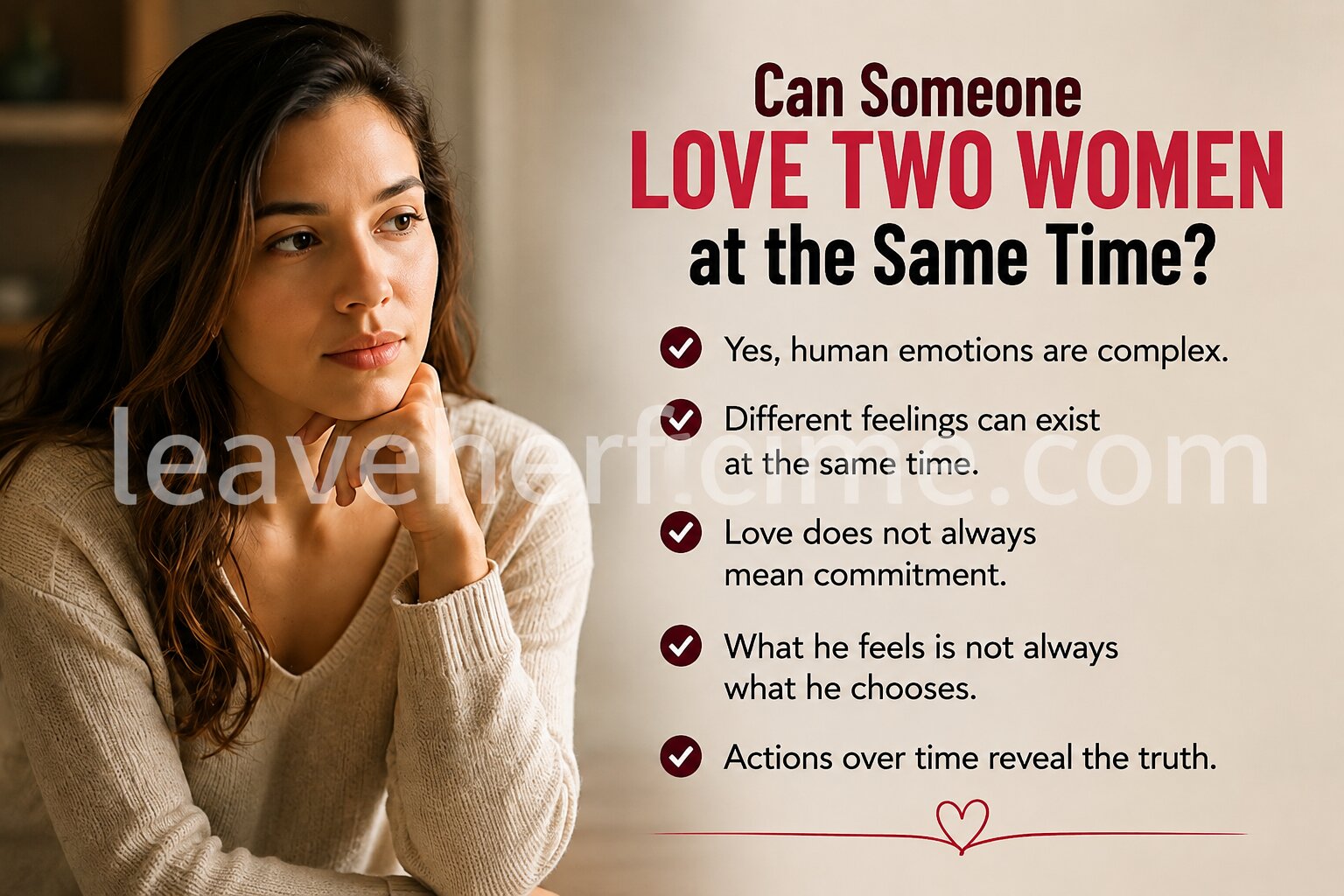
Why This Question Refuses to Leave You
There are some questions that stay in your mind long after the conversation has ended.
You try to distract yourself. You focus on work, family, or everyday responsibilities. Yet, when the day grows quiet, the same question finds its way back.
Can someone really love two women at the same time?
Perhaps you never imagined asking yourself that question.
Maybe you always believed love was simple. One heart. One choice. One future.
Then life became more complicated than the ideas you grew up with.
You met someone who made you feel deeply loved, yet he was already married.
Or perhaps you are the wife who has discovered that your husband has formed a meaningful connection with another woman.
Maybe you are not sure what to believe anymore because his actions and his words no longer seem to belong to the same story.
One day he speaks about a future with you.
Another day he returns to the life he already has.
Sometimes he seems completely devoted.
At other times, he feels distant, conflicted, or impossible to understand.
You are left trying to answer a question that affects far more than your relationship.
It affects your confidence.
Your hope.
Your decisions.
Your future.
If he truly loves someone else, where does that leave you?
If he truly loves you, why does he remain where he is?
Can both things somehow be true at the same time?
These are not easy questions because they are not simply about love.
They are about trust.
About commitment.
About responsibility.
About promises.
About whether the future you are waiting for is slowly becoming real or quietly slipping further away.
That uncertainty can become exhausting.
Not because you enjoy overthinking.
Because your heart is trying to make sense of two experiences that seem to contradict each other.
You remember the tenderness in his voice.
The way he looks at you when nobody else is watching.
The conversations that felt too genuine to be fake.
The moments that made you believe this relationship was different.
Then reality interrupts.
He goes home.
He cancels another plan.
He asks for more time.
He says the situation is complicated.
Again.
Suddenly, every beautiful memory begins arguing with every painful disappointment.
You are no longer asking whether he cares.
You are asking whether caring is enough.
That is a much heavier question.
Before We Search for the Answer
Before we try to understand whether someone can love two women at the same time, I want to begin somewhere else.
Not with him.
With you.
Because behind almost every search for this question is a person carrying a private story that nobody else can fully see.
Some readers have spent years loving someone they cannot openly build a life with.
Others are trying to understand why the marriage they believed in no longer feels emotionally secure.
Some feel guilty for falling in love with someone who was already committed.
Others feel guilty for wondering whether their partner’s heart now belongs somewhere else.
Different stories.
Different people.
The same question.
It is easy for the outside world to judge these situations.
People who have never lived them often offer quick answers.
“If he loved you, he would leave.”
“If he loved his wife, he would never have met someone else.”
“If he loved both of you, something must be wrong with him.”
Simple explanations can sound comforting.
Real life rarely works that way.
Human relationships are often far more complicated than the opinions people share from a distance.
Feelings do not always arrive in the order we expect.
People sometimes make promises they fully intend to keep, only to discover that fear, responsibility, family, or their own uncertainty makes those promises far harder to fulfil than they imagined.
Others remain in relationships long after love has changed because leaving affects children, finances, identity, or years of shared history.
Some genuinely care for two people while struggling with the emotional consequences of that reality.
Others confuse emotional attachment with lasting love.
Those situations are not identical.
Treating them as though they are only creates more confusion.
Perhaps that is why you are here.
You have already heard simple answers.
They did not fit your situation.
You are looking for something deeper.
Not because you want someone to tell you what to believe.
Because you want to understand what might actually be happening.
That is exactly what this article is here to explore.
We are not going to reduce your relationship to one sentence.
We are not going to assume that every man who loves two women is dishonest.
We are not going to assume that every difficult relationship is destined to fail.
Instead, we are going to explore what psychology, human behaviour, emotional attachment, commitment, and relationship patterns can genuinely tell us.
Along the way, we will also recognise something important.
Understanding why someone behaves the way they do does not automatically tell you what your future will be.
Those are two different questions.
By the time you reach the end of this article, my hope is not simply that you understand him better.
My hope is that you also understand yourself, your relationship, and your choices more clearly than you did before you arrived.
Because sometimes the most important answer is not hidden inside another person’s heart.
Sometimes it begins when you finally understand your own.
Why This Question Hurts So Much
Most people think this question is only about love.
It isn’t.
If it were simply about love, the answer would not keep you awake at night.
It would not replay in your mind while you’re driving home, folding laundry, sitting at work, or trying to enjoy dinner with friends.
The question hurts because it touches something much deeper.
It challenges your understanding of relationships.
It challenges your confidence.
It challenges the future you have quietly imagined.
When someone you love says, “I love you,” but continues sharing his life with another woman, your heart is forced to hold two realities that seem impossible to reconcile.
Part of you believes him.
Another part of you wonders whether believing him is slowly breaking your own heart.
That internal conflict is exhausting because your mind keeps searching for one answer that will finally make everything make sense.
Yet human emotions rarely fit into simple categories.
Real relationships often contain contradictions.
People can genuinely care about someone while making choices that cause them pain.
They can speak honestly about their feelings while remaining uncertain about their future.
They can also use the language of love without being prepared to build a life around it.
Those possibilities look similar from the outside.
Living through them feels completely different.
Before we explore whether someone can truly love two women at the same time, we first need to understand why this question carries so much emotional weight.
Only then can we begin separating genuine possibilities from assumptions that create even more confusion.
When Two Opposite Things Feel True
Imagine standing on a shoreline where two waves meet.
One wave keeps pulling you forward.
The other keeps dragging you back.
Neither is strong enough to win completely.
That is what emotional conflict often feels like.
One part of you remembers every reason you believe his love is genuine.
Perhaps he has stood beside you during difficult moments when nobody else knew what you were carrying.
Maybe he remembers small details about your life that even close friends forget.
Perhaps he speaks about you with warmth, kindness, and affection that never feels forced.
Those experiences are real.
They matter.
At the same time, another part of your reality refuses to disappear.
He still goes home to someone else.
Important decisions remain postponed.
Promises move from one month to the next.
The future never seems to arrive.
Now two completely different stories begin living inside your mind.
One says,
“He loves me.”
The other whispers,
“If he truly loved me, wouldn’t something be changing?”
Neither voice disappears.
Instead, they argue with each other every day.
That inner argument is often more painful than the relationship itself.
Many people eventually stop trusting their own judgement because every new experience seems to support both possibilities at once.
One loving conversation restores hope.
One cancelled plan destroys it again.
One unexpected visit makes everything feel certain.
Another excuse fills you with doubt.
Little by little, your emotional world begins depending on events you cannot control.
Without realising it, you become less focused on your own life and more focused on interpreting his.
You replay conversations.
You analyse messages.
You search for hidden meaning inside ordinary moments.
Not because you enjoy overthinking.
Because your heart desperately wants consistency.
Human beings naturally look for patterns.
When those patterns constantly contradict each other, the mind keeps searching until it finds an explanation that finally feels complete.
That search is exhausting.
It is also deeply human.
Why His Love for Someone Else Feels Personal
One of the hardest parts of loving someone who also loves another woman is that her existence can begin to feel like a judgement of your own worth.
Perhaps you compare yourself without even noticing.
You wonder whether she is prettier.
Whether she understands him better.
Whether she gives him something you cannot.
If she is his wife, you may question whether shared history will always matter more than what the two of you have built together.
If you are the wife, you may wonder whether years of marriage suddenly became less valuable than someone new.
Those thoughts can quietly reshape how you see yourself.
The relationship stops feeling like a question about him.
It becomes a question about you.
“Why wasn’t I enough?”
That question can become dangerous because it assumes another person’s complicated decisions must reflect your value.
They often do not.
Human relationships are influenced by far more than attraction alone.
History matters.
Responsibility matters.
Children matter.
Fear matters.
Timing matters.
Personal character matters.
Emotional maturity matters.
Life is rarely decided by one feeling or one person.
Yet when emotions are involved, our minds naturally personalise everything.
We interpret another person’s hesitation as evidence that something must be lacking within us.
Sometimes that belief becomes stronger than reality itself.
You begin changing yourself in ways that were never necessary.
You become quieter because you fear asking difficult questions.
You become more patient because you worry that honesty will push him away.
You accept less than you truly need because you believe asking for more might cost you everything.
Over time, the relationship starts shaping your identity instead of simply being one part of your life.
That is why understanding your own emotional experience matters just as much as understanding his.
Because even if he genuinely loves two women, your value has never depended on whether someone else is struggling to choose.
When Your Mind Keeps Searching for One Clear Answer
Our minds dislike uncertainty.
Psychologists have long observed that people experience ongoing uncertainty as one of the most emotionally draining situations they can face.
A difficult truth can hurt.
An uncertain truth often hurts longer.
Imagine being told that heavy rain will arrive tomorrow.
You may not like the forecast, but you know what to expect.
Now imagine watching dark clouds gather for weeks without knowing whether the storm will ever come.
Every morning you wonder.
Every afternoon you look at the sky again.
That constant waiting slowly becomes its own burden.
Relationships often create the same emotional pattern.
Every conversation feels as though it might finally bring clarity.
Every visit feels like it could become the turning point.
Every promise sounds as though this time things might really change.
When they don’t, your mind starts searching even harder.
You read articles.
You watch videos.
You ask friends.
You revisit old memories.
You compare your story with other people’s experiences.
Eventually, you discover that every answer seems to contradict another.
One person says,
“If he loved you, he would already be with you.”
Another says,
“Real love sometimes takes time.”
Someone else insists,
“He’s using you.”
Another believes,
“He’s trapped by circumstances.”
Now your confusion grows because every opinion sounds convincing for a moment.
That search for an answer can also change the strength of your attachment. When closeness and distance keep alternating, uncertainty may make you focus on the relationship more intensely rather than helping you emotionally step away. Why Mixed Signals Make You More Emotionally Attached explores that mechanism and the difference between becoming more attached and the relationship itself becoming stronger.
That is one reason this article will avoid giving simplistic answers.
Real relationships deserve more honesty than that.
Some situations involve genuine emotional conflict.
Others involve avoidance.
Some involve fear.
Others involve convenience.
Looking only at one explanation often creates more misunderstanding than clarity.
Understanding begins when we become willing to explore the full picture rather than searching for one sentence that explains everything.
The Emotional Cost of Not Knowing Where You Stand
Uncertainty rarely stays confined to one relationship.
It quietly begins influencing every part of your life.
Plans become difficult because you don’t know what the future will look like.
Celebrations become bittersweet because someone important may or may not be there.
Ordinary conversations with family or friends become uncomfortable because you grow tired of answering questions you cannot answer yourself.
Even joyful moments can become interrupted by private thoughts.
You might be laughing with friends while wondering where he is.
You could be lying awake beside your phone, hoping tonight will finally be different.
Perhaps you postpone your own dreams because part of you believes everything depends on what he eventually decides.
That emotional waiting can become so familiar that it starts feeling normal.
Months become years.
Life quietly arranges itself around uncertainty.
The greatest danger is not simply that someone keeps you waiting.
It is that uncertainty slowly teaches you to stop expecting clarity.
Once that happens, confusion begins feeling safer than asking difficult questions.
Hope begins replacing honest evaluation.
Waiting begins replacing movement.
That is often the moment when people tell themselves,
“Maybe this is simply how love feels.”
It isn’t.
Love can certainly include uncertainty.
Every relationship faces seasons of doubt.
However, healthy love should gradually create greater understanding, not permanent emotional fog.
As this article continues, we are going to explore one of the biggest questions behind all of this.
Can someone genuinely love two women at the same time, or are we sometimes using one word to describe several very different emotional experiences?
That distinction changes everything.
Can Human Beings Really Love More Than One Person?
This is the question that quietly sits behind everything else.
Not because people are curious about psychology.
Because the answer has the power to change how they see their relationship.
If the answer is no, then someone must be lying.
If the answer is yes, then an even more difficult question appears.
What does that actually mean for the future?
Many articles answer this by saying either:
“Yes, people can love two people.”
or
“No, true love only happens once.”
Neither answer is enough.
Real life is rarely that simple.
The human heart does not experience every relationship in the same way.
Love itself is not a single emotion.
It is a collection of feelings, choices, responsibilities, memories, attachments, hopes, fears, sacrifices, and experiences that slowly develop over time.
Two people may both say,
“I love you,”
while meaning completely different things.
That is why simply asking whether someone loves two women is not enough.
A better question is:
What kind of love exists in each relationship?
Understanding that difference changes everything.
Love Is More Than One Feeling
Imagine asking someone,
“What does water look like?”
One person describes rain.
Another describes the ocean.
Someone else pictures a quiet river.
All of them are describing water.
Yet each experience feels completely different.
Love works in much the same way.
The word itself is simple.
The reality behind it is incredibly varied.
A father loves his daughter.
A lifelong friend loves the person who stood beside him through difficult years.
A husband may deeply love his wife after decades together.
Someone else may fall passionately in love with a person they met only months ago.
None of those relationships are identical, even though we use the same word to describe them.
Romantic love itself also changes.
The excitement of a new relationship often feels different from the steady affection built through years of shared experiences.
Sometimes love grows quietly.
Sometimes it arrives unexpectedly.
Sometimes it survives enormous difficulties.
Sometimes it fades despite sincere effort.
That is why reducing love to one definition often creates more confusion than understanding.
When someone says,
“I love both of you,”
our first instinct is usually to imagine that both relationships must feel exactly the same.
They rarely do.
One relationship may represent history.
The other may represent possibility.
One may feel safe.
The other may feel exciting.
One may provide familiarity.
The other may awaken emotions that had been forgotten for years.
Understanding that difference does not excuse anyone’s choices.
It simply reminds us that human emotions are rarely identical, even when the same word is used.
Emotional Attachment Can Feel Like Love
One reason people struggle to answer this question is because emotional attachment often feels almost identical to love.
Both create longing.
Both create comfort.
Both create a desire to remain close.
Both can make separation painful.
Yet they are not always the same experience.
Imagine a man who still reaches for the side of the bed where his late wife used to sleep.
That habit is more than routine.
Years of shared life have created an emotional bond that continues even after loss.
Now imagine someone entering a new relationship after years of loneliness.
They finally feel seen, understood, and emotionally safe again.
Naturally, they become deeply attached.
Attachment itself is not unhealthy.
It is one of the ways human beings create connection.
The challenge comes when attachment is mistaken for evidence that two people are building the same future.
Someone may return repeatedly because they feel emotionally understood.
Another may return because they cannot imagine life without the comfort you provide.
Those experiences can feel like profound love.
Sometimes they are.
Sometimes they are not.
That distinction cannot be made by one emotional moment.
It can only be understood by observing the entire relationship over time.
This is one reason people often remain confused for months or even years.
They are trying to understand a relationship by looking at feelings alone, while overlooking the larger pattern those feelings create.
If you are beginning to wonder whether his feelings reflect lasting love or a deep emotional bond that has never developed into genuine commitment, Signs He Is Emotionally Attached to Another Woman explores those patterns in much greater depth.
Desire Is Powerful, but It Does Not Build a Future
Few emotions are as intense as romantic desire.
It can make ordinary conversations feel unforgettable.
A brief touch can linger in your thoughts for days.
Waiting for one message can seem impossible.
When desire is mutual, it often convinces both people that what they share must be extraordinary.
Sometimes it truly is.
Other times, desire creates an emotional intensity that is mistaken for lasting compatibility.
Think about the beginning of almost any relationship.
Everything feels exciting.
Both people make time for one another.
Conversations last late into the night.
Small moments become treasured memories.
That intensity is real.
However, intensity alone cannot tell us what the relationship will become.
Building a future requires something different.
It asks difficult questions.
Can trust survive disappointment?
Can respect survive conflict?
Can honesty survive uncomfortable conversations?
Can two people keep choosing one another after the excitement naturally becomes quieter?
Those questions cannot be answered by desire alone.
Many relationships begin with extraordinary chemistry.
Only some develop into enduring partnership.
That is why someone may genuinely desire two different women while only one relationship gradually becomes capable of supporting a shared future.
Commitment Is Where Feelings Become Decisions
Perhaps the greatest misunderstanding about love is believing that feelings automatically create commitment.
They do not.
Commitment begins when emotions become consistent choices.
It appears in everyday decisions that nobody applauds.
Keeping promises.
Being honest even when honesty is uncomfortable.
Protecting trust.
Making sacrifices.
Planning together.
Accepting responsibility for how your choices affect another person’s life.
Anyone can speak beautifully about love during an emotional conversation.
Commitment asks a much harder question.
“What happens tomorrow?”
And the day after that.
And next month.
And next year.
That does not mean everyone who struggles to commit lacks genuine feelings.
Life can become complicated.
Divorce may affect children.
Financial realities may feel overwhelming.
Long family histories may carry enormous emotional weight.
Fear of hurting someone can become paralysing.
All of those experiences deserve understanding.
Even so, commitment remains the place where love gradually becomes visible.
Without movement, promises eventually become difficult to separate from hope.
Without decisions, emotions remain suspended between two possible futures.
That uncertainty is often what causes the deepest pain for everyone involved.
Loyalty and Responsibility Can Pull the Heart in Different Directions
One of the greatest mistakes people make is assuming that love automatically erases every previous responsibility.
Life rarely works that way.
Imagine a man who has spent twenty years building a family.
His children expect him home every evening.
His wife has shared countless experiences with him, both joyful and painful.
Their lives have become deeply intertwined.
Now imagine that somewhere along that journey he develops genuine feelings for someone else.
Those new feelings do not erase twenty years of history.
At the same time, twenty years of history do not automatically erase the new feelings.
Now he faces something many people never expect.
His emotions begin pulling in one direction.
His responsibilities continue pulling in another.
That internal conflict does not automatically make him honest.
Nor does it automatically make him dishonest.
It simply means that human beings sometimes carry competing loyalties at the same time.
Some rise to the challenge by making difficult but honest decisions.
Others avoid choosing because every option feels painful.
Still others continue trying to preserve both worlds for as long as possible, often hurting everyone in the process.
Understanding those possibilities is important.
Excusing endless indecision is something entirely different.
We will explore that distinction more deeply in the next stage.
Real Love Is Revealed Through the Pattern It Creates
After everything we have explored, you may still feel disappointed.
Perhaps you hoped this section would end with a simple answer.
“Yes, someone can love two women.”
Or,
“No, genuine love only belongs to one person.”
Real life rarely allows such certainty.
Psychology can help us understand human emotions.
It cannot predict the future of every relationship.
What it does show is something far more useful.
Feelings alone are incomplete.
To understand love, we must look beyond isolated moments and ask a deeper question.
What pattern is this relationship creating over time?
Is honesty increasing?
Is trust growing?
Is clarity replacing confusion?
Are difficult decisions slowly being faced?
Does the relationship create greater emotional security?
Or does every month simply repeat the same promises, the same explanations, and the same uncertainty?
That is where genuine understanding begins.
Not by asking whether love exists.
But by asking what that love consistently produces.
Because real love is not only recognised by what people feel.
It is also revealed by the direction their relationship continues to move.
If He Loves Two Women, Why Doesn’t He Choose?
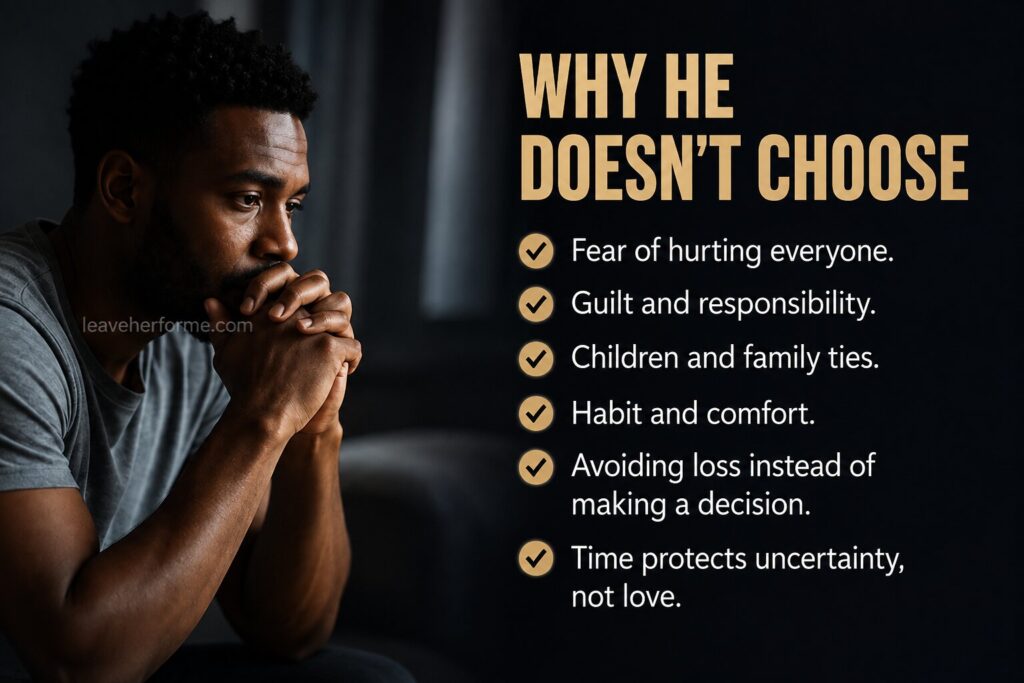
By now, you may be thinking something that thousands of people quietly ask themselves every day.
“If his feelings are genuine, why doesn’t he simply choose?”
On the surface, it sounds like a reasonable question.
After all, we often imagine that love naturally leads to action.
If someone loves you, surely they move towards you.
If someone is unhappy, surely they leave.
If someone wants a different future, surely they begin creating it.
Real life rarely unfolds so neatly.
One of the greatest misunderstandings about human behaviour is believing that people always act according to what they feel most strongly.
They don’t.
Human beings often act according to what they fear losing most.
That difference explains why someone can appear deeply conflicted for months, or even years.
It also explains why outsiders sometimes misunderstand situations that feel impossible to explain from the inside.
Love is powerful.
Yet love is only one voice inside a person’s decision-making.
Other voices speak just as loudly.
Sometimes they speak even louder.
The Heart Wants One Thing While Life Pulls in Another Direction
Imagine a man standing at a crossroads.
One path leads towards a relationship that makes him feel emotionally alive.
The other leads back to a life built over many years.
Neither path is easy.
Choosing one means grieving the other.
Whatever decision he makes, someone he cares about will almost certainly be hurt.
That emotional reality creates far more pressure than many people realise.
His feelings may genuinely pull him towards someone new.
At the same time, another part of him remembers birthdays celebrated together, children growing up, shared struggles, family traditions, financial responsibilities, ageing parents, and promises made many years ago.
Those memories do not disappear simply because new feelings have appeared.
Likewise, new love does not automatically disappear because old responsibilities remain.
This is where many relationships become emotionally paralysed.
The question is no longer,
“Who do I love?”
It quietly becomes,
“Who can I bear to lose?”
Those are completely different questions.
One comes from emotion.
The other comes from consequence.
People often imagine that choosing between two relationships is like selecting one road instead of another.
In reality, it often feels like deciding which part of your own life you are willing to leave behind.
Sometimes Fear Becomes Stronger Than Love
Fear has an extraordinary ability to influence human behaviour.
Not because it destroys love.
Because it delays action.
Someone may fear hurting children who have done nothing wrong.
Another fears becoming the reason elderly parents watch a family fall apart.
Someone else worries about financial uncertainty after years of building a shared life.
There are people who fear living with regret if they discover the new relationship is not what they imagined.
Others fear being judged by friends, relatives, colleagues, or their community.
For some, the greatest fear is not losing a relationship.
It is losing the identity they have spent years building.
For decades they have been someone’s husband.
Someone’s father.
Part of a family.
Part of a community.
Changing those roles can feel like changing who they are.
Fear rarely announces itself clearly.
It often disguises itself as,
“I just need more time.”
“This isn’t the right moment.”
“Things are complicated.”
Sometimes those statements are completely genuine.
Other times they become comfortable places to hide from difficult decisions.
Understanding that difference requires looking beyond the words themselves.
It requires observing whether anything is gradually changing beneath them.
Why Familiarity Can Feel Safer Than Happiness
Human beings are remarkably adaptable.
We become accustomed to routines, even when those routines no longer bring us joy.
Think about someone who has driven the same road to work for fifteen years.
They barely notice the journey anymore.
Every turn becomes automatic.
Relationships can develop a similar rhythm.
Shared routines become familiar.
Morning coffee.
Family dinners.
Holiday traditions.
Paying bills together.
Looking after children.
Even silence can become familiar.
That familiarity creates a powerful emotional anchor.
It is not always love.
It is not always happiness.
Sometimes it is simply the comfort of knowing what tomorrow will look like.
Beginning again asks far more than falling in love.
It asks someone to rebuild routines, friendships, financial plans, family relationships, and daily life itself.
That can feel overwhelming.
For this reason, remaining where life feels predictable often becomes easier than stepping into uncertainty, even when the heart quietly longs for something different.
This does not necessarily mean someone loves less.
Nor does it guarantee they love more.
It simply reminds us that human beings often choose familiarity over uncertainty because the unknown asks them to risk everything they already understand.
Guilt Can Keep People Standing Still
Love is not the only emotion capable of keeping someone awake at night.
Guilt can be equally powerful.
A man may genuinely care for the woman he has fallen in love with while simultaneously feeling overwhelming guilt about hurting his wife.
He may think about the children who would experience two homes instead of one.
He may remember promises made on his wedding day.
He may ask himself whether pursuing his own happiness justifies the pain that decision could create for others.
These thoughts rarely disappear after one conversation.
They often return repeatedly, making every decision feel heavier than the last.
Some people respond by confronting those feelings and eventually making a choice.
Others remain caught between compassion for everyone else and uncertainty about themselves.
From the outside, this hesitation can easily look like indifference.
From the inside, it may feel like carrying responsibilities that no decision seems capable of solving.
Understanding guilt does not mean accepting endless waiting.
It simply helps explain why some people remain emotionally trapped long after they recognise that life cannot continue exactly as it is.
Avoiding Loss Is Not the Same as Choosing Love
Perhaps the most overlooked truth about complicated relationships is this.
Many people are not actively choosing one relationship.
They are trying to avoid losing either one.
That may sound similar.
Psychologically, it is completely different.
Choosing requires accepting loss.
Avoiding loss delays it.
Imagine someone trying to hold sand in both hands.
The tighter they squeeze, the faster it slips away.
Relationships often work the same way.
Trying to preserve every possibility usually creates greater uncertainty for everyone involved.
The wife continues living with unanswered questions.
The other woman continues waiting for promises to become reality.
The man remains trapped between two emotional worlds, neither of which receives the clarity it deserves.
Eventually, everyone begins carrying the weight of a decision that has never actually been made.
This is why time alone rarely resolves complicated relationships.
Without honest decisions, time often protects uncertainty rather than creating clarity.
That is an important distinction.
Because people frequently confuse waiting with progress.
They are not always the same thing.
If you have begun wondering whether his hesitation reflects genuine emotional conflict or an ongoing pattern of avoiding difficult decisions, you may find How to Tell If He’s Confused or Simply Keeping You Waiting helpful. It explores the difference between understandable uncertainty and repeated delay, helping you recognise the patterns that become clearer over time.
Love Does Not Always Decide the Future
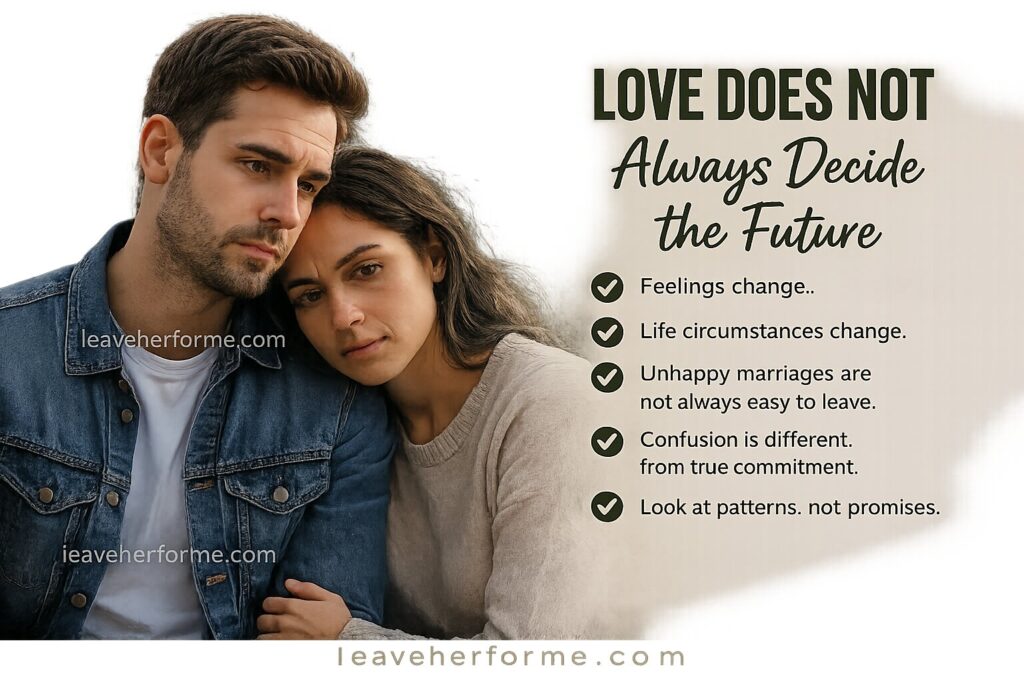
By now, one truth has probably become clear.
The question was never simply,
“Can someone love two women?”
The deeper question is far more personal.
If love is real, why doesn’t it always change anything?
That question has ended relationships.
It has kept people waiting for years.
It has caused countless sleepless nights because it challenges something many of us quietly believe.
We want to believe that genuine love naturally creates movement.
That if two people truly love one another, life somehow finds a way.
Sometimes it does.
Sometimes it doesn’t.
That does not mean the feelings were fake.
Neither does it automatically mean they were strong enough to overcome everything standing in their way.
Love has extraordinary power.
It can inspire courage.
It can heal old wounds.
It can change how someone sees themselves and the world around them.
Yet love does not make every difficult decision disappear.
Real life asks questions that feelings alone cannot answer.
What happens to the children?
Who leaves the family home?
How will both households survive financially?
What becomes of promises made years ago?
Can trust ever be rebuilt after such a decision?
Will the new relationship survive the weight of everything that had to be sacrificed to create it?
Those are not questions love answers on its own.
They are questions people answer through decisions.
That difference is easy to overlook.
It is also one of the reasons so many people remain trapped between hope and uncertainty.
Feelings Can Be Genuine While Decisions Remain Unfinished
One of the greatest sources of emotional pain is believing that every genuine feeling must immediately produce visible action.
Human behaviour rarely works like that.
Think about someone who dreams of starting a new business.
They may genuinely want it.
They may talk about it often.
They may even make small preparations.
Still, years can pass before they finally take the first real step.
Not because the dream was fake.
Because fear, responsibility, uncertainty, and the comfort of familiar routines continued pulling them backwards.
Relationships can unfold in much the same way.
Someone may genuinely love another person.
They may honestly imagine a different future.
Even so, imagining change and creating change are not the same experience.
One lives inside the heart.
The other requires decisions that reshape real lives.
That distinction matters because it helps us avoid two common mistakes.
The first mistake is believing that love automatically guarantees a shared future.
The second is believing that delayed action automatically proves love never existed.
Neither conclusion reflects the complexity of real human relationships.
Instead of asking,
“Does he love me?”
it is often more helpful to ask,
“What is he consistently doing with that love?”
That question moves us away from assumptions and closer to understanding.
The Future Is Built Through Repeated Choices
Imagine watching someone plant a tree.
The seed itself contains enormous potential.
Given enough care, it may one day provide shade, fruit, and shelter.
Yet potential alone does not grow roots.
Watering matters.
Time matters.
Daily attention matters.
Relationships follow the same principle.
Love may begin the journey.
Commitment continues it.
Honesty strengthens it.
Responsibility protects it.
Consistent action allows it to grow.
Without those repeated choices, even genuine affection can remain trapped as possibility rather than becoming reality.
This is why some relationships feel as though they are always standing at the starting line.
The feelings never seem to disappear.
Neither does the waiting.
Months pass.
Sometimes years.
The conversations remain remarkably similar.
The promises remain familiar.
The circumstances rarely change.
Eventually, the relationship becomes defined less by what has happened and more by what might happen someday.
Hope quietly replaces movement.
That is an important moment to recognise.
Not because hope is wrong.
Because hope deserves evidence.
Without evidence, hope slowly becomes expectation built on imagination rather than on lived experience.
Understanding His Situation Does Not Mean Ignoring Your Own
There is something beautiful about empathy.
Trying to understand another person’s struggles is part of what makes healthy relationships possible.
However, empathy becomes unhealthy when it slowly teaches you to disappear from your own story.
Perhaps you know exactly why he hesitates.
You understand the pressure he feels.
You know the responsibilities he carries.
You recognise how frightened he is of hurting people he cares about.
All of that may be true.
Understanding those realities does not require you to ignore your own.
Your needs remain real.
Your future still matters.
Your emotional wellbeing deserves attention too.
Sometimes people become so focused on explaining another person’s behaviour that they stop asking whether the relationship is meeting their own emotional needs.
Compassion should never require you to abandon yourself.
Healthy love creates space for both people’s experiences to matter.
If only one person’s fears, responsibilities, and hopes are shaping every decision, the relationship slowly loses balance.
That imbalance often creates emotional exhaustion long before either person notices it.
When Waiting Quietly Becomes Your Life
Waiting has a strange way of changing shape.
At first, it feels temporary.
You tell yourself,
“A few more weeks.”
Then,
“Perhaps after the holidays.”
Later,
“Things will probably become clearer once the children are older.”
Without realising it, waiting begins organising your future.
You hesitate to make your own plans.
Big decisions become difficult because everything depends on what someone else might eventually decide.
You begin measuring time not by your own milestones but by someone else’s promises.
One day you suddenly realise that you have spent more energy waiting than living.
That realisation can be deeply painful.
Not because waiting is always wrong.
Because somewhere along the way, your own future quietly became dependent upon another person’s uncertainty.
This is often the moment when people begin asking different questions.
Not,
“Will he choose me?”
But,
“How long can I continue building my life around a decision that is not mine to make?”
That question does not come from impatience.
It comes from emotional maturity.
It recognises that while love may be shared, time never returns.
If you would like to understand why some people remain in unhappy marriages even when genuine feelings exist elsewhere, Why Married Men Stay in Unhappy Marriages explores the psychological, emotional, and practical forces that often keep relationships from changing as quickly as outsiders expect.
Understanding Explains Behaviour. It Does Not Predict Outcomes.
Perhaps this is the most important distinction in the entire article.
Psychology can help us understand why someone feels conflicted.
It can explain why fear delays action.
It can reveal how attachment, guilt, responsibility, and habit influence difficult decisions.
Those insights matter.
They often replace confusion with compassion.
Even so, understanding the reasons behind someone’s behaviour does not tell you what they will ultimately choose.
Two men may carry remarkably similar fears.
One eventually leaves.
The other remains where he is.
Two people may love with equal sincerity.
One relationship grows.
The other slowly fades beneath the weight of circumstances.
This is why no article, no checklist, and no simple formula can predict every relationship.
Human beings remain capable of surprising themselves.
That is also why genuine guidance should never promise certainty where none exists.
It should help you understand the situation more clearly, recognise meaningful patterns, and make wiser decisions based on what is consistently happening rather than what you hope might happen.
Sometimes greater understanding brings peace.
Sometimes it leads to difficult choices.
Either way, clarity is always more valuable than endless uncertainty.
If you are still wondering whether his hesitation reflects genuine emotional conflict or a pattern that continues without meaningful progress, How to Tell If He’s Confused or Simply Keeping You Waiting explores those differences in greater depth and helps you recognise the signs that become clearer over time.
What His Love Is Creating in Your Life
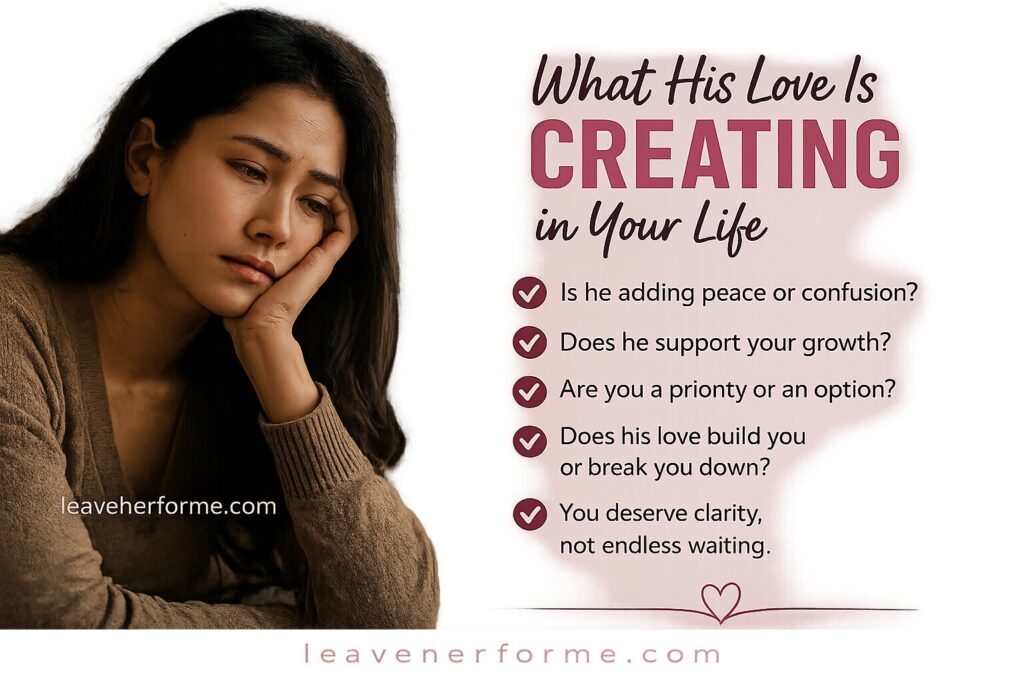
By now, we have spent a great deal of time trying to understand him.
His emotions.
His fears.
His responsibilities.
His hesitation.
His divided heart.
Those questions matter.
They deserve thoughtful answers.
Yet there comes a point in every complicated relationship when another question quietly becomes more important.
Not:
“How does he feel?”
But:
“What is this relationship creating in my life?”
That question changes everything.
Because a relationship should never be measured only by what someone says they feel.
It should also be measured by what living inside that relationship is slowly doing to you.
Are you becoming more secure?
More peaceful?
More confident?
More hopeful because meaningful progress is happening?
Or are you becoming more anxious, more uncertain, and more dependent on promises that never seem to become reality?
Love should not only be examined by looking into another person’s heart.
Sometimes it is revealed by looking honestly at the life you are living because of that love.
That shift in perspective is not selfish.
It is necessary.
Love Should Not Cost You Your Sense of Self
When relationships become emotionally complicated, something very subtle often begins to happen.
Without noticing it, your world slowly becomes smaller.
You stop making long-term plans because everything depends on what he eventually decides.
You hesitate to accept opportunities because you keep thinking,
“What if things finally change next month?”
Birthdays, holidays, family gatherings, and important milestones begin carrying an invisible question.
“Will he be there?”
Little by little, your own future starts revolving around someone else’s uncertainty.
At first, that may seem like patience.
Eventually, it can become self-abandonment.
There is a difference between making space for someone you love and quietly disappearing from your own life.
Healthy love should allow both people to continue growing.
It should not require one person to place their dreams, confidence, and identity on hold indefinitely.
That does not mean difficult seasons never exist.
Every meaningful relationship experiences uncertainty.
The important question is whether those difficult seasons are gradually leading somewhere or simply repeating themselves.
Real love should make your life feel larger over time.
Not smaller.
Your Heart Deserves More Than Beautiful Words
Words matter.
Few things are more comforting than hearing someone say,
“I love you.”
Those words carry hope.
They create closeness.
They often become the memories we replay when doubt begins creeping in.
Yet words are only one part of love.
Imagine receiving a beautiful letter every month from someone who never arrives.
At first, each letter feels meaningful.
After a while, another question begins to grow.
“When will these words become something I can actually live?”
Relationships work much the same way.
Affection is important.
Reassurance is important.
Promises matter.
Even so, words become most powerful when they are consistently supported by choices.
That does not mean perfection.
Life will always interrupt plans.
Unexpected difficulties will appear.
People will sometimes fail each other despite good intentions.
The difference lies in the overall pattern.
When someone’s words and actions slowly begin telling the same story, trust naturally grows.
When those stories continue moving in opposite directions, uncertainty quietly takes its place.
One conversation rarely defines a relationship.
Repeated patterns often do.
Sometimes the Greatest Question Is Not Whether He Loves You
It is natural to spend months asking,
“Does he really love me?”
For many people, that question becomes the centre of their emotional world.
Yet there comes a moment when another question becomes even more important.
“Even if he does… is this relationship giving me what I need to build a future?”
Those are not the same question.
Someone can genuinely care for you.
Someone can miss you deeply.
Someone can think about you every day.
Someone can even imagine a life with you.
Still, none of those feelings automatically create emotional security.
A future requires more than affection.
It asks for honesty.
Consistency.
Respect.
Shared decisions.
Mutual responsibility.
The willingness to face uncomfortable realities together instead of postponing them indefinitely.
That is why understanding love is only part of understanding relationships.
Love may begin the story.
It cannot write every chapter by itself.
You Can Understand Him Without Losing Yourself
One of the most compassionate things you can do is try to understand another person’s struggles.
That empathy is one reason you have stayed.
You have tried to see the pressure he carries.
You understand his responsibilities.
You recognise the difficult choices standing in front of him.
Those qualities speak well of your character.
Compassion is a strength.
However, compassion becomes unhealthy when it slowly teaches you that your own needs should always come second.
Understanding him should never require misunderstanding yourself.
You are allowed to ask difficult questions.
You are allowed to need clarity.
You are allowed to hope for consistency.
You are allowed to protect your own emotional wellbeing.
Loving someone else should never mean forgetting that your own life deserves care too.
Many people quietly believe that asking for clarity will destroy the relationship.
Healthy relationships rarely become weaker because two people honestly discuss the future.
Avoiding those conversations often causes much greater damage.
The Pattern Matters More Than the Promise
Imagine watching someone plant seeds every spring.
Year after year, they tell you that this time the harvest will be different.
Yet every season ends exactly the same way.
Eventually, you stop listening only to the promise.
You begin paying attention to the pattern.
Relationships deserve the same honesty.
One promise tells you very little.
One disappointment tells you very little.
One wonderful weekend together tells you very little.
Patterns tell you far more.
Is greater honesty appearing?
Are difficult conversations becoming easier?
Are meaningful decisions gradually being made?
Does each year bring more clarity than the year before?
Or do the same explanations quietly repeat while your life remains suspended between hope and uncertainty?
Patterns are rarely dramatic.
They are built through ordinary days.
That is exactly why they reveal so much.
Looking honestly at the overall direction of a relationship is often kinder to yourself than clinging to isolated moments that briefly restore hope before uncertainty returns again.
Sometimes Love Is Real, Yet the Future Remains Unclear
This may be one of the hardest truths to accept.
Life does not always reward sincere feelings with the future we hope for.
Two people may genuinely love one another.
Even so, circumstances, responsibilities, fear, timing, or repeated indecision may still prevent the relationship from becoming the life either person imagined.
Accepting that possibility is painful.
It also creates space for a different kind of clarity.
Instead of spending every day trying to prove whether love exists, you begin asking a healthier question.
“What is this relationship consistently creating in my life?”
That question is not about giving up.
It is about seeing your reality with greater honesty.
Because understanding another person’s heart is valuable.
Understanding the direction of your own life is essential.
If you would like to explore the difference between genuine love, emotional attachment, commitment, and the patterns that reveal lasting affection over time, How to Know If He Truly Loves You examines those questions in much greater depth and may help you see your relationship from a different perspective.
When Understanding the Psychology Still Doesn’t Bring Answers
There is something important I have learned after listening to people from many different countries, cultures, and relationship situations.
Understanding is powerful.
Sometimes, it changes everything.
A person finally recognises why they have been arguing with their partner.
Someone else realises they have been ignoring their own needs for years.
Another discovers that the relationship they were trying to save quietly ended long ago.
Insight can be life-changing.
Yet insight does not always create movement.
There are people who understand exactly why their relationship feels stuck.
They know his fears.
They recognise the family pressures.
They understand the emotional attachment.
They appreciate the responsibilities he carries.
They have read books.
They have watched relationship experts.
They have spoken to trusted friends.
Some have even spent years reflecting on every conversation and every decision.
Even after all that understanding, one sentence remains painfully familiar.
“Nothing has really changed.”
That moment deserves honesty.
Not judgement.
Because understanding why something happens and knowing what to do next are not always the same thing.
Sometimes Knowledge Brings Clarity but Not Change
Imagine standing in front of a locked door.
Someone carefully explains how the lock works.
They describe every mechanism inside it.
They even tell you why it became stuck.
Now you understand the problem perfectly.
The door is still closed.
Relationships can sometimes create a similar experience.
Psychology helps explain patterns.
Communication improves understanding.
Self-reflection reveals blind spots.
Healthy boundaries protect emotional wellbeing.
All of those things are valuable.
Many relationships genuinely improve because of them.
Others do not.
Some people eventually reach a place where they quietly say,
“I understand everything now.”
“I just don’t know why nothing is moving.”
That experience is more common than many people realise.
It does not automatically mean something mysterious is happening.
Neither does it mean psychology has failed.
It simply reminds us that human relationships involve far more than understanding alone.
People still make choices.
Life still unfolds unpredictably.
Every relationship continues to carry its own unique circumstances.
Every Relationship Has a Story That No Article Can Fully Know
Throughout this article, we have explored love.
Attachment.
Commitment.
Fear.
Responsibility.
Hope.
Waiting.
Those ideas help many people understand themselves more clearly.
Even so, every article has a limitation.
It cannot know your relationship personally.
It does not know how your story began.
It cannot hear the conversations you have shared.
It cannot recognise the changes you have witnessed over months or years.
It cannot see the details that often become important when trying to understand why one relationship slowly moves forward while another remains unchanged.
That limitation does not make articles unhelpful.
It simply reminds us that education and personal understanding are different experiences.
One explains general patterns.
The other explores your unique situation.
That distinction matters.
Because no two relationships are ever completely identical.
Why Some People Begin Exploring Spiritual Guidance
After many years of doing this work, I have noticed something interesting.
Very few people contact me as their first step.
Most arrive after they have already tried almost everything they know.
They have communicated honestly.
They have waited patiently.
They have prayed.
They have reflected on their own behaviour.
Many have sought advice from people they trust.
Some have worked through relationship books, podcasts, or counselling.
Others simply hoped that more time would naturally solve the problem.
Sometimes those approaches bring meaningful change.
Sometimes they do not.
When they don’t, some people begin asking a different kind of question.
Not,
“How do relationships work?”
But,
“Could there be something about my particular situation that general advice cannot fully explain?”
That question is deeply personal.
People answer it differently depending on their own experiences, beliefs, and values.
Some continue focusing entirely on practical solutions.
Others choose to include spiritual guidance as part of their journey.
Neither path should be forced.
Neither path should be judged.
What matters is choosing the approach that genuinely aligns with your own beliefs and circumstances.
The Miko Kana Philosophy
Over the years, many people have contacted me expecting immediate answers.
Some wanted me to tell them that everything would work out.
Others hoped I would instantly explain why their relationship had become so difficult.
That has never been how I work.
I believe every relationship deserves to be understood before it is ever judged.
That is why I never begin with assumptions.
I begin with the story.
I want to understand how the relationship developed.
What changed.
What has already been tried.
What patterns continue repeating.
What both people have experienced.
Only then do I consider whether I believe my spiritual guidance is appropriate for that particular situation.
Sometimes I tell people that what they need most is another honest conversation.
Sometimes I encourage them to focus on rebuilding trust.
Sometimes I explain that more time and patience may genuinely be necessary.
There are also situations where, based on my experience and beliefs, I believe spiritual guidance may be worth considering alongside practical reflection.
That recommendation is never automatic.
It comes after understanding the relationship, not before it.
Because no meaningful guidance should begin with assumptions.
It should begin with listening.
A Personal Relationship Assessment
One of the reasons I created this website was because I realised how many people were trying to fit their unique relationship into advice written for everyone.
General articles are valuable.
They explain common patterns.
They offer perspective.
They help people feel less alone.
They cannot examine your individual circumstances.
A Personal Relationship Assessment is different.
It is not about finding a quick answer.
It is about understanding the relationship as it actually exists.
The conversations.
The timeline.
The changes.
The promises.
The setbacks.
The emotional patterns that may not be obvious to someone looking from the outside.
Only after understanding those details can I honestly explain whether I believe spiritual guidance may have a place in your particular journey.
Sometimes the answer is yes.
Sometimes it is no.
Either way, I believe people deserve an honest assessment rather than assumptions built on a few paragraphs or a single question.
If This Feels Like Your Story
Perhaps you recognised yourself several times while reading this article.
You may finally understand why his behaviour has been so confusing.
You may also recognise that understanding his psychology has not fully answered the questions that matter most to you.
What happens now?
Can this relationship genuinely move forward?
Is waiting still helping?
Has the relationship quietly stopped changing?
Or are there signs that meaningful progress is still unfolding?
Those questions cannot always be answered by another article.
Sometimes they require someone willing to look carefully at the unique story behind the search.
If that is where you find yourself today, know that you do not have to force yourself into one conclusion or another.
Whether your next step is another honest conversation, personal reflection, or exploring spiritual guidance in a way that aligns with your own beliefs, let that decision come from understanding rather than fear.
Because the clearer you see your situation, the wiser every future decision becomes.
Frequently Asked Questions
One thing we agreed on when building your content library is that your FAQ section should not exist simply for SEO.
It should answer the questions people quietly ask after reading the article.
Each answer should:
- educate first,
- deepen trust,
- naturally support your topical authority,
- and where appropriate, help readers understand why their individual situation may need personal understanding rather than another generic article.
Frequently Asked Questions
Can Someone Really Love Two Women at the Same Time?
Yes, it is possible for someone to develop genuine feelings for two different women at the same time. Human emotions are far more complex than many people realise. However, recognising those feelings is only the beginning of the story.
Love does not automatically mean both relationships are equally healthy, equally committed, or moving towards the same future. One relationship may be built on history, shared responsibilities, and years of life together. The other may represent emotional connection, hope, or a different future that has not yet become reality.
Instead of asking only whether love exists, it is often more helpful to ask what each relationship is consistently creating over time. Genuine love should gradually become visible through honesty, responsibility, and meaningful decisions rather than remaining only a feeling.
Can A Married Man Truly Love Another Woman?
Some married men genuinely develop romantic feelings for another woman, even though they never intended to. Human attraction does not always appear at convenient times.
That does not automatically mean the marriage has become meaningless, nor does it guarantee that he will eventually leave. Relationships are influenced by history, responsibility, fear, commitment, family, and many other factors alongside emotion.
Understanding that possibility helps explain why some situations feel so confusing. It does not predict what any individual person will ultimately choose.
Does Loving Two Women Mean He Is Being Dishonest?
Not necessarily.
Some people are completely honest about their emotional conflict.
Others hide it because they fear hurting everyone involved.
Some avoid making difficult decisions for years.
Others promise change while quietly protecting the situation exactly as it is.
The important issue is not simply whether he has feelings for two people.
It is whether he behaves with honesty, respect, and responsibility towards everyone affected by those feelings.
If He Truly Loves Me, Why Hasn’t He Chosen?
This is one of the most painful questions anyone in this situation can ask.
Sometimes the delay comes from genuine emotional conflict, family responsibilities, fear of causing harm, or uncertainty about life-changing decisions.
In other situations, repeated delay becomes a pattern that protects comfort rather than creating meaningful progress.
That is why looking at one conversation is rarely enough. Patterns observed over time usually reveal much more than isolated promises.
If this question feels especially personal, you may also find How to Tell If He’s Confused or Simply Keeping You Waiting helpful, as it explores those patterns in much greater depth.
Can Someone Love Two People Equally?
Equal love is extremely difficult to measure because relationships are never identical.
Each relationship carries different experiences, responsibilities, memories, and emotional needs.
Rather than trying to compare two loves like numbers on a scale, it is often more realistic to recognise that each relationship may fulfil different emotional roles.
Even then, equal feelings do not always result in equal commitment or equal effort.
Is Emotional Attachment The Same As Love?
No.
Emotional attachment and love often overlap, but they are not identical.
Someone may become deeply attached because another person provides comfort, understanding, familiarity, or emotional safety.
Love usually involves those experiences as well, but it also grows through trust, responsibility, respect, honesty, and the willingness to build a shared future.
Looking at the overall relationship pattern often provides more clarity than focusing on feelings alone.
Can Love Exist Without Commitment?
Love can exist without commitment.
Commitment, however, is where love begins influencing everyday life.
People sometimes experience powerful emotions while remaining unable or unwilling to make decisions that support those feelings.
That distinction explains why some relationships feel deeply meaningful while remaining emotionally uncertain for long periods.
Should I Keep Waiting If He Says He Loves Me?
Only you can decide what feels right for your own life.
Waiting is not automatically unhealthy.
Many relationships require patience during genuinely difficult seasons.
However, patience should not prevent you from honestly evaluating whether the relationship is gradually moving towards greater clarity or quietly repeating the same cycle.
Hope becomes healthier when it is supported by meaningful progress rather than promises alone.
Can Love Alone Keep A Relationship Alive?
Love is an important foundation.
It is not the entire structure.
Healthy relationships also depend upon communication, trust, respect, commitment, emotional safety, and shared decisions.
When those elements remain absent for long periods, love alone often struggles to carry the relationship forward.
How Can I Tell If His Actions Match His Feelings?
Instead of focusing on isolated moments, observe the overall direction of the relationship.
Ask yourself:
Are honesty and trust increasing?
Are difficult conversations leading to meaningful change?
Is the future becoming clearer over time?
Do his actions consistently support what he says?
One action rarely defines a relationship.
Patterns usually do.
What If I Feel Emotionally Exhausted From Waiting?
Emotional exhaustion often develops gradually.
Many people do not notice it until they realise they have spent months or years organising their lives around someone else’s uncertainty.
If you recognise yourself in that experience, it may help to step back and ask not only how he feels, but also what this relationship has been creating in your own life.
Sometimes that reflection brings greater clarity than another promise ever could.
Can Spiritual Guidance Help Me Understand My Situation?
Many people who visit this website are already exploring spiritual guidance because they feel ordinary advice has not fully answered their questions.
Psychology can help explain relationship patterns.
It often brings valuable understanding.
Some people also choose to explore spiritual guidance because they believe their individual situation deserves personal attention rather than another general explanation.
Whether that path feels right is a personal decision based on your own beliefs and experiences.
When Should I Consider A Personal Relationship Assessment?
A Personal Relationship Assessment may become valuable when you feel that you already understand the general advice but remain uncertain about your own relationship.
Every relationship carries its own history, conversations, patterns, and turning points.
Articles explain common experiences.
A personal assessment focuses on yours.
The purpose is not to replace practical understanding but to explore your unique situation before considering whether any further guidance may be appropriate.
Can Two Relationships Both Be Real At The Same Time?
Yes.
Two relationships can both feel emotionally real to the people involved.
That does not necessarily mean both relationships are equally healthy or equally likely to become lasting partnerships.
Understanding that difference often helps reduce confusion because emotional reality and future reality are not always the same thing.
What Is The Most Important Question I Should Ask Myself?
Many people spend months asking,
“Does he really love me?”
That question matters.
Yet there is another question that often brings even greater clarity.
“What is this relationship consistently creating in my life?”
If the relationship is gradually creating greater honesty, emotional safety, trust, and meaningful movement, that pattern deserves attention.
If it continues creating confusion, uncertainty, and repeated waiting without change, that pattern deserves equal honesty.
Sometimes understanding your own experience becomes more important than trying to prove another person’s feelings.
Tired Of Waiting For Him To Leave Her For You, Then Make Him Leave Her For You Now
Get your boyfriend to leave his wife for you. Make him leave her for you now regardless of what. Save him from his unhappy marriage or relationship.
Before You Close This Page
Perhaps this article answered questions you have been carrying for a long time.
Perhaps it also raised a few new ones.
That often happens when we begin looking honestly at complicated relationships.
Very few people arrive here because life has been simple.
Most arrive carrying a mixture of hope, confusion, disappointment, love, fear, and uncertainty.
You may now understand that someone can, in certain circumstances, develop genuine feelings for two women.
You may also recognise that love alone does not automatically determine the future.
Feelings matter.
Choices matter too.
So do honesty, responsibility, consistency, and the direction a relationship continues to move over time.
Those are not easy realities to accept.
They are, however, the realities that often help people see their situation more clearly.
Perhaps the Most Important Question Has Changed
When you first arrived, you may have been asking,
“Can someone love two women at the same time?”
That question matters.
I hope this article has helped you understand why the answer is more complex than a simple yes or no.
At the same time, another question may now feel even more important.
What is this relationship creating in your life?
That question deserves your attention.
Because even if love exists, your life should not become permanently built around uncertainty.
Healthy relationships rarely remove every difficulty.
They do, over time, create greater honesty.
Greater understanding.
Greater trust.
Greater movement.
If those qualities never begin appearing, it is worth asking yourself why.
Not from fear.
Not from anger.
But from quiet honesty.
Sometimes the answers we need begin with the questions we have been avoiding.
The Miko Kana Philosophy
Over many years of working with people from different countries, cultures, and relationship situations, I have learned one lesson that continues to shape everything I do.
No two relationships are ever exactly the same.
Two women may both be waiting for a married man.
Their stories may sound remarkably similar.
Yet the reasons behind each situation can be completely different.
Two wives may both discover an affair.
One marriage may still have a strong foundation waiting to be rebuilt.
Another may have been slowly breaking apart long before anyone else entered the picture.
Two people may hear the same words.
“I love you.”
Those words may carry completely different meanings depending on the history, actions, and patterns behind them.
That is why I have never believed in treating people as though they are simply another case.
Every relationship deserves to be understood before conclusions are reached.
Understanding comes before judgement.
Listening comes before advice.
Clarity comes before decisions.
That philosophy guides every article I write and every person who chooses to contact me.
When General Advice Reaches Its Limit
Articles like this one can do something valuable.
They can help you recognise patterns.
They can explain psychology.
They can offer perspective that helps you feel less alone.
What they cannot do is understand the details that make your relationship different from every other relationship in the world.
They cannot hear your conversations.
They cannot recognise the changes that have happened over months or years.
They cannot explore the questions that exist beneath the surface of your own story.
That is where general guidance naturally reaches its limit.
Some people finish reading an article and realise they already have the clarity they needed.
Others discover that understanding the psychology still leaves them with deeply personal questions.
Both outcomes are perfectly valid.
The important thing is recognising which situation you are in.
If Your Story Feels More Complicated
If you have reached the point where you understand the psychology, recognise the relationship patterns, and still find yourself wondering what they mean for your own future, you do not have to carry those questions alone.
My Personal Relationship Assessment begins exactly where general articles naturally end.
Rather than assuming every relationship follows the same path, I take time to understand your individual situation.
How your relationship developed.
What has changed.
What has already been tried.
What patterns continue repeating.
Only after understanding those details do I explain whether I believe practical guidance, further reflection, or spiritual guidance may be appropriate for your particular circumstances.
I do not believe meaningful guidance begins with assumptions.
I believe it begins with understanding.
Whatever You Decide Next
Whether this article simply helped you see your relationship differently or whether it becomes the beginning of a deeper conversation, I hope you leave with one thing you may not have had before.
Greater clarity.
Not certainty.
No honest person can promise certainty about another human being.
Clarity is different.
Clarity helps you recognise the difference between love and attachment.
Between hope and progress.
Between waiting and genuine movement.
Most importantly, it helps you make future decisions with open eyes rather than unanswered questions.
Whatever path you choose from here, let it be guided by understanding instead of fear, by honesty instead of assumption, and by the quiet confidence that your own life deserves the same care and attention you have spent giving to someone else’s.
Thank you for taking the time to read this article.
I sincerely hope it has helped you move one step closer to understanding both your relationship and yourself.